It's pretty hard to escape the pull of the Procopius-black hole when it comes to the sixth-century East Roman Empire, at least if you're interested in military and political issues. That's part of the reason why scholars like Roger Scott have devoted so much attention to the other historians like Malalas. Scott's four pillars of the age of Justinian are: the construction of Hagia Sophia, the codification of Roman law, the closing of Plato's Academy in Athens, and Justinian's reconquest of the west. Although Procopius does devote considerable attention to Hagia Sophia in the Buildings, it's the reconquest that garners so much attention in the Wars. There's no doubt that this presents a skewed view of Justinian's world. In this post, however, I'd like to flip things around. To what degree does Procopius' interests in war obscure other pertinent matters, and in turn cause most of us to overlook other important pieces of evidence? Bearing all this in mind, I want to discuss six aspects of Procopius' military history: his classicizing vocabulary, his descriptions of combat, his interest in the conquest of Africa and Italy, and his focus on Belisarius in the Wars, his account of the fortifications of the northeast frontier in the Buildings, and his account of the malaise of the empire's soldiers in the Secret History.
Let's begin with the latter, and proceed in reverse order, finishing with Belisarius. In the Secret History Procopius' emphasizes the suffering of most of the empire's inhabitants, and the soldiers are no exception. One particular group that Procopius complains suffered a great deal are the border troops, who got into such a sorry state that they effectively stopped being soldiers. If we forget about Procopius' comments here, and in the other two texts for that matter, in which frontier troops feature hardly at all, and instead look at the surviving evidence we get quite a different picture, at least potentially. We have plenty of documentary evidence for frontier soldiers in Egypt and Israel/Palestine, and to a lesser degree Jordan. That material points to thriving frontier communities full of soldiers, who identify as such. Most seem fully integrated into local life, and if anything the abundance of property documents, not to mention marriage certificates, point to some degree of wealth and prosperity amongst those very soldiers. So where are they getting their money? Have they managed to supplement their income through other means, as some has suggested was the case with the soldier from Aphrodito who also served as a boatmen? Or is their income derived primarily if not entirely from their state income? If we didn't have Procopius' comments, I suspect the argument would be that the frontier soldiers were flourishing, at least in the sixth-century southeast. The legal evidence, which is full of material concerned specifically with soldiers, would reinforce these sorts of arguments.
Next we move to the forts of the northeast. Procopius' love-in for Justinians' building programme has led to a great debate: just how many of the fortification work we read about is really attributable to him? Many have highlighted the work of Anastasius, for instance, though in other cases the jury is still out. What if all we had were the surviving fortifications and a few incidental anecdotes? Justinian's efforts would certainly be diminished, but then so too might Anastasius'. There are plenty of forts still standing in Syria (or there were until recently), and plenty more in Jordan. The date of some of those Jordanian forts are ambiguous, while others are more obviously fourth century in date. Some seem to have been occupied regularly, though only some have been privy to detailed excavations. If all we had to go on was these Jordanian (and the neighbouring Israeli/Palestinian forts) forts, we wouldn't see Justinian's reign as an age of considerable frontier work in this part of the frontier, though the comparative epigraphic and papyrological evidence would imply that many if not most of the fortifications continued to the sites of a good deal of activity.
Procopius tends to use archaic vocabulary, vocabulary better suited to the world of Thucydides, or so goes the usual complaints. This applies to military matters too, and we get hints of this in the words he uses for divisions within the military. Much of his terminology is vague: the men with general X, the infantry, the horsemen, etc. In other cases, his diction has occluded more than it has illuminated. He likes to use the word katalologos, for instance, a word rarely used by classical or even classicizing historians, when describing groups of soldiers (units or even regiments). Quite a few have taken this to mean that the term had a more technical meaning, and more specifically that it denoted the army's field units. It's not an unreasonable assumption if we assume that Procopius is mostly concerned with the field unit soldiers (at the expense of frontier soldiers). That it features in virtually no other military source for the sixth century should give us pause, however, and A H M Jones is one of the only ones to have done so. If we didn't have Procopius' Wars narrative where he used words like katalogos we'd probably devote more attention to the words we do occasionally find in the inscriptions and papyri. The newly published inscription form Perge would receive a great deal of attention - and scholars would likely be obsessed with how we get from the regiments of the eastern section of the Notitia Dignitatum to the units of Maurice, with no unnecessary - even unhelpful - pauses to consider Procopius. To some degree this might still happen, though maybe it should happen sooner. Is it not, for example, interesting that Theophylact can talk of legions on the eastern frontier around the same time that we find the word "legion" in Egyptian papyri - and just a few decades after that Anastasian inscription detailing the structure (it seems) of a legion?
Turning to combat, Maurice's Strategikon might give the impression that cavalry played a major role in combat at the end of the sixth century. But it wouldn't explain quite which proportions of the military dominated decades earlier. Our material evidence is limited, while the other evidence is ambiguous. If we had to rely on Pseudo-Joshua, we wouldn't get too far. Corippus' Iohannis, though quite detailed, is a panegyrical epic, and his combat scenes are vaguely Homeric: they involve single combats, and the dashing to and fro of soldiers into and out of battle. Agathias, on the other hand, does go to some
lengths to describe the experience of combat even if he spends only a
little on the finer details. In his most detailed battle, the Battle of Casilinum, there's little in his account that betrays a clear emphasis on either cavalry or infantry. That might help provide context for the anonymous treatise of political science which includes that fictional debate between Menas and Thomas on the relative merits of the two solitudes to borrow a Canadian literary-cum-historical phrase. But whether cavalry had supplanted infantry would not yet be clear.
Moving on to the conquest, we would suspect that the campaign in Italy had the smallest of impacts on matters in the capital, which would be in line with some of Scott's arguments. Even the more local evidence, the Lives of the Popes, devotes only a little bit of attention to the war, with the siege of Rome, such a central feature of Procopius' account, restricted to a few lines. North Africa, on the other hand, is something else. Later writers, like Photius and Theophanes, who had read all of part of Procopius, either paraphrase or quote Procopius' narrative of the Vandal Wars. The aforementioned epic of Corippus also gives the impression that a significant conflict had taken place in the region. In fact, we could even look to another of the four pillars, Roman law, for yet more evidence of the war's impact. Besides the overt propaganda at the opening of the Codex of Justinian, there are specific laws that point the acquisition of significant territory in North Africa, and the efforts of the state to administer the new lands. What this evidence might imply was that a long and significant war had taken place in North Africa, which resulted in a lasting Roman victory.
That North African success brings us to the last point, the reputation of Belisarius. It seems to me, and many others besides, that his reputation rests largely on the literary efforts of Procopius. A closer look at the epigraphy, on the other hand, might bring greater attention to Solomon, who published his successes in North Africa quite widely. Belisarius features in maybe a dozen Latin inscriptions, and a handful of Greek ones. Solomon, however, features in nearly three times as many Latin inscriptions from North Africa. On this limited evidence the impression might be that Solomon was the great general of the age, or at least the campaign. Thanks to Agathias, Narses' reputation might rise too, and though the historian is not unflattering towards Belisarius, his account gives only the vaguest impression of the man's military accomplishments. Indeed, if all we had to go on was the many later references to Procopius' works, we'd be left wondering what the scope of Belisarius' accomplishment truly was, and perhaps a little baffled the comments of authors like the one who wrote the entry on Procopius in the Suda, or the later Byzantine historian Manasses.
All this is to suggest that the survival of Procopius' long works has not only obfuscated our understanding of the wider world of sixth-century Byzantium, but also more specifically Byzantine military affairs. While his work has undoubtedly shed a great deal of light on matters like combat, in other instances, such as the careers of "lesser" generals like Solomon or the hardships of the frontier soldiers, what he has provided has obscured other important aspects of the empire's military history. A greater focus on these other kinds of evidence for sixth-century military affairs might bring a much more about this period to light.
NOTE: I'd forgotten about Foss' paper on Theodora. He does this, only with the Secret History. I've got a copy, but haven't read it yet (will do so now...)
Showing posts with label Jordan. Show all posts
Showing posts with label Jordan. Show all posts
Thursday, 19 April 2018

End of Term, Continued
The term may be over, but the deadlines remain. Besides the pile of marking that awaits, I have a conference paper to write, two book chapters to finish/tweak, a pile of research grants to review, a volume's worth of Phoenix articles to read, and a webinar to think about. And all of this is due by the 10th of May.
All that being said, and perhaps not surprisingly, I want to start with Netflix. I waited with eager anticipation for the arrival of the new Troy show. The first episode left me wanting, though I was surprised by how varied the quantity of myths connected to Troy they included (death of Menelaus' father, Paris' first love as a shepherd, the Odysseus' madness and his son story). Because I wasn't enamoured, and all I really want to do is travel the stars, Lost in Space stole me away a little into episode two of Troy. I'm more than halfway through, and am thoroughly enjoying it. Admittedly, I tend to like shows like this more for how they stir my imagination (what would it be like to travel the stars) than anything else.
Anyway, I did manage to go back to Troy, and I think the second episode was thoroughly enjoyable, at least what I've seen so far. Although Agamemnon was underwhelming at first, once the issue with the winds cropped up, and the decision was made to sacrifice his daughter, I was impressed with how they presented it. I wondered too, like the fate of the Trojans as a whole, if it was somehow more emotional (for me the viewer) because I knew what was going to happen. To have to meet Iphigenia, and see how she reacted to her father's confession - and his anguish, Clytemnesra's pain, Odysseus' subterfuge: that scene to my mind was something else. Suffice to say, I'm now hooked, even if I've always wished the Trojans had won. They may have left out ole smelly-foot's abandoning (Philoctetes), or the thrilling landing on the shore at Troy, but I'm looking forward to what comes next. It's definitely something I'll be using in myth class next year - and Troy as a whole will be getting much more attention.
Over the next few days, I need to do some thinking about Procopius, as I'll be participating in the Virtual Centre for Late Antiquity's first webinar on Monday (10:30...or 10am CST) on said historian. We have a few bigger themes that we're going to discuss, and I guess I should get a better handle on where I land on all of them, or even if there is somewhere I land. I don't want to give the game away - is it possible to build up suspense for a webinar on Procopius - but they're big issues, some I've been thinking about for the purposes of this SSHRC grant that is getting closer to its end. Along those lines, rather than spilling the beans, I'd like to highlight a question I asked an undergraduate student (Dan Russell) who defended his honour's thesis just a few days ago: how would you approach the subject if you didn't have Procopius? Because the central item (Procopius book one sequel) that will emerge from the grant deals with him, I've started wondering that myself. How would a monograph-length account of military matters in the sixth century East Roman Empire look if you didn't have Procopius? To some degree, I'll be answering this in my follow-up, which will focus more specifically on limitanei (think all these trips to Jordan). But it's easier to do in that case as you have inscriptions, papyri, and the physical remains of fortifications, some of which have been fully excavated. What do you do if you want to focus on matters that pertain to war and that have a direct impact on the heart of the state, and the central activities that an army is engaged in? Battle would be difficult, though not impossible, without Procopius: you'd still have Maurice, Pseudo-Joshua, and Agathias for instance. You could even cover aspects of Justinian's reconquest thanks to authors like Malalas, Corippus, and the author/s of the lives of the Popes. It would be easier still if you used Theophanes, though given he both quoted and paraphrased Procopius it would seem a bit like cheating. This (leaving out Procopius) is an easier question to ask/issue to tackle if you're not interested in war. It's much more difficult if you are. Would anyone read/accept an article on the things Procopius covers that doesn't include Procopius? Maybe I'll do a post on this over the weekend to get me thinking about the webinar.
I'm going to stop there. For all the challenges I faced with my Roman army (and myth) class this year, the former's essays were just about the best, collectively, I've ever read. I'm not sure if this is because I've gone soft, I've forgotten past years, they're cheating (some), or the abstract/outline assignment actually worked, but I'm pleasantly surprised. And with that, I'm going to do some Procopius reading/thinking, at least when I'm not thinking about the Jets' playoff run - one more tangent. I seem to have reached a stage in my sports-fan life when there are very few teams that I really care about (i.e. there used to be so many more): number one the Sens (Ottawa Senators), two the Jets (Winnipeg Jets), and three the Jays (Toronto Blue Jays). I used to be much more into certain national team things, and random teams from other sports, but really it's Sens, Jets, and then Jays. Who was I kidding?
Till next time...
All that being said, and perhaps not surprisingly, I want to start with Netflix. I waited with eager anticipation for the arrival of the new Troy show. The first episode left me wanting, though I was surprised by how varied the quantity of myths connected to Troy they included (death of Menelaus' father, Paris' first love as a shepherd, the Odysseus' madness and his son story). Because I wasn't enamoured, and all I really want to do is travel the stars, Lost in Space stole me away a little into episode two of Troy. I'm more than halfway through, and am thoroughly enjoying it. Admittedly, I tend to like shows like this more for how they stir my imagination (what would it be like to travel the stars) than anything else.
Anyway, I did manage to go back to Troy, and I think the second episode was thoroughly enjoyable, at least what I've seen so far. Although Agamemnon was underwhelming at first, once the issue with the winds cropped up, and the decision was made to sacrifice his daughter, I was impressed with how they presented it. I wondered too, like the fate of the Trojans as a whole, if it was somehow more emotional (for me the viewer) because I knew what was going to happen. To have to meet Iphigenia, and see how she reacted to her father's confession - and his anguish, Clytemnesra's pain, Odysseus' subterfuge: that scene to my mind was something else. Suffice to say, I'm now hooked, even if I've always wished the Trojans had won. They may have left out ole smelly-foot's abandoning (Philoctetes), or the thrilling landing on the shore at Troy, but I'm looking forward to what comes next. It's definitely something I'll be using in myth class next year - and Troy as a whole will be getting much more attention.
Over the next few days, I need to do some thinking about Procopius, as I'll be participating in the Virtual Centre for Late Antiquity's first webinar on Monday (10:30...or 10am CST) on said historian. We have a few bigger themes that we're going to discuss, and I guess I should get a better handle on where I land on all of them, or even if there is somewhere I land. I don't want to give the game away - is it possible to build up suspense for a webinar on Procopius - but they're big issues, some I've been thinking about for the purposes of this SSHRC grant that is getting closer to its end. Along those lines, rather than spilling the beans, I'd like to highlight a question I asked an undergraduate student (Dan Russell) who defended his honour's thesis just a few days ago: how would you approach the subject if you didn't have Procopius? Because the central item (Procopius book one sequel) that will emerge from the grant deals with him, I've started wondering that myself. How would a monograph-length account of military matters in the sixth century East Roman Empire look if you didn't have Procopius? To some degree, I'll be answering this in my follow-up, which will focus more specifically on limitanei (think all these trips to Jordan). But it's easier to do in that case as you have inscriptions, papyri, and the physical remains of fortifications, some of which have been fully excavated. What do you do if you want to focus on matters that pertain to war and that have a direct impact on the heart of the state, and the central activities that an army is engaged in? Battle would be difficult, though not impossible, without Procopius: you'd still have Maurice, Pseudo-Joshua, and Agathias for instance. You could even cover aspects of Justinian's reconquest thanks to authors like Malalas, Corippus, and the author/s of the lives of the Popes. It would be easier still if you used Theophanes, though given he both quoted and paraphrased Procopius it would seem a bit like cheating. This (leaving out Procopius) is an easier question to ask/issue to tackle if you're not interested in war. It's much more difficult if you are. Would anyone read/accept an article on the things Procopius covers that doesn't include Procopius? Maybe I'll do a post on this over the weekend to get me thinking about the webinar.
I'm going to stop there. For all the challenges I faced with my Roman army (and myth) class this year, the former's essays were just about the best, collectively, I've ever read. I'm not sure if this is because I've gone soft, I've forgotten past years, they're cheating (some), or the abstract/outline assignment actually worked, but I'm pleasantly surprised. And with that, I'm going to do some Procopius reading/thinking, at least when I'm not thinking about the Jets' playoff run - one more tangent. I seem to have reached a stage in my sports-fan life when there are very few teams that I really care about (i.e. there used to be so many more): number one the Sens (Ottawa Senators), two the Jets (Winnipeg Jets), and three the Jays (Toronto Blue Jays). I used to be much more into certain national team things, and random teams from other sports, but really it's Sens, Jets, and then Jays. Who was I kidding?
Till next time...
Thursday, 2 March 2017
Qasr el-Hallabat and the Edict of Anastasius
Last spring, an internal grant allowed me to make a grand tour of the UK, which included stops at Roman military sites, and some libraries (London, Oxford). At the Institute for Classical Studies Library in London, I spent some time pouring through its excellent collection of published volumes on epigraphy in late antiquity. One inscription I came across was the Edict of Anastasius found in Qasr el-Hallabat. I had already spent a bit of time reading about the similar edict (or one of several edicts) Anastasius had published at Perge, so coming across this other one was something of a boon. I made some notes, made a scan, and determined to come back to it at a later date. Needless to say, I would never have expected that I'd be able to visit Qasr el-Hallabat, an unknown entity to me in early May of 2016, only nine months later. I owe that opportunity to a major external grant I never imagined I'd get.
When in Jordan I put a visit of Qasr el-Hallabat near the top of my list. And on the fourth day, it was our first top, sometime after 8:30am. We were just about the only ones there, barring a few people working at the beautiful welcome centre. The site itself is some ways up from the centre, and it sits on a little plateau with spectacular views of the surrounding countryside.

Once I made it to the top I resolved to make a tour of the walls, which included a stop at the "Roman" crane in righthand side of the photo. I then plunged in, eager to find traces of the edict. Much of the structure, which at various times was an imperial-era (Roman) fort, a late antique quadriburgium, a monastery, and eventually an Umayyad (?) palace, had been reconstructed and reinforced. The presence of the crane suggests that more is planned. Among the many interesting things I stumbled across were yet more mosaics, in this case carefully protected behind a gate.
 If the mosaics are, roughly, in the eastern section of the structure, the fragments of the edict are in the southern section. Several pieces are fixed into the walls. Some were placed in the middle of other bricks, as below.

Some are placed with the letters oriented as they should be, like the photo above. In other spots, the letters are upside down.
 In yet others, the letters are sideways, and even partially cut off.
 As it happens, these fragments are, well, only a fraction of the original total, and by all accounts they seem to be in situ, at least with respect to the time when these blocks were fixed into these walls at el-Hallabat. Many more fragments, however, had toppled over, and though these particular fragments were visible to early excavators, those that had fallen over were not. Although I don't have any visual evidence for what the pile of rubble is likely to have looked like, there are other sites in Jordan, military ones too (it seems), that are overrun with blocks, and which are undoubtedly concealing all sorts of wonderful things. For instance, the fortress at the heart of the World Heritage Site of Umm er-Rasas is strewn with blocks.

This is in contrast to many of the surrounding structures, many of them churches, which are filled with incredible mosaics, like those below.
 Anyway, in good time many more fragments of the edict were recovered, and these have been fixed to a wall in the visitor centre. A picture of one of those fragments is below, with a shot of a good portion of the total below that.

 One feature that stands out about these fragments is their colour: it contrasts, sharply, with the limestone found in the modern visitor centre (above), and the majority of the blocks in the reconstructed structure. A little detective work determined that these blocks had likely come from Umm el-Jimal, some 20km down the road (a fair distance by car, as it happens), and just south of the modern border with Syria (and not far from a Syrian refugee camp incidentally). Umm el-Jimal, a remarkable site itself, and with hardly a visitor, me aside, is filled with these black basalt blocks. Note, for instance, the photos below, the first a shot of the town, the second a larger house/villa.

 Archaeologists four blocks from the larger edict at Umm el-Jimal, and largely on that basis (and the coloration), it seems likely the edict was initially posted at this larger, and seemingly more prominent centre. Umm el-Jimal was at the halfway point (roughly) on the road between Bosra and Gerasa, unlike Qasr el-Hallabat. A copy of the edict is posted on a wall on the visitor centre at Umm el-Jimal.
 Now, we don't know where the edict was originally posted, though the suggestion that it was posted at the praetorium (headquarters) at Umm el-Jimal, which happens to be near the main gate to the town, seems sensible enough. At present work continues on the edict. Professor Denis Feissel, along with Drs. Ignacio Arce and Thomas Weber, have been working away, and it seems that a complete edition will be published before long (a precis http://www.klassische-archaeologie.uni-mainz.de/Bilder_allgemein/Hallabat_Report_2013_2014Final-lightVersion.pdf I found of theirs forms the basis for this post). Regrettably, the easily accessible (free, online) version of the text contains only a portion of the total - fragments discovered later have filled out our picture of the original, though 20% of the total remains lost. You can see that earlier version on the link below.
http://epigraphy.packhum.org/text/321948?hs=96-108
A majority of the fragments remain at Qasr el-Hallabat. Some more are scattered at Umm el-Jimal, and assorted museums, universities, and military (contemporary) mess halls in Jordan. It's hard to overstate the importance of this text. While there are other comparable edicts from Anastasius, including an English translation of a comparable edict found at Cyrenaica (Libya) below, this particular edict seems particularly important for some of the administrative and military-organizational changes implemented by the emperor.
https://books.google.ca/books?id=zBurLat60hIC&pg=PA253&lpg=PA253&dq=ancient+roman+statutes+anastasius+libya&source=bl&ots=gfQoq-N-ZX&sig=hLO_M4YB4rAu4hrrgrKHoNLYb98&hl=en&sa=X&ved=0ahUKEwiIlpKE7bjSAhVB9YMKHeH2CCkQ6AEIHzAA#v=onepage&q=ancient%20roman%20statutes%20anastasius%20libya&f=false
We are told, for instance, that this edict, covers a number of issues ranging from the salary of dukes and assorted branches of the military administration in the east, to the regulations regarding soldiers unfit for service and the requirement that public money for churches not be funnelled to military issues. Needless to say, I eagerly the publication of this edict, and for the time being will content myself on working my way through the currently published portion of the text.
When in Jordan I put a visit of Qasr el-Hallabat near the top of my list. And on the fourth day, it was our first top, sometime after 8:30am. We were just about the only ones there, barring a few people working at the beautiful welcome centre. The site itself is some ways up from the centre, and it sits on a little plateau with spectacular views of the surrounding countryside.

Once I made it to the top I resolved to make a tour of the walls, which included a stop at the "Roman" crane in righthand side of the photo. I then plunged in, eager to find traces of the edict. Much of the structure, which at various times was an imperial-era (Roman) fort, a late antique quadriburgium, a monastery, and eventually an Umayyad (?) palace, had been reconstructed and reinforced. The presence of the crane suggests that more is planned. Among the many interesting things I stumbled across were yet more mosaics, in this case carefully protected behind a gate.


This is in contrast to many of the surrounding structures, many of them churches, which are filled with incredible mosaics, like those below.


http://epigraphy.packhum.org/text/321948?hs=96-108
A majority of the fragments remain at Qasr el-Hallabat. Some more are scattered at Umm el-Jimal, and assorted museums, universities, and military (contemporary) mess halls in Jordan. It's hard to overstate the importance of this text. While there are other comparable edicts from Anastasius, including an English translation of a comparable edict found at Cyrenaica (Libya) below, this particular edict seems particularly important for some of the administrative and military-organizational changes implemented by the emperor.
https://books.google.ca/books?id=zBurLat60hIC&pg=PA253&lpg=PA253&dq=ancient+roman+statutes+anastasius+libya&source=bl&ots=gfQoq-N-ZX&sig=hLO_M4YB4rAu4hrrgrKHoNLYb98&hl=en&sa=X&ved=0ahUKEwiIlpKE7bjSAhVB9YMKHeH2CCkQ6AEIHzAA#v=onepage&q=ancient%20roman%20statutes%20anastasius%20libya&f=false
We are told, for instance, that this edict, covers a number of issues ranging from the salary of dukes and assorted branches of the military administration in the east, to the regulations regarding soldiers unfit for service and the requirement that public money for churches not be funnelled to military issues. Needless to say, I eagerly the publication of this edict, and for the time being will content myself on working my way through the currently published portion of the text.
Tuesday, 28 February 2017
Water and Frontiers in Roman Jordan
I just got back from a short visit to Jordan. It took me just under a day to get there. I had five full days visiting the sites. And then just over a day to get back home. I took between 1500 and 2000 photos (the total eludes me because of some copying errors), which I plan to use in a host of publications. Though brief, the trip was incredible. So much so, in fact, that I'm pretty sure I want to shift my focus more squarely to Roman Jordan.
It's fair to say I've loved (or at least really, really liked) the Near East for some decades now. In the early days of my indoctrination in Classics, I even contemplated shifting to Near Eastern studies, and Assyriology in particular. I was spurred, in part, by my first visit to the British Museum in 1999, when I saw the incredible Assyrian frieze. It was only the relatively limited options for Assyriologists that kept me away.
But there's more. For a few years when I was little (1983 and 1986 - I was born in 1978), we lived in Saudi Arabia, first in Tabuk in the northwest, then in Dhahdran/al-Damman in the southeast. While there, we visited Jordan and Egypt. Somewhat surprisingly, many years later my parents returned to the Middle East, only in this case to the UAE, first Abu Dhabi, and for several years now Dubai. There is, then, good reason for this personal affection for the Middle East.
Coming to Jordan now, however, after I've managed to make a career (or at least started one) as an ancient historian/Classicist/Byzantinist, made the visit all that much more special, especially given that I've done some work on the area, and have desired doing more. To see, then, some of the sites I've written about and/or studied as an undergraduate and graduate student was fantastic.
The intention of the visit was to visit as many Roman military sites as possible, and I managed to make it to Petra (honorable mention on the military front - inscriptions, papyri), Udruh, el-Lejjun, Qasr-Bshir, Umm er-Resas, Qasr el-Hallabat, and Umm el-Jimal. I missed quite a few, and hope to see some of those next year, in addition to some of the ones I've already seen.
One of the purposes of the visit was to get a sense of Roman strategic sense in the choosing of these sites. It's a big issue that's attracted a good deal of attention thanks in part to the work of Luttwak, Whittaker, and Isaac on frontiers more generally, and Parker, Mayerson, and Graf on the southeast frontier more specifically. It is, admittedly, hard to know why certain sites were chosen, particularly new ones like el-Lejjun, which weren't occupied beforehand, unlike, say, Udruh, the history of which seems to stretch back to the Nabataean age. We don't, really, have documents that explain their decisions, so scholars have tried to figure this out by means of evaluating the locations of the forts and fortifications themselves, and careful analysis of what documentary and literary evidence of relevance we have.
I've visited Roman military sites in the opposite frontier before, namely Roman Britain, particularly along Hadrian's Wall. Of the few that I've seen, it can sometimes be difficult to tell why particular places were chosen. Roman Britain, however, is another story - and I think I would need to visit them all to really appreciate the British context. The same's true for what little I've seen myself of Roman Bulgaria, though what I did see suggests to me that crossing points played a big part.
Having now visited these few in Jordan, one of the last of Rome's frontiers, it seems careful consideration was given to sight-lines and general visibility, and access to water. First, the site lines. I've attached below some photos of select views from some of the fortresses I visited. Udruh, el-Lejjun, Qasr-Bshir, Umm er-Resas, and Qasr el-Hallabat all offer excellent views of the surrounding countryside in all or most directions. This is especially true of Qasr Bhsir (top) and Qasr el-Hallabat (bottom).


But this is also true, to a large degree, of Udruh (top) and el-Lejjun (bottom), two late Roman legionary sites of roughly the same size.


But it's also the case that access to water was important. Funnily enough, about two weeks before this trip I'd been in Vancouver giving a paper. During the talk I mentioned el-Lejjun, and someone asked me about its water supply after I'd finished. I didn't have a good answer, for it wasn't something I'd given much thought to beforehand. Given the desert conditions, I'd assumed the water had to come from somewhere. What I hadn't appreciated, however, was that each of the forts I visited was constructed with access to water well in mind. Some were adjacent to free-flowing water (or what had been free-flowing water). Note, for example, el-Lejjun below.

There was no obvious water source at Qasr Bshir (the wadi we crossed to reach the fort was dry), but the immediate environs of the fort itself was green, as you can see below.

Then those that were a bit removed from water sources had cisterns to store said water. Note, for instance, this re-purposed - and still in use - cistern from Umm el-Jimal, admittedly not solely a military site.

In many ways, then, visiting these sites reinforced some of the beliefs I'd already had about Roman decision making when it came to the construction of forts. But it also opened my eyes to others, especially when it came to water. Suffice to say, the trip has done its trip and more, and I have reams of data to process as a result.
It's fair to say I've loved (or at least really, really liked) the Near East for some decades now. In the early days of my indoctrination in Classics, I even contemplated shifting to Near Eastern studies, and Assyriology in particular. I was spurred, in part, by my first visit to the British Museum in 1999, when I saw the incredible Assyrian frieze. It was only the relatively limited options for Assyriologists that kept me away.
But there's more. For a few years when I was little (1983 and 1986 - I was born in 1978), we lived in Saudi Arabia, first in Tabuk in the northwest, then in Dhahdran/al-Damman in the southeast. While there, we visited Jordan and Egypt. Somewhat surprisingly, many years later my parents returned to the Middle East, only in this case to the UAE, first Abu Dhabi, and for several years now Dubai. There is, then, good reason for this personal affection for the Middle East.
Coming to Jordan now, however, after I've managed to make a career (or at least started one) as an ancient historian/Classicist/Byzantinist, made the visit all that much more special, especially given that I've done some work on the area, and have desired doing more. To see, then, some of the sites I've written about and/or studied as an undergraduate and graduate student was fantastic.
The intention of the visit was to visit as many Roman military sites as possible, and I managed to make it to Petra (honorable mention on the military front - inscriptions, papyri), Udruh, el-Lejjun, Qasr-Bshir, Umm er-Resas, Qasr el-Hallabat, and Umm el-Jimal. I missed quite a few, and hope to see some of those next year, in addition to some of the ones I've already seen.
One of the purposes of the visit was to get a sense of Roman strategic sense in the choosing of these sites. It's a big issue that's attracted a good deal of attention thanks in part to the work of Luttwak, Whittaker, and Isaac on frontiers more generally, and Parker, Mayerson, and Graf on the southeast frontier more specifically. It is, admittedly, hard to know why certain sites were chosen, particularly new ones like el-Lejjun, which weren't occupied beforehand, unlike, say, Udruh, the history of which seems to stretch back to the Nabataean age. We don't, really, have documents that explain their decisions, so scholars have tried to figure this out by means of evaluating the locations of the forts and fortifications themselves, and careful analysis of what documentary and literary evidence of relevance we have.
I've visited Roman military sites in the opposite frontier before, namely Roman Britain, particularly along Hadrian's Wall. Of the few that I've seen, it can sometimes be difficult to tell why particular places were chosen. Roman Britain, however, is another story - and I think I would need to visit them all to really appreciate the British context. The same's true for what little I've seen myself of Roman Bulgaria, though what I did see suggests to me that crossing points played a big part.
Having now visited these few in Jordan, one of the last of Rome's frontiers, it seems careful consideration was given to sight-lines and general visibility, and access to water. First, the site lines. I've attached below some photos of select views from some of the fortresses I visited. Udruh, el-Lejjun, Qasr-Bshir, Umm er-Resas, and Qasr el-Hallabat all offer excellent views of the surrounding countryside in all or most directions. This is especially true of Qasr Bhsir (top) and Qasr el-Hallabat (bottom).


But this is also true, to a large degree, of Udruh (top) and el-Lejjun (bottom), two late Roman legionary sites of roughly the same size.

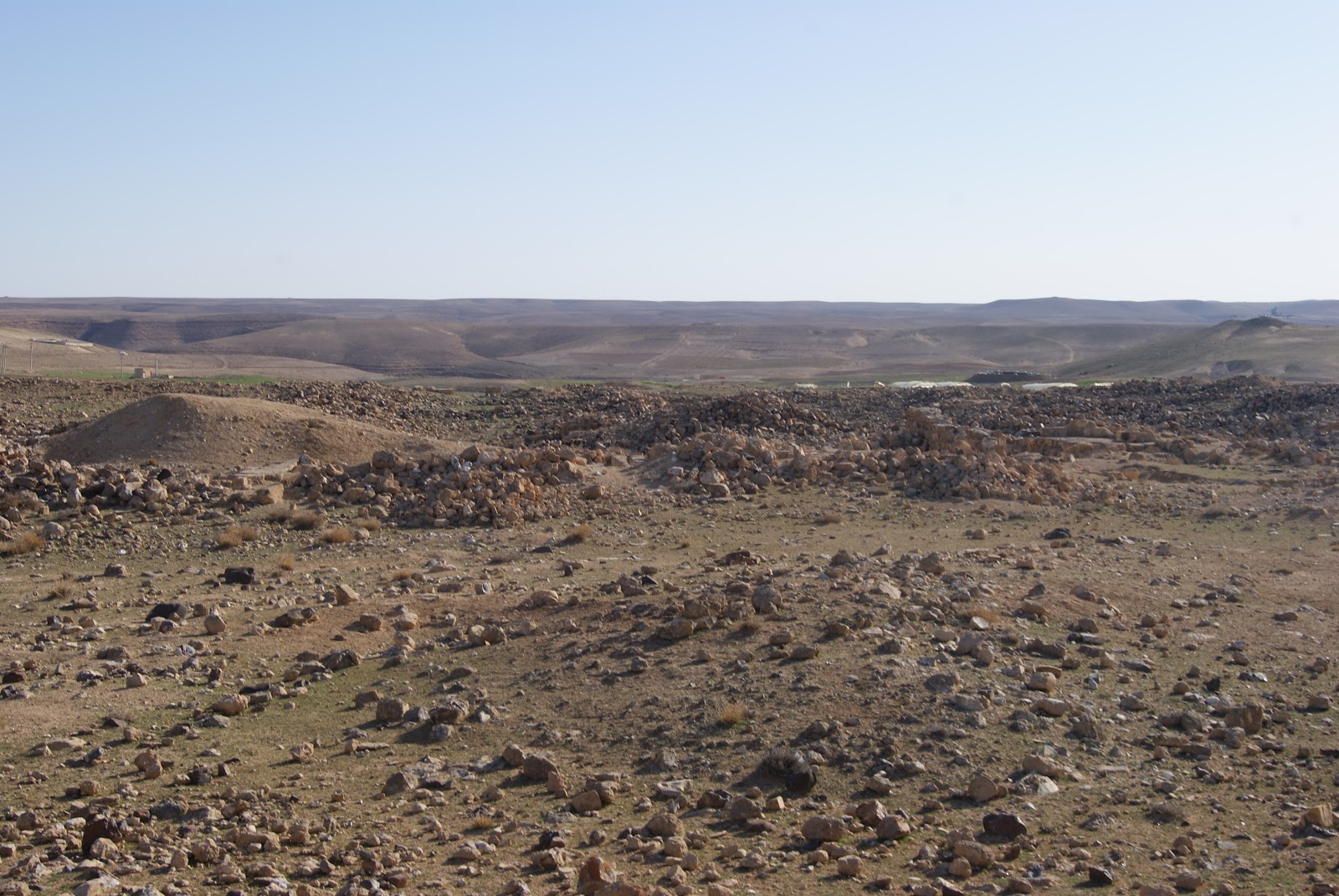
But it's also the case that access to water was important. Funnily enough, about two weeks before this trip I'd been in Vancouver giving a paper. During the talk I mentioned el-Lejjun, and someone asked me about its water supply after I'd finished. I didn't have a good answer, for it wasn't something I'd given much thought to beforehand. Given the desert conditions, I'd assumed the water had to come from somewhere. What I hadn't appreciated, however, was that each of the forts I visited was constructed with access to water well in mind. Some were adjacent to free-flowing water (or what had been free-flowing water). Note, for example, el-Lejjun below.

There was no obvious water source at Qasr Bshir (the wadi we crossed to reach the fort was dry), but the immediate environs of the fort itself was green, as you can see below.

Then those that were a bit removed from water sources had cisterns to store said water. Note, for instance, this re-purposed - and still in use - cistern from Umm el-Jimal, admittedly not solely a military site.

In many ways, then, visiting these sites reinforced some of the beliefs I'd already had about Roman decision making when it came to the construction of forts. But it also opened my eyes to others, especially when it came to water. Suffice to say, the trip has done its trip and more, and I have reams of data to process as a result.
Subscribe to:
Posts (Atom)