Lately, Ammianus Marcellinus has been on my mind for a number of things. I'm working on a paper on Ammianus for a conference in July that focuses on his discussion of legions. To that end, I found myself looking through the admittedly much later Etymologies of Isidore of Seville, composed, it seems, in the first quarter of the seventh century. Isidore has a section on military terms, and another on war. Isidore's discussions are interesting for a number of reasons, and I want to highlight a few features. One of the interesting questions is where he gets his material, and as the examples I highlight will show, it's an eclectic army that he describes.
As I said, my interest was in his use of legion. Not surprisingly in a work on Latin terms, Isidore defines quite a few divisions in the Roman army. Surprises include the size of the legion he gives (6000), and its Romanity (Isidore lived in post-Roman Spain - all 9.46). What's more, he says the legion is comprised of 60 centuries, 30 maniples, 12 cohorts, and 200 turmae. A legion was comprised of centuries and cohorts, and at one stage maniples. But turmae? And were maniples and cohorts ever part of one legion, and one that numbered 6000? Turmae were usually cavalry squadrons - he says so as much a short while later (9.51). Could it be he's referring to the cavalry attached to the legion? That would make sense, though 200 turmae, which says comprised 30 horsemen, would seem high (that makes for 6000 soldiers). There's also no 30-man unit within the legion: there's the 80-100 man century, and the 8-10 man contubernium. So the 200 30-man turmae (10 is better) is a mystery.
The size of the cohort (500-men) and the century (100-men) are fine, at least at a basic level. The 6000-men legion and the 200-man maniples are harder to understand. The imperial-era (Lucan and Tacitus) legion was about 5000 or so (closer to 5200) strong. The mid-republican was usually about 4200 ordinarily, or 5000 in emergencies in the mid-republic, the era of the maniple. By the second Punic war the cohort had been introduced, and some speculate that by its conclusion it was already used widely. The maniple as a word gets used much later than the maniple as pre-cohort division survives. It's hard to say (and I haven't really checked), but it might well continue to be a division in the Roman navy well into the imperial era (a few inscriptions imply as much). That doesn't explain its association here, however. It's used by Ammianus occasionally, sometimes just for a generic unit, though also in a phrase he repeats a few times before speeches ("centuries, cohorts, and maniples"). Did it continue to be used long after its death, only it effectively disappeared from contemporary records? Is that how we should understand the discussion of maniple here, and how we should understand the regular usage of commanipularis in imperial-era inscriptions? I suspect, however, that the latter's appearance was more a matter of tradition than its continued usage.
For Isidore, a camp, the place a soldier was stationed, was given that name (castra) because it was as if they were chaste (castus) or they might be castrated (castrare). That, in turn, was due to women never entering a camp (9.45). Now there's been a lot of debate on the presence of women in Roman military bases, and it now seems pretty clear that they were there. So on this matter he's wrong, but was he basing his estimation strictly on what he knows about those other words? Or was he using one of the many earlier Latin texts he refers to, like the works of Lucan, Sallust, or Vergil?
Anyway, just a sample. There's much more interesting nuggets in the Etymologies, and I've only been focusing on military things. More work to do!
Showing posts with label University of Winnipeg. Show all posts
Showing posts with label University of Winnipeg. Show all posts
Wednesday, 16 May 2018

Monday, 7 August 2017
Further Reflections on the Roman Military Studies Panel
For the next post on the Roman military studies panel/sessions at the Montreal CCC 2017, I'm going to give, effectively, a list of interesting points/comments/suggestions I jotted down. There are fewer for the last couple of panels (I was getting tired - more of the material covered ground I was familiar with). Here are some highlights (and apologies for overlapping with the first Montreal post).
Fred Drogula, "the Legalization of War".
Evidently early Roman warfare reads a bit like mob warfare, with wealthy clans engaging in raids led by patricians in charge of private war bands. Ultimately they were looking for plunder. Drogula asked how did military command become a legally sanctioned activity of the state given these beginnings - and I wonder how and why it regressed (if you want to call it that) back to this state at the end of antiquity. Additionally, the gradual expansion of the state led to a change in the nature of war. Along the way, some intriguing parallels were drawn between early Roman warfare and early modern Italian warfare (think Medici, etc).
Jeremy, Armstrong, "On the Eve of Empire..."
The late fourth/early third century (BC) was a period of significant change, and this included a number of different facets of the Roman state such as: weapons and armour, allies, citizenship, territory, naval power, military infrastructure, coinage, command, tactics. Despite all these changes, much had been set in motion earlier. The manipular legion was a big part of all this change. Evidently, too, the legion wasn't very phalanx-like, and fighting with a phalanx goes against all we know about warfare in early Italy (it wasn't conducive to this - surprised to hear all this, because I'd assumed the phalanx was the early method, later changed. Goes to show what I know). Indeed, he argues that the Romans were always manipular in a way because of the gentes, warbands, and tribes of early Rome, which when organized together tended to be divided into the sort of divisions that matched a maniple well. Ultimately, take Polybius' legion versus phalanx discussion with a grain of salt.
Peter Vanderpuy, "Debt Structures, Warfare, and the rise"
He too noted the gentilicial, clan-based, warfare which characterized early Rome, which was in contrast to the more state-based approach of later times. V provided an intriguing list of agrarian statues from the 12 tables (some of which had a very modern feel). He got into the formation of all these new farms that is often associated with mid-republican Rome. It got into issues of environmental history (more or less). One interesting point (or series of points) he raised pertained to the costs associated with these new farms: the suggestion was farming wasn't ingrained, for some would have had a much more successful go of things on this front than others. Finally, following Berry-Wendell (to some degree), he said the primary cultural output at Rome was its warfare.
John Serrati, "Religion and Roman Warfare..."
His paper touched on gender, and a key figure was Bellona. Bellona was present at the opening and the close of hostilities in Roman combat. For him, it was surprising that a female deity had such a prominent place in such a male part of a patriarchal society. That said, Athena had a big role in Athens too (this me), and it could hardly be praised for its gender equity. Evidently, there's much we don't know about Bellona (I'd known almost nothing) - though much of early Rome IS murky. Was Bellona Italian in origin? Roman? Who knows. She served as a war god in Rome up until Sulla (and if this is true maybe we should consider this another strike against him?). Should note some comparisons were drawn between her and Mars (who wasn't unloved at Rome).
Kathryn Milne, "The Middle Republican Soldier..."
The soldiery were vilified: there was nothing inherently noble in serving. So how did the state manage to ennoble the soldier, which it seems to have done at some point or other? As they served farther and farther from home, his faraway actions were quite different from what he did when he was at home (and this parallels nicely with more recently materials, which she discusses in her thesis, and which I have a copy of). One possible means of ennobling was the parade (triumph). Others include decorations, the volume of spoils, and their exotic prizes. She put a lot of stress on awards, which had a bonding effect, and which made soldiers feel good about themselves (and all this would be relevant to my research on the sixth century). It was important that the awards be accepted by the community at large for them to have any meaning. Some comments were made afterwards about the bodies (what did they do with them at the end of battles) and war's universality.
There are more comments from additional papers, but I'm typing this outside (it's 9:17pm at the moment) and it's getting dark, so I'll stop for the moment. Cheers
Fred Drogula, "the Legalization of War".
Evidently early Roman warfare reads a bit like mob warfare, with wealthy clans engaging in raids led by patricians in charge of private war bands. Ultimately they were looking for plunder. Drogula asked how did military command become a legally sanctioned activity of the state given these beginnings - and I wonder how and why it regressed (if you want to call it that) back to this state at the end of antiquity. Additionally, the gradual expansion of the state led to a change in the nature of war. Along the way, some intriguing parallels were drawn between early Roman warfare and early modern Italian warfare (think Medici, etc).
Jeremy, Armstrong, "On the Eve of Empire..."
The late fourth/early third century (BC) was a period of significant change, and this included a number of different facets of the Roman state such as: weapons and armour, allies, citizenship, territory, naval power, military infrastructure, coinage, command, tactics. Despite all these changes, much had been set in motion earlier. The manipular legion was a big part of all this change. Evidently, too, the legion wasn't very phalanx-like, and fighting with a phalanx goes against all we know about warfare in early Italy (it wasn't conducive to this - surprised to hear all this, because I'd assumed the phalanx was the early method, later changed. Goes to show what I know). Indeed, he argues that the Romans were always manipular in a way because of the gentes, warbands, and tribes of early Rome, which when organized together tended to be divided into the sort of divisions that matched a maniple well. Ultimately, take Polybius' legion versus phalanx discussion with a grain of salt.
Peter Vanderpuy, "Debt Structures, Warfare, and the rise"
He too noted the gentilicial, clan-based, warfare which characterized early Rome, which was in contrast to the more state-based approach of later times. V provided an intriguing list of agrarian statues from the 12 tables (some of which had a very modern feel). He got into the formation of all these new farms that is often associated with mid-republican Rome. It got into issues of environmental history (more or less). One interesting point (or series of points) he raised pertained to the costs associated with these new farms: the suggestion was farming wasn't ingrained, for some would have had a much more successful go of things on this front than others. Finally, following Berry-Wendell (to some degree), he said the primary cultural output at Rome was its warfare.
John Serrati, "Religion and Roman Warfare..."
His paper touched on gender, and a key figure was Bellona. Bellona was present at the opening and the close of hostilities in Roman combat. For him, it was surprising that a female deity had such a prominent place in such a male part of a patriarchal society. That said, Athena had a big role in Athens too (this me), and it could hardly be praised for its gender equity. Evidently, there's much we don't know about Bellona (I'd known almost nothing) - though much of early Rome IS murky. Was Bellona Italian in origin? Roman? Who knows. She served as a war god in Rome up until Sulla (and if this is true maybe we should consider this another strike against him?). Should note some comparisons were drawn between her and Mars (who wasn't unloved at Rome).
Kathryn Milne, "The Middle Republican Soldier..."
The soldiery were vilified: there was nothing inherently noble in serving. So how did the state manage to ennoble the soldier, which it seems to have done at some point or other? As they served farther and farther from home, his faraway actions were quite different from what he did when he was at home (and this parallels nicely with more recently materials, which she discusses in her thesis, and which I have a copy of). One possible means of ennobling was the parade (triumph). Others include decorations, the volume of spoils, and their exotic prizes. She put a lot of stress on awards, which had a bonding effect, and which made soldiers feel good about themselves (and all this would be relevant to my research on the sixth century). It was important that the awards be accepted by the community at large for them to have any meaning. Some comments were made afterwards about the bodies (what did they do with them at the end of battles) and war's universality.
There are more comments from additional papers, but I'm typing this outside (it's 9:17pm at the moment) and it's getting dark, so I'll stop for the moment. Cheers
Tuesday, 28 February 2017
Water and Frontiers in Roman Jordan
I just got back from a short visit to Jordan. It took me just under a day to get there. I had five full days visiting the sites. And then just over a day to get back home. I took between 1500 and 2000 photos (the total eludes me because of some copying errors), which I plan to use in a host of publications. Though brief, the trip was incredible. So much so, in fact, that I'm pretty sure I want to shift my focus more squarely to Roman Jordan.
It's fair to say I've loved (or at least really, really liked) the Near East for some decades now. In the early days of my indoctrination in Classics, I even contemplated shifting to Near Eastern studies, and Assyriology in particular. I was spurred, in part, by my first visit to the British Museum in 1999, when I saw the incredible Assyrian frieze. It was only the relatively limited options for Assyriologists that kept me away.
But there's more. For a few years when I was little (1983 and 1986 - I was born in 1978), we lived in Saudi Arabia, first in Tabuk in the northwest, then in Dhahdran/al-Damman in the southeast. While there, we visited Jordan and Egypt. Somewhat surprisingly, many years later my parents returned to the Middle East, only in this case to the UAE, first Abu Dhabi, and for several years now Dubai. There is, then, good reason for this personal affection for the Middle East.
Coming to Jordan now, however, after I've managed to make a career (or at least started one) as an ancient historian/Classicist/Byzantinist, made the visit all that much more special, especially given that I've done some work on the area, and have desired doing more. To see, then, some of the sites I've written about and/or studied as an undergraduate and graduate student was fantastic.
The intention of the visit was to visit as many Roman military sites as possible, and I managed to make it to Petra (honorable mention on the military front - inscriptions, papyri), Udruh, el-Lejjun, Qasr-Bshir, Umm er-Resas, Qasr el-Hallabat, and Umm el-Jimal. I missed quite a few, and hope to see some of those next year, in addition to some of the ones I've already seen.
One of the purposes of the visit was to get a sense of Roman strategic sense in the choosing of these sites. It's a big issue that's attracted a good deal of attention thanks in part to the work of Luttwak, Whittaker, and Isaac on frontiers more generally, and Parker, Mayerson, and Graf on the southeast frontier more specifically. It is, admittedly, hard to know why certain sites were chosen, particularly new ones like el-Lejjun, which weren't occupied beforehand, unlike, say, Udruh, the history of which seems to stretch back to the Nabataean age. We don't, really, have documents that explain their decisions, so scholars have tried to figure this out by means of evaluating the locations of the forts and fortifications themselves, and careful analysis of what documentary and literary evidence of relevance we have.
I've visited Roman military sites in the opposite frontier before, namely Roman Britain, particularly along Hadrian's Wall. Of the few that I've seen, it can sometimes be difficult to tell why particular places were chosen. Roman Britain, however, is another story - and I think I would need to visit them all to really appreciate the British context. The same's true for what little I've seen myself of Roman Bulgaria, though what I did see suggests to me that crossing points played a big part.
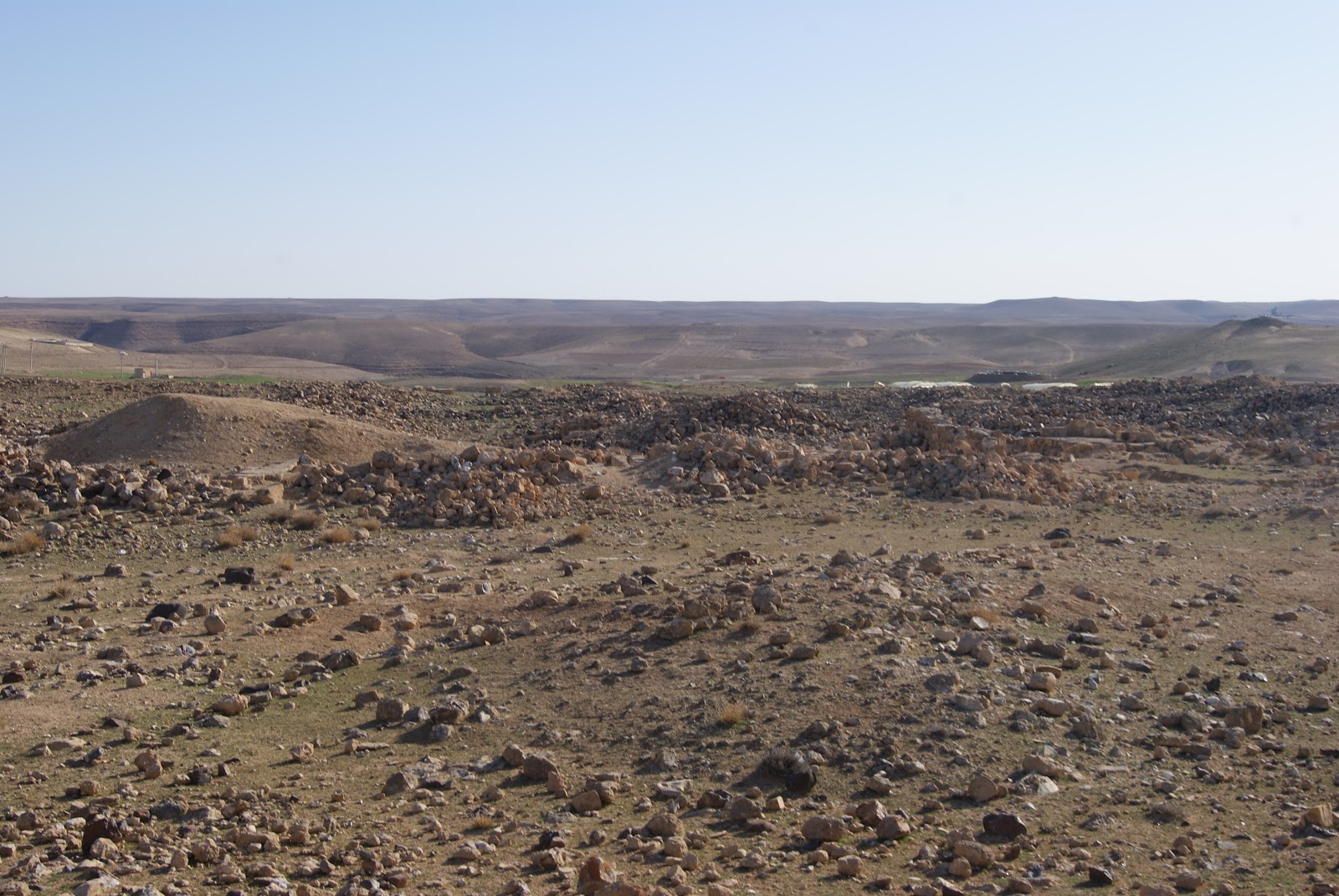
Having now visited these few in Jordan, one of the last of Rome's frontiers, it seems careful consideration was given to sight-lines and general visibility, and access to water. First, the site lines. I've attached below some photos of select views from some of the fortresses I visited. Udruh, el-Lejjun, Qasr-Bshir, Umm er-Resas, and Qasr el-Hallabat all offer excellent views of the surrounding countryside in all or most directions. This is especially true of Qasr Bhsir (top) and Qasr el-Hallabat (bottom).


But this is also true, to a large degree, of Udruh (top) and el-Lejjun (bottom), two late Roman legionary sites of roughly the same size.


But it's also the case that access to water was important. Funnily enough, about two weeks before this trip I'd been in Vancouver giving a paper. During the talk I mentioned el-Lejjun, and someone asked me about its water supply after I'd finished. I didn't have a good answer, for it wasn't something I'd given much thought to beforehand. Given the desert conditions, I'd assumed the water had to come from somewhere. What I hadn't appreciated, however, was that each of the forts I visited was constructed with access to water well in mind. Some were adjacent to free-flowing water (or what had been free-flowing water). Note, for example, el-Lejjun below.

There was no obvious water source at Qasr Bshir (the wadi we crossed to reach the fort was dry), but the immediate environs of the fort itself was green, as you can see below.

Then those that were a bit removed from water sources had cisterns to store said water. Note, for instance, this re-purposed - and still in use - cistern from Umm el-Jimal, admittedly not solely a military site.

In many ways, then, visiting these sites reinforced some of the beliefs I'd already had about Roman decision making when it came to the construction of forts. But it also opened my eyes to others, especially when it came to water. Suffice to say, the trip has done its trip and more, and I have reams of data to process as a result.
It's fair to say I've loved (or at least really, really liked) the Near East for some decades now. In the early days of my indoctrination in Classics, I even contemplated shifting to Near Eastern studies, and Assyriology in particular. I was spurred, in part, by my first visit to the British Museum in 1999, when I saw the incredible Assyrian frieze. It was only the relatively limited options for Assyriologists that kept me away.
But there's more. For a few years when I was little (1983 and 1986 - I was born in 1978), we lived in Saudi Arabia, first in Tabuk in the northwest, then in Dhahdran/al-Damman in the southeast. While there, we visited Jordan and Egypt. Somewhat surprisingly, many years later my parents returned to the Middle East, only in this case to the UAE, first Abu Dhabi, and for several years now Dubai. There is, then, good reason for this personal affection for the Middle East.
Coming to Jordan now, however, after I've managed to make a career (or at least started one) as an ancient historian/Classicist/Byzantinist, made the visit all that much more special, especially given that I've done some work on the area, and have desired doing more. To see, then, some of the sites I've written about and/or studied as an undergraduate and graduate student was fantastic.
The intention of the visit was to visit as many Roman military sites as possible, and I managed to make it to Petra (honorable mention on the military front - inscriptions, papyri), Udruh, el-Lejjun, Qasr-Bshir, Umm er-Resas, Qasr el-Hallabat, and Umm el-Jimal. I missed quite a few, and hope to see some of those next year, in addition to some of the ones I've already seen.
One of the purposes of the visit was to get a sense of Roman strategic sense in the choosing of these sites. It's a big issue that's attracted a good deal of attention thanks in part to the work of Luttwak, Whittaker, and Isaac on frontiers more generally, and Parker, Mayerson, and Graf on the southeast frontier more specifically. It is, admittedly, hard to know why certain sites were chosen, particularly new ones like el-Lejjun, which weren't occupied beforehand, unlike, say, Udruh, the history of which seems to stretch back to the Nabataean age. We don't, really, have documents that explain their decisions, so scholars have tried to figure this out by means of evaluating the locations of the forts and fortifications themselves, and careful analysis of what documentary and literary evidence of relevance we have.
I've visited Roman military sites in the opposite frontier before, namely Roman Britain, particularly along Hadrian's Wall. Of the few that I've seen, it can sometimes be difficult to tell why particular places were chosen. Roman Britain, however, is another story - and I think I would need to visit them all to really appreciate the British context. The same's true for what little I've seen myself of Roman Bulgaria, though what I did see suggests to me that crossing points played a big part.
Having now visited these few in Jordan, one of the last of Rome's frontiers, it seems careful consideration was given to sight-lines and general visibility, and access to water. First, the site lines. I've attached below some photos of select views from some of the fortresses I visited. Udruh, el-Lejjun, Qasr-Bshir, Umm er-Resas, and Qasr el-Hallabat all offer excellent views of the surrounding countryside in all or most directions. This is especially true of Qasr Bhsir (top) and Qasr el-Hallabat (bottom).


But this is also true, to a large degree, of Udruh (top) and el-Lejjun (bottom), two late Roman legionary sites of roughly the same size.

But it's also the case that access to water was important. Funnily enough, about two weeks before this trip I'd been in Vancouver giving a paper. During the talk I mentioned el-Lejjun, and someone asked me about its water supply after I'd finished. I didn't have a good answer, for it wasn't something I'd given much thought to beforehand. Given the desert conditions, I'd assumed the water had to come from somewhere. What I hadn't appreciated, however, was that each of the forts I visited was constructed with access to water well in mind. Some were adjacent to free-flowing water (or what had been free-flowing water). Note, for example, el-Lejjun below.

There was no obvious water source at Qasr Bshir (the wadi we crossed to reach the fort was dry), but the immediate environs of the fort itself was green, as you can see below.

Then those that were a bit removed from water sources had cisterns to store said water. Note, for instance, this re-purposed - and still in use - cistern from Umm el-Jimal, admittedly not solely a military site.

In many ways, then, visiting these sites reinforced some of the beliefs I'd already had about Roman decision making when it came to the construction of forts. But it also opened my eyes to others, especially when it came to water. Suffice to say, the trip has done its trip and more, and I have reams of data to process as a result.
Thursday, 26 May 2016
Roman Military Kaibos (i.e. loos)
One of the biggest surprises
of my tour of select Roman military sites on the British frontier/s has been
coming across the "prominently" placed, and often signposted, Roman
military loos (in Britain, so loos). Of course, there had to be a place
where people did numbers ones and number twos, but in normal conversation or
discussion - at least in my experiences in class and in the course of my
research - it's not something that's entered my stream (pun intended) of
consciousness. Toilets have come occasionally, or rarely even, in my
preparation in years past for the UofW's Roman Society course. It's
always fun too to bring up the famed bleaching of Roman togas, for which we
have such great evidence from Pompeii. Indeed, I remember learning all
about it in my 4th year honours seminar class on Pompeii at Mac.
Anyway, point is it's come up on occasion, I know it had to be there (in the back of my mind), but I hadn't given much thought beyond that. I've come across five Roman military loos on this comparably short and condensed tour: one at Caerleon in Wales, one at Chesters in England, one at Housesteads in England, and one at Arbeia in England. Evidently too, though I haven't seen it myself, they've found a wooden "posh" toilet seat at Vindolanda. What's familiar about seeing what few "seats" we've found is that the shape is basically the same that you find in most toilets, at least in the west, today. What's less familiar, again in the west, save for those troughs you find in so many UK mens' toilets, is the public aspect of the urination and defecation. Some of us don't have any trouble doing the duty in the presence of others; others of us, myself included, like to keep our number ones and numbers twos on the down-loo. In the Roman forts, however, at least those that I've seen, the common soldiers are more often than not going to be doing the business - how many euphemisms can I use? - in the presence of their comrades. Sure, we can't prove that those long-dead Roman soldiers who shared my views didn't go off into the middle of the woods to do their thing, but I'm guessing given various rules and regulations surrounding movement into and out of a fort on duty, this might have been more difficult to do.
Ultimately, this public pooing raises all sorts of interesting questions. For one thing, from the perspective of the sensory experience of Roman life, it's not hard to imagine what it might have been like. If you've ever had some experience of port-o-johns, as they called them in my youth, put up for construction workers or at outdoor concerts and the like, or even the kaibos and outhouses of the Canadian cottage-country world, then you know how bad those things can smell when you're inside. Many of those, at least the former, would be emptied on some sort of rotation; of the latter, I've never really known. In the case of Roman military bases, however, would anyone every empty those things? Presumably something would have to give, though beyond my experience with dog poo in the cities and wilds of Canada, I know little-to-nothing about how long it takes for it decompose. Still, if it was allowed to pile up, and if the all the men (to say nothing of the women and children) in a base were regular (no fibre needed), it wouldn't be long before you might have something approaching "Aegean Stable" proportions with no Herakles in sight. Even so, even if the emptying of the loos wasn't regular, the smell, possibly even the taste, of those environments would have been remarkable unless they made some attempt to mask the smell or keep things in check. And, these loos were also found within the confines of what where enclosed settlements – Roman military forts were without fail surrounded by walls, often stone ones that would, I’m guessing, trap the smell inside. For, as bad as it might be for those who went in to do a number one or number two, there’s also the issue of the smell wafting over to those who lived beside the loos. If I recall, at Caerleon the loos were positioned right beside one part of the barracks. Perhaps if you’d been a bad soldier you’d have to live at that end for a time?
As many forts as possible, it seems, from what I can gather, tried their utmost to be self-sustaining. Should the loos be seen as part of this practice? When it comes to urine I would think so, if we assume that there was some sort of piping that led the urine to some sort of fulling centre. On the other hand, I don’t recall ever coming across some sort of place in a fort. Maybe they’re there and I missed them, but maybe not. Of course, Roman soldiers, the odd officer aside, would likely have little concern with getting their togas gleaming white. If we get back to the poo, might it have been used as part of wider fertilization practices in and around the fort? I have no idea how useful human poo is when it comes to fertilization, though I imagine it would have some benefit. At the same time, their diets wouldn’t have been comprised of the same sorts chemicals and processed foods that ours are today, so their poo might have been more valuable from a re-use perspective, though I’m speculating.
Another issue is the standing or sitting for number ones – and one can’t hope to resolve (I think?). We thinking of men standing to pee and, well, obviously sitting to poo. From a practical point of view – and bear in mind you would get a whole row of these toilets – would those who had to pee be standing, hypothetically, between those who had to poo? What happened if the spray got out of control? On the other hand, did you just sit in these environments? Standing while peeing, at least among males, seems like a biological characteristic, at least when toilets aren’t involved. But if you were in this environment would you change your habits?
One last thing to note: unit cohesion. What better way to bond with your fellow soldiers than in the loos? Those who shit together, fight better together. Might these public military loos have had some sort of advantage from that perspective? I guess the only catch with this angle is that I believe that public loos were a common thing in the Roman Empire in general. In that instance it might have been less the case that it provided soldiers an opportunity to bond and more the case that it was just part of regular Roman urban life. Indeed, many see Roman forts as mini-outposts of Roman urban life, which I think is a reasonable enough assumption.
All in all, much food for thought – or in this case digest. And I leave you with a photo of the Roman military kaibos at Arbeia.

Anyway, point is it's come up on occasion, I know it had to be there (in the back of my mind), but I hadn't given much thought beyond that. I've come across five Roman military loos on this comparably short and condensed tour: one at Caerleon in Wales, one at Chesters in England, one at Housesteads in England, and one at Arbeia in England. Evidently too, though I haven't seen it myself, they've found a wooden "posh" toilet seat at Vindolanda. What's familiar about seeing what few "seats" we've found is that the shape is basically the same that you find in most toilets, at least in the west, today. What's less familiar, again in the west, save for those troughs you find in so many UK mens' toilets, is the public aspect of the urination and defecation. Some of us don't have any trouble doing the duty in the presence of others; others of us, myself included, like to keep our number ones and numbers twos on the down-loo. In the Roman forts, however, at least those that I've seen, the common soldiers are more often than not going to be doing the business - how many euphemisms can I use? - in the presence of their comrades. Sure, we can't prove that those long-dead Roman soldiers who shared my views didn't go off into the middle of the woods to do their thing, but I'm guessing given various rules and regulations surrounding movement into and out of a fort on duty, this might have been more difficult to do.
Ultimately, this public pooing raises all sorts of interesting questions. For one thing, from the perspective of the sensory experience of Roman life, it's not hard to imagine what it might have been like. If you've ever had some experience of port-o-johns, as they called them in my youth, put up for construction workers or at outdoor concerts and the like, or even the kaibos and outhouses of the Canadian cottage-country world, then you know how bad those things can smell when you're inside. Many of those, at least the former, would be emptied on some sort of rotation; of the latter, I've never really known. In the case of Roman military bases, however, would anyone every empty those things? Presumably something would have to give, though beyond my experience with dog poo in the cities and wilds of Canada, I know little-to-nothing about how long it takes for it decompose. Still, if it was allowed to pile up, and if the all the men (to say nothing of the women and children) in a base were regular (no fibre needed), it wouldn't be long before you might have something approaching "Aegean Stable" proportions with no Herakles in sight. Even so, even if the emptying of the loos wasn't regular, the smell, possibly even the taste, of those environments would have been remarkable unless they made some attempt to mask the smell or keep things in check. And, these loos were also found within the confines of what where enclosed settlements – Roman military forts were without fail surrounded by walls, often stone ones that would, I’m guessing, trap the smell inside. For, as bad as it might be for those who went in to do a number one or number two, there’s also the issue of the smell wafting over to those who lived beside the loos. If I recall, at Caerleon the loos were positioned right beside one part of the barracks. Perhaps if you’d been a bad soldier you’d have to live at that end for a time?
As many forts as possible, it seems, from what I can gather, tried their utmost to be self-sustaining. Should the loos be seen as part of this practice? When it comes to urine I would think so, if we assume that there was some sort of piping that led the urine to some sort of fulling centre. On the other hand, I don’t recall ever coming across some sort of place in a fort. Maybe they’re there and I missed them, but maybe not. Of course, Roman soldiers, the odd officer aside, would likely have little concern with getting their togas gleaming white. If we get back to the poo, might it have been used as part of wider fertilization practices in and around the fort? I have no idea how useful human poo is when it comes to fertilization, though I imagine it would have some benefit. At the same time, their diets wouldn’t have been comprised of the same sorts chemicals and processed foods that ours are today, so their poo might have been more valuable from a re-use perspective, though I’m speculating.
Another issue is the standing or sitting for number ones – and one can’t hope to resolve (I think?). We thinking of men standing to pee and, well, obviously sitting to poo. From a practical point of view – and bear in mind you would get a whole row of these toilets – would those who had to pee be standing, hypothetically, between those who had to poo? What happened if the spray got out of control? On the other hand, did you just sit in these environments? Standing while peeing, at least among males, seems like a biological characteristic, at least when toilets aren’t involved. But if you were in this environment would you change your habits?
One last thing to note: unit cohesion. What better way to bond with your fellow soldiers than in the loos? Those who shit together, fight better together. Might these public military loos have had some sort of advantage from that perspective? I guess the only catch with this angle is that I believe that public loos were a common thing in the Roman Empire in general. In that instance it might have been less the case that it provided soldiers an opportunity to bond and more the case that it was just part of regular Roman urban life. Indeed, many see Roman forts as mini-outposts of Roman urban life, which I think is a reasonable enough assumption.
All in all, much food for thought – or in this case digest. And I leave you with a photo of the Roman military kaibos at Arbeia.

Wednesday, 25 May 2016
England, Hadrian's Wall, and the Romans Part 1 (text)
I’m currently in the tail end of my whirlwind tour of
British libraries and military sites.
After making the trek, by car, from Winnipeg to Brantford with the dog,
I flew off to London to head to the Institute for Classical Studies
library. Had four productive days, then,
after a brief layover just outside of Worcester, it was off to Wales – with
another family layover at the start, this time in Cardiff. I spend two nights taking photos of the area
around Caerleon, site of some well-preserved legionary ruins. Next I charged off for two nights in
Aberystwyth, for a lecture on cohesion and combat motivation. Went down well, and got some excellent
feedback.
A brief sojourn to Devon (Sidmouth and family) was
followed by a trip to Oxford for some more library work – and some typing. I also squeezed in two nights in Birmingham
to catch up with some friends and colleagues, including my former PhD
supervisor. Then a night back in Oxford
(family) and a night in Devon (Sidmouth, family again). This week, however, I’ve been in the north,
along Hadrian’s Wall. The purpose of
this portion of the trip has been to visit as many Roman military sites along
the wall as is feasible and to take as many photos as possible. These photos, or the best of them, will
appear in an introduction to the Roman military, in the works. I think in a follow-up post I’ll attach a
couple of the pictures. Perhaps, too,
I’ll consider joining Instagram.
Although I’ll be posting this written entry from Newcastle, I’m writing
it on the train from Carlisle, a train trip I’ve done twice before.
Anyway, there’s probably any number of things I could
say at this point, from how I’m feeling about the news about Gord Downie (hits
close to home in a number of ways) to the remarkable beauty of this landscape,
but I should say a thing or two about military stuff, since I’ve devoted this
blog to work matters.
What I’d like to draw attention to here is how
well-sited most of the bases are along the wall. The wall, one of the most glorious archaeological
sites in the world, in my humble opinion, runs for about 73 miles (British? –
never understood the difference, if there is one, between US and UK miles) from
coast to coast, or sea to sea. That’s
from just west of Carlisle to Newcastle.
Now, at many points the isle of Britain tends to be much wider, so that
they’ve chosen one of narrowest points, though not necessarily the easiest in
terms of landscape, to build the wall reflects, I think, Roman
practicality. Sure, their geographical
knowledge differs from ours, but after brief consideration it’s a remarkable
coincidence that they built it at this point.
I’m sure there were geographical and tribal considerations in part, but
practicality and cost must have been a major consideration.
The other matter, or the principal matter, that I
wanted to touch on was also how well-placed the sites are. In nearly all those sites that survive that I
saw – and the forts and fortlets in particular – you are afforded excellent
views of the surrounding countryside. This,
too, could be chance: it’s not the case
that the landscape has changed enough that my modern perspective is defective,
as you can see when you notice how the wall hugs the landscape. No, some thinking went into choosing the
locations, and again, in an albeit small sample size, and without making any
mathematical calculations using, say, Google Earth, it’s clear they wanted
their forts in spots where they could observe approaching visitors with comparable
ease. In some cases too they went to such
remarkable lengths to do this that certain forts were built into the side of
hills. Housesteads, for instance, is one
the side of the hill, and the slope is not inconsiderable. I don’t doubt that there might have been some
levelling in the past, but the surviving foundations suggest that this was
limited.
Now, there are
obviously lower points – the wall goes in as straight a line as possible, but
the landscape is anything but flat and straightforward. This means it snakes its way up and down up
and over hills and then down into valleys.
That also means that certain spots would have been easy to get across
for a determined group. Even there,
however, it should be stressed that there were towers or forts or something
every mile (or is it Roman mile? – can’t remember off the top of my head). And given you could see that sort of distance
fairly easily, unless the conditions were dreadful, I don’t think they need
have been too concerned, and they probably weren’t.
All in all, as I’m sure commentators have noted time
and again, even when they have disagreed over the precise function of the wall,
it’s clear that a great deal of care, consideration, and planning when into its
construction. This was no mean feat for
any number of reasons, and it is a testament to Roman ingenuity and
practicality – and in some instances their efficiency. Plus, while I don’t doubt that the wall had
all sorts of functions ranging from the control of peoples to the movement of
goods, when you’re here and you see it on the ground it’s hard to get past its
defensive function too.
From the train south of the wall, until next time.
Wednesday, 15 October 2014
The Value of Sources and the Face of Procopian/Justinianic Warfare
Back to it. Strike while the ember's hot and all that.
Do the references to Procopius' own actions in the sixth century contained within the Wars make a difference to whether we think he's a good historian or not, or at least whether we really ought to use his text? It can, I guess to some degree, provide evidence of his own worth, his authority for discussing the material that he's narrating. This was an age old authority trick by the time Procopius was writing. If he was a participant then would seemingly provide some insight into what happened, though the problems with human memories and eye witnesses demonstrate that we shouldn't put too much stock in affairs. What it probably is really useful for is putting him in a position to get to the materials he'd need to write what he wrote, and to see, with his own eyes, how things worked. Too often we sort of assume, however, that he spent an ordinate amount of time making detailed and accurate notes, when we contain no such definitive evidence.
Even if we are able to get a sense of what kinds of sources he used in different situations, we still have to rank that material. Should things he saw himself rank higher than the rest? Than oral after that? And then dispatches and reports? Or should the order be switched some way? All those references to they say cause problems of their own. There are some examples where they might seem to referring to a particular person or persons, and others where it seems more likely that he's relying on written materials. Often, however, the statements aren't anywhere near clear enough, and in most of the Wars, like any good classicizing historian, he tends to shy away from identifying particular authors. There are exceptions, like Arrian, Herodotus, and Homer, but many of those come from book VIII, and it should be apparent that they have little bearing on current events.
Is this attempt to uncover his sources for particular military events all an exercise in futility? Even if I can uncover any of it, can it really tell us what we should believe? Probably not a whole heck of a lot - rather, we'd need comparable evidence, where it exists.
One last note: back to the doryphoroi. Discussion has often centred on whether Procopius was advocating an era of horse-archery at the expense of the infantry, and it's been suggested that this was partly (or largely) the result of Procopius' attachment to Belisarius. The general himself seems to have used a lot of cavalry, so Procopius would, unsurprisingly, use it and highlight it at the expense of others. Is this mere "bias" on the part of Procopius? Or is he actually reflecting reality? Rance has made a good case that he's not being exactly forthright. What all this thinking about sources has got me thinking, however, is whether the conversation should be shifted towards private armies versus public armies, not cavalry versus infantry. Is this the face of Procopian combat?
It seems that there was a shift towards cavalry, regardless of whether Procopius was overzealous in his reporting of their actions. But he also hints at a shift towards private armies. OK - you could say that the abandonment of the heavy infantry that won Rome its empire is cause for concern. But what about the failure of the state to pay for the armies to keep the empire secure? Or make the desired conquests easier? In some sense, then, what we see is a return to the profiteering of the late republic: soldier-generals fighting each other for power and prestige, while in the process nearly ruining the state. In the republic's case, it was fortunate enough, depending on your perspective, to have a guy like Octavian come round and right the ship. Without him, it's hard to imagine a Rome existing in the form that it did by the time Justinian came around. The sixth and seventh century state, however, didn't have anyone like that. Sure, Heraclius deserves lots of credit for what he did to prevent the ship from going down, but we all know that the empire would never again reach the geographical extent that it once did (and assuming that's the best sign of the strength of an empire - it might not be).
So, more for me to ponder. Yes, think more about sources. Think more about how to evaluate his worth. Think more about he characterizes the various militaries who feature in his works. But think too what was the most significant of those (if there is such a thing).
As always, more to come...
Do the references to Procopius' own actions in the sixth century contained within the Wars make a difference to whether we think he's a good historian or not, or at least whether we really ought to use his text? It can, I guess to some degree, provide evidence of his own worth, his authority for discussing the material that he's narrating. This was an age old authority trick by the time Procopius was writing. If he was a participant then would seemingly provide some insight into what happened, though the problems with human memories and eye witnesses demonstrate that we shouldn't put too much stock in affairs. What it probably is really useful for is putting him in a position to get to the materials he'd need to write what he wrote, and to see, with his own eyes, how things worked. Too often we sort of assume, however, that he spent an ordinate amount of time making detailed and accurate notes, when we contain no such definitive evidence.
Even if we are able to get a sense of what kinds of sources he used in different situations, we still have to rank that material. Should things he saw himself rank higher than the rest? Than oral after that? And then dispatches and reports? Or should the order be switched some way? All those references to they say cause problems of their own. There are some examples where they might seem to referring to a particular person or persons, and others where it seems more likely that he's relying on written materials. Often, however, the statements aren't anywhere near clear enough, and in most of the Wars, like any good classicizing historian, he tends to shy away from identifying particular authors. There are exceptions, like Arrian, Herodotus, and Homer, but many of those come from book VIII, and it should be apparent that they have little bearing on current events.
Is this attempt to uncover his sources for particular military events all an exercise in futility? Even if I can uncover any of it, can it really tell us what we should believe? Probably not a whole heck of a lot - rather, we'd need comparable evidence, where it exists.
One last note: back to the doryphoroi. Discussion has often centred on whether Procopius was advocating an era of horse-archery at the expense of the infantry, and it's been suggested that this was partly (or largely) the result of Procopius' attachment to Belisarius. The general himself seems to have used a lot of cavalry, so Procopius would, unsurprisingly, use it and highlight it at the expense of others. Is this mere "bias" on the part of Procopius? Or is he actually reflecting reality? Rance has made a good case that he's not being exactly forthright. What all this thinking about sources has got me thinking, however, is whether the conversation should be shifted towards private armies versus public armies, not cavalry versus infantry. Is this the face of Procopian combat?
It seems that there was a shift towards cavalry, regardless of whether Procopius was overzealous in his reporting of their actions. But he also hints at a shift towards private armies. OK - you could say that the abandonment of the heavy infantry that won Rome its empire is cause for concern. But what about the failure of the state to pay for the armies to keep the empire secure? Or make the desired conquests easier? In some sense, then, what we see is a return to the profiteering of the late republic: soldier-generals fighting each other for power and prestige, while in the process nearly ruining the state. In the republic's case, it was fortunate enough, depending on your perspective, to have a guy like Octavian come round and right the ship. Without him, it's hard to imagine a Rome existing in the form that it did by the time Justinian came around. The sixth and seventh century state, however, didn't have anyone like that. Sure, Heraclius deserves lots of credit for what he did to prevent the ship from going down, but we all know that the empire would never again reach the geographical extent that it once did (and assuming that's the best sign of the strength of an empire - it might not be).
So, more for me to ponder. Yes, think more about sources. Think more about how to evaluate his worth. Think more about he characterizes the various militaries who feature in his works. But think too what was the most significant of those (if there is such a thing).
As always, more to come...
Procopius' Sources
For the second major Procopius project of mine, I've been investigating sources and thinking about reliability in ways that I wasn't for the first one. It's all much more interesting than I'd considered, and I've benefitted from reading some interesting things of relevance by people like Borm, Whitby, Howard-Johnston, Kaegi, Colvin, Cameron, Greatrex, Treadgold, Parnell (excellent prosopography) and especially Sinclair (military bulletins), among others.
One of the first things that I did was evaluate, or consider, those instances where Procopius, the historical figure, intervened himself in the action, whether it was to provide advice about trumpets, get some intel from Sicily, or scope out some supply routes (and the supplies themselves) for the Romans. He doesn't intervene too often, though when he does he evinces some knowledge and experience with military stuff.
More recently I've turned to campaign reports and bulletins, and oral sources. I've been engaged in some TLG searches with a few choice words and phrases, and they have turned up some interesting results. There are, for instance, far more references to specific spearmen (doryphoroi) and shield-bearers (hypaspistes) than I had appreciated before, and possibly more than there should be given their relative numbers. I had wondered if this was, in part, due to their increased usage - and the connections with buccellarii, Procopius' experiences, and Belisarius' wealth might bear this out - in sixth century combat. But, I've also noticed that it is invariably the spearmen who are mentioned rather than the shield bearers. Not unusual in and of itself - all classical and classicizing (or just about) authors and theorists advocate attention be focused on the elite - though it's definitely something that's worth exploring. I can certainly appreciate why some see these men as the ones who gave Procopius much of his information.
I should add, on the subject of oral sources I'm also taking a look at Procopius' usage of words like phasi. Has a good pedigree, of course. What's stuck me so far is how much he uses it in what I consider the Herodotean parts of the Wars: books 1, 2 and 8 - the majority of usages are found there. This too might not be a coincidence, given, if I recall (off the top of my head) Herodotus' practices.
Bulletins and reports are a tougher nut to crack. None of these survive, save a possible example in the Chronicon Paschale. We also lack all those strength reports from the earlier empire, which seem to hint at some sort of record keeping of this sort, at least to my mind. Having considered some battles again, and looked closely (again) at one or two, I'm finding it hard trying to decide how we would find evidence of this sort of thing, and if we did what it would mean. Just because something's official it doesn't make it right. It does seem entirely likely that they existed in some form, and Procopius himself might have composed some for Justinian. If that's true, he probably did use them - maybe it was in his capacity as writer of official reports that he decided to compose the Wars?
Anyway, lots of interesting things being uncovered (to my mind), with many more to follow. This also happens to be raising, at least in my mind, interesting questions about composition. More to come...
One of the first things that I did was evaluate, or consider, those instances where Procopius, the historical figure, intervened himself in the action, whether it was to provide advice about trumpets, get some intel from Sicily, or scope out some supply routes (and the supplies themselves) for the Romans. He doesn't intervene too often, though when he does he evinces some knowledge and experience with military stuff.
More recently I've turned to campaign reports and bulletins, and oral sources. I've been engaged in some TLG searches with a few choice words and phrases, and they have turned up some interesting results. There are, for instance, far more references to specific spearmen (doryphoroi) and shield-bearers (hypaspistes) than I had appreciated before, and possibly more than there should be given their relative numbers. I had wondered if this was, in part, due to their increased usage - and the connections with buccellarii, Procopius' experiences, and Belisarius' wealth might bear this out - in sixth century combat. But, I've also noticed that it is invariably the spearmen who are mentioned rather than the shield bearers. Not unusual in and of itself - all classical and classicizing (or just about) authors and theorists advocate attention be focused on the elite - though it's definitely something that's worth exploring. I can certainly appreciate why some see these men as the ones who gave Procopius much of his information.
I should add, on the subject of oral sources I'm also taking a look at Procopius' usage of words like phasi. Has a good pedigree, of course. What's stuck me so far is how much he uses it in what I consider the Herodotean parts of the Wars: books 1, 2 and 8 - the majority of usages are found there. This too might not be a coincidence, given, if I recall (off the top of my head) Herodotus' practices.
Bulletins and reports are a tougher nut to crack. None of these survive, save a possible example in the Chronicon Paschale. We also lack all those strength reports from the earlier empire, which seem to hint at some sort of record keeping of this sort, at least to my mind. Having considered some battles again, and looked closely (again) at one or two, I'm finding it hard trying to decide how we would find evidence of this sort of thing, and if we did what it would mean. Just because something's official it doesn't make it right. It does seem entirely likely that they existed in some form, and Procopius himself might have composed some for Justinian. If that's true, he probably did use them - maybe it was in his capacity as writer of official reports that he decided to compose the Wars?
Anyway, lots of interesting things being uncovered (to my mind), with many more to follow. This also happens to be raising, at least in my mind, interesting questions about composition. More to come...
Sunday, 20 January 2013
Return of the Blog
Many moons ago, while I was a graduate student at Warwick, I had a wee blog. What posts I had were usually about late antique things, with Procopius, Justinian, and sixth century warfare the subject of the bulk of those posts. There were occasional posts about non-academic things. Here, I plan on doing the same. On the academic side of things probable topics include the Classical World, Late Antiquity, Byzantium, Rome, historiography (classical, late antique, and byzantine), ancient and medieval warfare, frontiers, barbarians, and teaching. Those of a less academic sort are likely to include Winnipeg, hockey, and, well, whatever else comes to mind.
Subscribe to:
Posts (Atom)