I just finished reading Peter Heather's (PH) Rome Resurgent, which I now have to write a review for. When I first heard about the book, I was both excited and horribly disappointed: excited because I love the topic and have read some of Heather's other work, disappointed because it looked like he had done what I had done. The good news, for me, is that he doesn't quite seem to have done what I had intended: write a detailed study of the impact of Justinian's wars on the fate of the empire. Yes, this is what the book purports to do - and to some degree it does just that, but not quite in the way that I would.
I'm not going to get into all the nitty-gritty here; most of that will have to wait for the review. That being said, there is one issue I want to raise, which PH got to, or at least underlined, at the end: how do you rule for a really long time? As PH makes clear, Justinian (J) did a lot of things while he was emperor, some of which are quite significant, with four items the accomplishments that usually get most of the attention: wars of conquest, legal reforms, building of Hagia Sophia, and the closing of the Academy in Athens. Besides those accomplishments, PH illustrates well J's determination in a number of other capacities, including the religious sphere, for J, like many before and after, strove to bring unity to the Christian church, though with mixed results.
As PH sees J, a great deal of his accomplishments should be ascribed to his attempts to prove his credentials (for rule) and, in the aftermath of the Nika revolt, restore order and his lost prestige (or something to that effect). J didn't have a clear plan with the west. Rather, with real challenges to his rule all around, J needed to find some means of consolidating his power, and military success in far-flung places, as the opportunities arose, seemed the best bet. Yes, there was some strategic thinking on J's and his empire's part, but little of it was long term, and PH argues there's not much in the way of concern for the wellbeing of that empire. Ultimately, then, while J doesn't deserve the blame for the later ills of the empire, which were largely the result of the world war (as PH calls it) of the later sixth century, most of his success would seem to be a combination of opportunism and - as I take PH's underlying message - dumb luck.
Like others, PH sees J as an emperor only out for number one, with little regard for his people and what impact his policies had on them. He was quite happy to plunder and pillage if it got him what he wanted, and that was control of the empire. So, the many thousands who died in Constantinople itself, or the wider parts of the empire at large (Antioch, North Africa, Italy), mattered little. Many have seen J as a particularly harsh ruler, and PH would seem to fall on this side of the spectrum, if not quite at the far end.
This is where I come in. I don't want to make a judgement on J's cruelty here, but I do wonder if the absence of long term strategic planning fits well with what we know about J's reign. Few emperors lived and reigned as long as J. While many of PH's explanations are perfectly reasonable, is it really possible to rule for nearly 40 years on dumb luck, or something a little more sophisticated than that? Augustus' long reign is undoubtedly due to his careful networking, planning, and plotting - and like J, he was a master propagandist. Even if J didn't have any real long term version at the start of his reign, the near disastrous Nika riot would, to my mind, seem to have provided just such an opportunity, after the dust settled, for J to carefully, with Theodora's help, work out how to rule for a long time without the same kinds of crises. Rather importantly, it seems to have worked, despite all the challenges that he later faced, from the death of his wife and the onset of the plague, which might have afflicted J himself, to the Persian invasions of 540 and the 559 Kutrigur attack of Constantinople.
This doesn't necessarily mean that J had a long term plan to conquer the west and rebuild the ancient pan-Mediterranean empire. A good part of J's initiatives on that front truly could have been the result of circumstances, and I don't doubt that J did many of the same things that many if not all pre-modern rules have done to ensure rule, including prove their religious and military mettle. I think the absence of detail - and insufficient evidence - are the cause of some of my dissatisfaction with the explanation PH offers. I guess then too that what I'd also like to know more about is how exactly an emperor like J went about carrying out his foreign policy objectives - and even how he created them in the first place. To what degree were there sets of instructions, or guidelines, left from previous rulers that laid out some of this stuff? Anyway, what the book proves to me, at least for the moment, that my 'great' "impact of war under Justinian" project isn't dead yet, and in fact might be in better shape than I'd feared. Now if only I hadn't just sent in a proposal for a big research project on Ammianus. Oh well, maybe it'll get rejected in April? :)
Showing posts with label Late Antiquity. Show all posts
Showing posts with label Late Antiquity. Show all posts
Wednesday, 10 October 2018

Thursday, 17 May 2018
Isidore of Seville and Vegetius
No trees yet. I think a post on trees is coming - it'll mostly be pictures - but not yet. I want to see out this thread, in part because I had more to say after completing the last post.
In the last post I noted the discrepancy between Isidore's figures for the subdivisions of the legion and Aulus Gellius', my possible/probable source. The number of centuries and maniples seemed fine, but the number of cohorts was off, turmae were added, and Isidore gave a troop total, namely 6000. Where did the extra material come from?
One reasonable possibility is Vegetius, the famed and popular (in the medieval era) writer of the Epitoma Rei Militaris. Vegetius, as I'm sure I've mentioned before (and as you may already know), spends a good deal of time in his work discussing the ancient legion, which Sylvain Janniard has identified with the legion of the Severan dynasty. While Janniard doesn't argue that Vegetius' legion is a bang-on copy of that earlier one, he makes a good case. At the same time, there's still scope for other legionary components to find themselves in Vegetius' corpus.
First, Vegetius isn't the source, it seems, of Isidore's definition of a maniple, which runs (9.3.50, trans. Bentley et al.): "A maniple consists of two hundred soldiers soldiers. These troops are called maniples either because they would begin a battle in the first combat, or because, before battle-standards existed, they would make 'handfuls' for themselves as standards, that is, bundles of straw or of some plant, and from this standard the soldiers were nicknamed 'manipulars'." Isidore then gives a quotation from Lucan (1.296), which mentions maniples rallied around standards, and which seems only vaguely related. That said, one of the definitions for manipulus in the Lewis and Short reads as follows: "B. Because the ancient Romans adopted a pole, with a handful of hay or straw twisted about it, as the standard of a company of soldiers; in milit. lang., a certain number of soldiers belonging to the same standard, a company, maniple; generally applied to infantry, and only by way of exception to cavalry". So Isidore and Lewis and Short seem to agree, at least in part, on the origin of the term maniple. For Vegetius, however, a maniple could be a couple of things: first (2.13), it could be another word for contubernium, or at least an earlier form of that term. Secondly, he conflates century and maniple (2.14). Why the discrepancy? I think it's due to the same reason that Isidore explains maniple (manipulus) in terms of first combat (manus), as the translators have it. He says the contubernium used to be called a maniple because they found in groups (manus) joined together. What we seem to have is some disagreement between Vegetius and Isidore over what manus means in this military context, or at least this organizational one (both are right).
Just because they disagree over maniples and manus, that doesn't exclude Vegetius as a potential source for Isidore's much larger legion (in Isidore's 6000 range) and its attendant turmae. Vegetius (2.2) gives the size for a legion as 6000 (2.2 - sena milia), and the passage in which we find this is not unlike Isidore's (9.3.46), a point not lost on Milner (p. 31, n. 7): both refer to the regiments of Macedonians and Gauls, though Vegetius includes many more. Vegetius' (2.6) legion only contains ten cohorts, however, not Isidore's twelve, and it could have as many as 6100 men and 726 cavalry. Seems reasonable (though nothing like conclusive) to suppose that this is the source of Isidore's 6000 soldiers. And, as noted in the previous post or two (can't remember), Isidore would seem to be modifying his source material as he sees fit.
But Vegetius doesn't append turmae to his legion, and speaks of legionary cavalry solely in terms of numbers of soldiers, at least when he first brings them up at 2.2. That doesn't mean he leaves out turmae; rather, that he saves them for a different discussion. At 2.14, he has a section entitled "On the Turmae of Legionary Cavalry" (XIIII. De turmis equitum legionariorum). Therein he says that one turma contained thirty-two men, just two off Isidore's thirty (9.3.51). The rest of the discussion concerns the duties of decurions and ideal types - it reminds me of Procopius' horse-archers. Anyway, it's easy to imagine Isidore taking the number and rounding it out to better fit the other figures he gave for the legionary divisions, though it doesn't quite explain how he got to 200 turmae. When he discusses their 30-man size, he's reasonably accurate, and his vague connection (in my mind) of turmae with republican politics isn't far off the mark. What he might have done, then, is simply conflated the 200 cavalry usually associated with a legion and forgotten that a turma isn't applied to individual soldiers.
So there we go: the first half (or its original incarnation) of that little phrase in Isidore possibly/probably from Cincius via Aulus Gellius (not listed as a citation in the translation I'm using), and the modifications from Vegetius. Of course, there could even have been an intermediary, like Cato, who's work on military matters is lost. For the moment, I'll stick with what I've got. Ultimately, too, this should help me to understand how Ammianus uses forms of manipulus and legio, believe it or not. To close: I enjoy looking into Roman military divisions and subdivisions more than most things. Next...maybe tonight...trees?
In the last post I noted the discrepancy between Isidore's figures for the subdivisions of the legion and Aulus Gellius', my possible/probable source. The number of centuries and maniples seemed fine, but the number of cohorts was off, turmae were added, and Isidore gave a troop total, namely 6000. Where did the extra material come from?
One reasonable possibility is Vegetius, the famed and popular (in the medieval era) writer of the Epitoma Rei Militaris. Vegetius, as I'm sure I've mentioned before (and as you may already know), spends a good deal of time in his work discussing the ancient legion, which Sylvain Janniard has identified with the legion of the Severan dynasty. While Janniard doesn't argue that Vegetius' legion is a bang-on copy of that earlier one, he makes a good case. At the same time, there's still scope for other legionary components to find themselves in Vegetius' corpus.
First, Vegetius isn't the source, it seems, of Isidore's definition of a maniple, which runs (9.3.50, trans. Bentley et al.): "A maniple consists of two hundred soldiers soldiers. These troops are called maniples either because they would begin a battle in the first combat, or because, before battle-standards existed, they would make 'handfuls' for themselves as standards, that is, bundles of straw or of some plant, and from this standard the soldiers were nicknamed 'manipulars'." Isidore then gives a quotation from Lucan (1.296), which mentions maniples rallied around standards, and which seems only vaguely related. That said, one of the definitions for manipulus in the Lewis and Short reads as follows: "B. Because the ancient Romans adopted a pole, with a handful of hay or straw twisted about it, as the standard of a company of soldiers; in milit. lang., a certain number of soldiers belonging to the same standard, a company, maniple; generally applied to infantry, and only by way of exception to cavalry". So Isidore and Lewis and Short seem to agree, at least in part, on the origin of the term maniple. For Vegetius, however, a maniple could be a couple of things: first (2.13), it could be another word for contubernium, or at least an earlier form of that term. Secondly, he conflates century and maniple (2.14). Why the discrepancy? I think it's due to the same reason that Isidore explains maniple (manipulus) in terms of first combat (manus), as the translators have it. He says the contubernium used to be called a maniple because they found in groups (manus) joined together. What we seem to have is some disagreement between Vegetius and Isidore over what manus means in this military context, or at least this organizational one (both are right).
Just because they disagree over maniples and manus, that doesn't exclude Vegetius as a potential source for Isidore's much larger legion (in Isidore's 6000 range) and its attendant turmae. Vegetius (2.2) gives the size for a legion as 6000 (2.2 - sena milia), and the passage in which we find this is not unlike Isidore's (9.3.46), a point not lost on Milner (p. 31, n. 7): both refer to the regiments of Macedonians and Gauls, though Vegetius includes many more. Vegetius' (2.6) legion only contains ten cohorts, however, not Isidore's twelve, and it could have as many as 6100 men and 726 cavalry. Seems reasonable (though nothing like conclusive) to suppose that this is the source of Isidore's 6000 soldiers. And, as noted in the previous post or two (can't remember), Isidore would seem to be modifying his source material as he sees fit.
But Vegetius doesn't append turmae to his legion, and speaks of legionary cavalry solely in terms of numbers of soldiers, at least when he first brings them up at 2.2. That doesn't mean he leaves out turmae; rather, that he saves them for a different discussion. At 2.14, he has a section entitled "On the Turmae of Legionary Cavalry" (XIIII. De turmis equitum legionariorum). Therein he says that one turma contained thirty-two men, just two off Isidore's thirty (9.3.51). The rest of the discussion concerns the duties of decurions and ideal types - it reminds me of Procopius' horse-archers. Anyway, it's easy to imagine Isidore taking the number and rounding it out to better fit the other figures he gave for the legionary divisions, though it doesn't quite explain how he got to 200 turmae. When he discusses their 30-man size, he's reasonably accurate, and his vague connection (in my mind) of turmae with republican politics isn't far off the mark. What he might have done, then, is simply conflated the 200 cavalry usually associated with a legion and forgotten that a turma isn't applied to individual soldiers.
So there we go: the first half (or its original incarnation) of that little phrase in Isidore possibly/probably from Cincius via Aulus Gellius (not listed as a citation in the translation I'm using), and the modifications from Vegetius. Of course, there could even have been an intermediary, like Cato, who's work on military matters is lost. For the moment, I'll stick with what I've got. Ultimately, too, this should help me to understand how Ammianus uses forms of manipulus and legio, believe it or not. To close: I enjoy looking into Roman military divisions and subdivisions more than most things. Next...maybe tonight...trees?
Wednesday, 16 May 2018
Isidore of Seville on War Part 1
Lately, Ammianus Marcellinus has been on my mind for a number of things. I'm working on a paper on Ammianus for a conference in July that focuses on his discussion of legions. To that end, I found myself looking through the admittedly much later Etymologies of Isidore of Seville, composed, it seems, in the first quarter of the seventh century. Isidore has a section on military terms, and another on war. Isidore's discussions are interesting for a number of reasons, and I want to highlight a few features. One of the interesting questions is where he gets his material, and as the examples I highlight will show, it's an eclectic army that he describes.
As I said, my interest was in his use of legion. Not surprisingly in a work on Latin terms, Isidore defines quite a few divisions in the Roman army. Surprises include the size of the legion he gives (6000), and its Romanity (Isidore lived in post-Roman Spain - all 9.46). What's more, he says the legion is comprised of 60 centuries, 30 maniples, 12 cohorts, and 200 turmae. A legion was comprised of centuries and cohorts, and at one stage maniples. But turmae? And were maniples and cohorts ever part of one legion, and one that numbered 6000? Turmae were usually cavalry squadrons - he says so as much a short while later (9.51). Could it be he's referring to the cavalry attached to the legion? That would make sense, though 200 turmae, which says comprised 30 horsemen, would seem high (that makes for 6000 soldiers). There's also no 30-man unit within the legion: there's the 80-100 man century, and the 8-10 man contubernium. So the 200 30-man turmae (10 is better) is a mystery.
The size of the cohort (500-men) and the century (100-men) are fine, at least at a basic level. The 6000-men legion and the 200-man maniples are harder to understand. The imperial-era (Lucan and Tacitus) legion was about 5000 or so (closer to 5200) strong. The mid-republican was usually about 4200 ordinarily, or 5000 in emergencies in the mid-republic, the era of the maniple. By the second Punic war the cohort had been introduced, and some speculate that by its conclusion it was already used widely. The maniple as a word gets used much later than the maniple as pre-cohort division survives. It's hard to say (and I haven't really checked), but it might well continue to be a division in the Roman navy well into the imperial era (a few inscriptions imply as much). That doesn't explain its association here, however. It's used by Ammianus occasionally, sometimes just for a generic unit, though also in a phrase he repeats a few times before speeches ("centuries, cohorts, and maniples"). Did it continue to be used long after its death, only it effectively disappeared from contemporary records? Is that how we should understand the discussion of maniple here, and how we should understand the regular usage of commanipularis in imperial-era inscriptions? I suspect, however, that the latter's appearance was more a matter of tradition than its continued usage.
For Isidore, a camp, the place a soldier was stationed, was given that name (castra) because it was as if they were chaste (castus) or they might be castrated (castrare). That, in turn, was due to women never entering a camp (9.45). Now there's been a lot of debate on the presence of women in Roman military bases, and it now seems pretty clear that they were there. So on this matter he's wrong, but was he basing his estimation strictly on what he knows about those other words? Or was he using one of the many earlier Latin texts he refers to, like the works of Lucan, Sallust, or Vergil?
Anyway, just a sample. There's much more interesting nuggets in the Etymologies, and I've only been focusing on military things. More work to do!
As I said, my interest was in his use of legion. Not surprisingly in a work on Latin terms, Isidore defines quite a few divisions in the Roman army. Surprises include the size of the legion he gives (6000), and its Romanity (Isidore lived in post-Roman Spain - all 9.46). What's more, he says the legion is comprised of 60 centuries, 30 maniples, 12 cohorts, and 200 turmae. A legion was comprised of centuries and cohorts, and at one stage maniples. But turmae? And were maniples and cohorts ever part of one legion, and one that numbered 6000? Turmae were usually cavalry squadrons - he says so as much a short while later (9.51). Could it be he's referring to the cavalry attached to the legion? That would make sense, though 200 turmae, which says comprised 30 horsemen, would seem high (that makes for 6000 soldiers). There's also no 30-man unit within the legion: there's the 80-100 man century, and the 8-10 man contubernium. So the 200 30-man turmae (10 is better) is a mystery.
The size of the cohort (500-men) and the century (100-men) are fine, at least at a basic level. The 6000-men legion and the 200-man maniples are harder to understand. The imperial-era (Lucan and Tacitus) legion was about 5000 or so (closer to 5200) strong. The mid-republican was usually about 4200 ordinarily, or 5000 in emergencies in the mid-republic, the era of the maniple. By the second Punic war the cohort had been introduced, and some speculate that by its conclusion it was already used widely. The maniple as a word gets used much later than the maniple as pre-cohort division survives. It's hard to say (and I haven't really checked), but it might well continue to be a division in the Roman navy well into the imperial era (a few inscriptions imply as much). That doesn't explain its association here, however. It's used by Ammianus occasionally, sometimes just for a generic unit, though also in a phrase he repeats a few times before speeches ("centuries, cohorts, and maniples"). Did it continue to be used long after its death, only it effectively disappeared from contemporary records? Is that how we should understand the discussion of maniple here, and how we should understand the regular usage of commanipularis in imperial-era inscriptions? I suspect, however, that the latter's appearance was more a matter of tradition than its continued usage.
For Isidore, a camp, the place a soldier was stationed, was given that name (castra) because it was as if they were chaste (castus) or they might be castrated (castrare). That, in turn, was due to women never entering a camp (9.45). Now there's been a lot of debate on the presence of women in Roman military bases, and it now seems pretty clear that they were there. So on this matter he's wrong, but was he basing his estimation strictly on what he knows about those other words? Or was he using one of the many earlier Latin texts he refers to, like the works of Lucan, Sallust, or Vergil?
Anyway, just a sample. There's much more interesting nuggets in the Etymologies, and I've only been focusing on military things. More work to do!
Friday, 10 November 2017
Back to the Future: More Battles
It turns out, at least for me, that moving from one kid to two kids is a lot more draining than the shift to one. I've had lots of ideas cross my mind, but I haven't had a chance to write anything down. At the moment, the dog's locked in the basement, the youngest is happily bobbing away behind me in her chair, while the eldest is sorting out dinosaur-themed number cards.
This term I'm teaching a course on Hannibal, and it's been a great experience for all sorts of reasons. For one, it's allowed me to revisit a topic and period that I'm very interested, but not thought about for a long time. While I've sometimes thought that the mid-republic and Punic wars were a bit saturated, it seems clear there's still things to be said. I've been struck by all the exciting new finds that have added to our understanding (the wrecks of ships of the Egadi Islands from the First Punic War, the remains of Roman and Punic camps from Baecula in the Second Punic War). As before, I've been fascinated by all the research on the wider context of the wars: the demographic challenges, the international relations issues, and the difficulties with the historiography. In fact, in terms of the latter, I find myself contemplating undertaking a lengthy of study of Polybius (and if you've read this blog you know where I'm heading): Polybius as military historian, with an emphasis on his love of all things tactical and generalship-y, and whether we can deduce underlying hints of his lost Tactica (or how many of it we can). On the other hand, whenever I decide to write this large book on Justinian's wars of reconquest, I've often thought I'd draw heavily on all this interesting work on the impact of the Hannibalic wars. So, like I've said, very useful.
I'm in the middle of a discussion of Cannae in the class, which is a bit concerning if only because we've only got a few weeks left. That said, it's been useful for thinking about this Sensory History of War popular-history book, as well as one of the grant offshoots, the book on battle in classicizing histories from late antiquity. While preparing for the class I've had the fortune of reading Ted Lendon's new two-part study of ancient battle, which was originally, I've deduced, meant to appear in the Wiley Encyclopedia of Ancient Battles. My name appears in the study (a bit of a thrill), and he makes, not surprisingly (I'm quite receptive to his views), quite a lot of insightful comments.
One of the points he argues, which I brought up in class, is that we can't or shouldn't expect to know anything about the specifics of any individual battle from antiquity with a few exceptions. We can know a lot about the generalities - and so here he's in keeping with work by Goldsworthy and Hanson on the face of ancient battles - but the ancient accounts are just too vague and stereotypical to get much deeper. He also, quite wonderfully, illustrates and introduces the point by referring to Lucian's True History, which includes some fantastical battles between the people of the Moon and the Sun. I read it all last academic year in my second year Greek class, and I'll be doing the same again next academic year (2018-2019). Like him, I noticed all these cliched battle (and historiographical) elements, which added considerably to the story. I can see myself drawing on it at a later point.
Anyway, I think Lendon's points are well-taken, and it's had me wondering what to do with the late antique battle book. That book will include, essentially, a series of case studies of big ancient battles in late antique classicizing authors (Ammianus, Jordanes, Procopius, Agathias, Theophylact). It aims to show the variety in approaches those authors adopted (they're not all the same stereotypical accounts), while staying true, so to speak, to the conventions of the genre. It'll bring in some narrative theory, look at rhetorical practices, contextualize in terms other late antique approaches to battle (panegyric, imperial monuments, epic poetry, chronicles), and make some comments on the classical tradition.
For all the generalities, there are still a fair few idiosyncrasies in the classical tradition, at least that I've picked up on. Few of the later historians seem to have adopted Herodotus' specific approach to combat. There aren't many episodes, like that post-Marathon involving Epizelus, where classicizing historians include anecdotes that could be likened to instances of PTSD. Herodotus' attention to individual casualties from the Battle of Thermopylae also stands out. While you could make the case that Herodotus includes this because of the gravity of the situation, it's hard to argue this wasn't the situation in many later battles. Why no catalogue of the fallen in later historians? While they often do highlight the exploits of elite individuals (cue Lucian), the regular folk get left out, or grouped together at the very least, with some exceptions - I confess that as I write this I'm revisiting my views on the roles of all those bodyguards in Procopius.
Reading Livy and Polybius in tandem has been useful for this too. My class was divided into two parts and each told to focus on one version or the other of the Battle of Lake Trasimene. Because the battle takes place in a fairly distinct spot, at least in geographical terms, we can use those two authors to pinpoint the precise location (a valley and then a plain along the lake on the side closest to Cortona). While the two accounts are hardly long and detailed, they do indicate that there is quite a lot more room for teasing out the individualities of specific battles than Lendon suggests, even if, in this instance, it is largely a question of location. On the other hand, this might well be what Lendon was implying: you can find the specifics by looking for the unusual in the battle accounts. If an historian mentions things that aren't part of the usual battle fodder, then that probably means that it was something that happened in that particular engagement. We'll see if there's anything in those five case studies that bear this out.
So, all this is to say that not all is lost. I'm back to battles a lot more than I'd planned on being. I've also left out my planned inclusion in an SCS panel on lesser battles (I'm going to write on the Catalaunian Plains, believe it or not), which has given me much food for thought.
This term I'm teaching a course on Hannibal, and it's been a great experience for all sorts of reasons. For one, it's allowed me to revisit a topic and period that I'm very interested, but not thought about for a long time. While I've sometimes thought that the mid-republic and Punic wars were a bit saturated, it seems clear there's still things to be said. I've been struck by all the exciting new finds that have added to our understanding (the wrecks of ships of the Egadi Islands from the First Punic War, the remains of Roman and Punic camps from Baecula in the Second Punic War). As before, I've been fascinated by all the research on the wider context of the wars: the demographic challenges, the international relations issues, and the difficulties with the historiography. In fact, in terms of the latter, I find myself contemplating undertaking a lengthy of study of Polybius (and if you've read this blog you know where I'm heading): Polybius as military historian, with an emphasis on his love of all things tactical and generalship-y, and whether we can deduce underlying hints of his lost Tactica (or how many of it we can). On the other hand, whenever I decide to write this large book on Justinian's wars of reconquest, I've often thought I'd draw heavily on all this interesting work on the impact of the Hannibalic wars. So, like I've said, very useful.
I'm in the middle of a discussion of Cannae in the class, which is a bit concerning if only because we've only got a few weeks left. That said, it's been useful for thinking about this Sensory History of War popular-history book, as well as one of the grant offshoots, the book on battle in classicizing histories from late antiquity. While preparing for the class I've had the fortune of reading Ted Lendon's new two-part study of ancient battle, which was originally, I've deduced, meant to appear in the Wiley Encyclopedia of Ancient Battles. My name appears in the study (a bit of a thrill), and he makes, not surprisingly (I'm quite receptive to his views), quite a lot of insightful comments.
One of the points he argues, which I brought up in class, is that we can't or shouldn't expect to know anything about the specifics of any individual battle from antiquity with a few exceptions. We can know a lot about the generalities - and so here he's in keeping with work by Goldsworthy and Hanson on the face of ancient battles - but the ancient accounts are just too vague and stereotypical to get much deeper. He also, quite wonderfully, illustrates and introduces the point by referring to Lucian's True History, which includes some fantastical battles between the people of the Moon and the Sun. I read it all last academic year in my second year Greek class, and I'll be doing the same again next academic year (2018-2019). Like him, I noticed all these cliched battle (and historiographical) elements, which added considerably to the story. I can see myself drawing on it at a later point.
Anyway, I think Lendon's points are well-taken, and it's had me wondering what to do with the late antique battle book. That book will include, essentially, a series of case studies of big ancient battles in late antique classicizing authors (Ammianus, Jordanes, Procopius, Agathias, Theophylact). It aims to show the variety in approaches those authors adopted (they're not all the same stereotypical accounts), while staying true, so to speak, to the conventions of the genre. It'll bring in some narrative theory, look at rhetorical practices, contextualize in terms other late antique approaches to battle (panegyric, imperial monuments, epic poetry, chronicles), and make some comments on the classical tradition.
For all the generalities, there are still a fair few idiosyncrasies in the classical tradition, at least that I've picked up on. Few of the later historians seem to have adopted Herodotus' specific approach to combat. There aren't many episodes, like that post-Marathon involving Epizelus, where classicizing historians include anecdotes that could be likened to instances of PTSD. Herodotus' attention to individual casualties from the Battle of Thermopylae also stands out. While you could make the case that Herodotus includes this because of the gravity of the situation, it's hard to argue this wasn't the situation in many later battles. Why no catalogue of the fallen in later historians? While they often do highlight the exploits of elite individuals (cue Lucian), the regular folk get left out, or grouped together at the very least, with some exceptions - I confess that as I write this I'm revisiting my views on the roles of all those bodyguards in Procopius.
Reading Livy and Polybius in tandem has been useful for this too. My class was divided into two parts and each told to focus on one version or the other of the Battle of Lake Trasimene. Because the battle takes place in a fairly distinct spot, at least in geographical terms, we can use those two authors to pinpoint the precise location (a valley and then a plain along the lake on the side closest to Cortona). While the two accounts are hardly long and detailed, they do indicate that there is quite a lot more room for teasing out the individualities of specific battles than Lendon suggests, even if, in this instance, it is largely a question of location. On the other hand, this might well be what Lendon was implying: you can find the specifics by looking for the unusual in the battle accounts. If an historian mentions things that aren't part of the usual battle fodder, then that probably means that it was something that happened in that particular engagement. We'll see if there's anything in those five case studies that bear this out.
So, all this is to say that not all is lost. I'm back to battles a lot more than I'd planned on being. I've also left out my planned inclusion in an SCS panel on lesser battles (I'm going to write on the Catalaunian Plains, believe it or not), which has given me much food for thought.
Thursday, 17 August 2017
Procopius Revisited
Time for some more reflection. First, I love the fact that Cameron's and Kaldellis' chapters bookend the book. I also confess a great love - too strong? - for reading about how scholars came to their chosen topics/views. Reading Cameron's discussion of how she came to Procopius were fascinating. At the same time, I like Kaldellis' idea that more of us (those writing about Procopius) ought to say why we like reading him. I admit in my own case I was influenced by three things. I knew little about late antiquity (why did we cut off there?), but I started doing some background reading to bring myself up to speed. One particularly influential book for me was Cameron's first edition of the Mediterranean in Late Antiquity. In that book, this fellow Procopius kept popping up. While I don't remember what stood out, I do remember the sense that he seemed an intriguing figure who deserved closer attention. I seem to recall too that some of the formative thinking about this took place on a stationary bike at the McMaster University athletic centre (circa 2001, 2002).
Second, I love these sorts of chapters/papers: ones that highlight key aspects of a topic, some gaps in the scholarship, and avenues for future work. More often than not, these are the ones that have the most scribbles in my copies. Given my love for Roman military things, historiography things, and late antique things, it's no surprise that these chapters here really float my boat.
Third, I want to go back to a couple of points that both Cameron and Kaldellis have made (separate ones, more or less), which have given me much to think about. One is Cameron's emphasis on narrative and storytelling, that I mentioned in my woe-is-me post (which also has me thinking: what sorts of efforts should we make to publicize our books, and how can I make my work reach more people?). Cameron notes that his narrative approach relates to writers of sixth century history as well as other types of Byzantine prose writing, like hagiography. That's a fascinating idea, and I'm sure not wrong. I remember coming across all sorts of useful discussion vaguely related to these comments in Clark's 2004 book, History, Theory, Text. Maybe this is one avenue that deserves more exploration: Procopius and hagiography. After all, Procopius spends a lot of time characterizing a few individuals in his Wars, to say nothing of his Secret History. In crafting his portraits of Belisarius, has Procopius adopted and adapted some of the techniques employed by hagiographers?
Cameron also draws attention to Procopius' writing practices, especially with respect to what he chose to include and exclude. I talked about this a bit, but I'll be touching on it even more in the sequel. It seems to me that one of the hardest things to grasp (and it's almost certainly impossible) is why Procopius left things out, and one particular topic I'll be looking at in the book is recruitment. I suspect that as work continues on this sequel, I might have to address quite regularly why things were left out: did it suit his literary objectives somehow, is it a desire to make his work more palatable to his audience? There's so much he likely did know, even the regularly military stuff I'm interested, that he doesn't discuss.
Yeah, I seem to be trailing off so I'll move on to the next topic. Cameron stresses that all three of Procopius' works are anchored in material life, while Kaldellis (following Turquois) highlights the materiality of Procopius' writing. This is how he "structures, textures, surfaces, and fleshes out a world for us" (Kaldellis 2017: 265). His point is that Procopius has produced a literary simulacrum of sixth-century experience, and he draws attention to a number of topics for which this might be true including weapons, wounds, and forts. What I need to do, clearly, is read Turquois' thesis in its entirety and bear her conclusions in mind when looking at all the war stuff. One current project, stemming from the grant, is on battle narrative in late antique classicizing historiography. It might be worthwhile to consider all this as I examine (or continue - it's well on its way) my intended subjects, Ammianus, Jordanes, Procopius, Agathias, and Theophylact. As it happens, when it comes to open or pitched battle, Procopius might well be one of the weaker ones of the group. I think, if anything, Agathias and Ammianus might be the strongest in this regard, though only time will tell (and more reading).
Unfortunately now Cameron and Kaldellis have me wanting to write a third and fourth sequel of my Procopius book, the third on narrative techniques in the Wars as a whole (maybe narrative and character), the fourth on the materiality of warfare in Procopius. But then I'll never do any of these other things. Maybe I could combine the two into my eventual study of Agathias? If nothing else, this book has so far reminded me why Procopius might still be one of my favourite topics. It's also been a very challenging year or three professionally, and it's stimulating discussions like these that keep me going.
Second, I love these sorts of chapters/papers: ones that highlight key aspects of a topic, some gaps in the scholarship, and avenues for future work. More often than not, these are the ones that have the most scribbles in my copies. Given my love for Roman military things, historiography things, and late antique things, it's no surprise that these chapters here really float my boat.
Third, I want to go back to a couple of points that both Cameron and Kaldellis have made (separate ones, more or less), which have given me much to think about. One is Cameron's emphasis on narrative and storytelling, that I mentioned in my woe-is-me post (which also has me thinking: what sorts of efforts should we make to publicize our books, and how can I make my work reach more people?). Cameron notes that his narrative approach relates to writers of sixth century history as well as other types of Byzantine prose writing, like hagiography. That's a fascinating idea, and I'm sure not wrong. I remember coming across all sorts of useful discussion vaguely related to these comments in Clark's 2004 book, History, Theory, Text. Maybe this is one avenue that deserves more exploration: Procopius and hagiography. After all, Procopius spends a lot of time characterizing a few individuals in his Wars, to say nothing of his Secret History. In crafting his portraits of Belisarius, has Procopius adopted and adapted some of the techniques employed by hagiographers?
Cameron also draws attention to Procopius' writing practices, especially with respect to what he chose to include and exclude. I talked about this a bit, but I'll be touching on it even more in the sequel. It seems to me that one of the hardest things to grasp (and it's almost certainly impossible) is why Procopius left things out, and one particular topic I'll be looking at in the book is recruitment. I suspect that as work continues on this sequel, I might have to address quite regularly why things were left out: did it suit his literary objectives somehow, is it a desire to make his work more palatable to his audience? There's so much he likely did know, even the regularly military stuff I'm interested, that he doesn't discuss.
Yeah, I seem to be trailing off so I'll move on to the next topic. Cameron stresses that all three of Procopius' works are anchored in material life, while Kaldellis (following Turquois) highlights the materiality of Procopius' writing. This is how he "structures, textures, surfaces, and fleshes out a world for us" (Kaldellis 2017: 265). His point is that Procopius has produced a literary simulacrum of sixth-century experience, and he draws attention to a number of topics for which this might be true including weapons, wounds, and forts. What I need to do, clearly, is read Turquois' thesis in its entirety and bear her conclusions in mind when looking at all the war stuff. One current project, stemming from the grant, is on battle narrative in late antique classicizing historiography. It might be worthwhile to consider all this as I examine (or continue - it's well on its way) my intended subjects, Ammianus, Jordanes, Procopius, Agathias, and Theophylact. As it happens, when it comes to open or pitched battle, Procopius might well be one of the weaker ones of the group. I think, if anything, Agathias and Ammianus might be the strongest in this regard, though only time will tell (and more reading).
Unfortunately now Cameron and Kaldellis have me wanting to write a third and fourth sequel of my Procopius book, the third on narrative techniques in the Wars as a whole (maybe narrative and character), the fourth on the materiality of warfare in Procopius. But then I'll never do any of these other things. Maybe I could combine the two into my eventual study of Agathias? If nothing else, this book has so far reminded me why Procopius might still be one of my favourite topics. It's also been a very challenging year or three professionally, and it's stimulating discussions like these that keep me going.
Wednesday, 16 August 2017
The Monograph Do-over
I've been reading some of the chapters, particularly the opening and closing sections, in Lillington-Martin and Turquois' new edited volume on Procopius, and a few things have jumped out at me, much as I suspected they would. For one, it's a bit disappointing my book came out as late as it did, as the gestation period of the edited volume meant that no one really had the chance to digest what I had to say. On the other hand, had the edited volume come out before the book, there's every chance I might have seriously considered tweaking (to put it mildly) some of the book to respond to the interesting points that have been made. One other, general observation: some of the avenues for future research proclaimed in this book I have already embarked upon.
Let's begin with the first point. A couple of contributors (Whitby and Kaldellis) draw attention (or at least refer in passing) to the heroic, even Homeric, character of the Gothic War narrative, especially as it applies to the siege of Rome (537/538). I discuss all this in detail in the book (chapter 4). Somewhat frustratingly, I'd initially stumbled across this character to the narrative back at the start of the PhD in 2006. But things being what they are, Hornblower managed to comment on it before I did, at least in print, owing to the publication of his contribution to the Cambridge History of Greek and Roman Warfare. Still my chapter, a revised version of what was in the original PhD, discusses this in detail.
Indeed, Kaldellis (2017: 261) notes that Procopius' "coverage has breadth and detail in the right proportions as a military historian". That, in a nutshell, summarizes what I argue on the book, though my focus is more narrowly on battle. To complicate things, the follow-up, or sequel (which I've discussed regularly in this blog) as I'm thinking about it, will look at this more broadly, though more on this a bit later.
Another point that Cameron, Van Nuffelen, and Kaldellis draw attention to (to some degree or other) is the relationship between author and text. On the one hand, there's caution about how much we can take an author at his word (Cameron, Kaldellis). On the other, Van Nuffelen notes scholars have hardly ever heeded the advice of literary scholars that author and text are two different things. I did - and had planned to do more of this in the monograph. My desire to do so, however, was regularly tempered (by others) at the various submission/revision stage, such that I ended up including a background chapter (one that I'd planned to add to the end - after the reader had seen what I had to say about the text).
The narrative structure of Procopius' works features too, unsurprisingly. There's a sense that more could be done on this. Cameron (2017: 15) identifies this as an approach that "seeks to analyse the techniques by which narrative is constructed" and highlights his techniques of narrative and storytelling , while Kaldellis (2017: 261) says that Procopius' "ontology of action" remains to be studied. Although my focus was narrower (combat), this, again, is precisely what my book does. I ask (or answer), how does Procopius tell the story of battle, and what sort of narrative techniques does he employ? See, for instance, the second sections of my second, third, and fourth chapters. It involves bringing some narrative theory into the discussion, though also hints of rhetoric and classicism, among other things.
On the other hand, doubt is cast on the value of genre in understanding a text. Admittedly, I stressed the importance of genre in understanding how Procopius describes and explains combat. I even went so far as to claim that Procopius was constrained by his chosen genre (classicizing history). I think my point, however, was that this explained why he didn't include all those little details that military historians are often so keen on. Indeed, I also tried to show that for all this influence of genre, he was able to craft some truly remarkable accounts of battle, and that his latent classicism didn't necessarily mean that he couldn't represent reality truthfully (Van Nuffelen 2017: 40 - the prologue, section four in my introduction, and chapter six). Additionally, I spent a good part of the time showing what makes his accounts of combat in the Wars such dramatic narratives (section three in chapter two, and sections 2a, though maybe 2b and 2c too, in chapter four).
Then there are the avenues for future research (they are many), some of which I've started to take up (or will do soon). Cameron (2017: 18) says it's inadequate to evaluate Procopius' three works in terms of reliability and truth-telling. This had been my intention with the follow-up, under the preconception that people would rather read that sort of thing than what I had done in Battles and Generals. Some months ago that approach seemed better left for something else (a commentary, maybe), and some sort of unifying theme would make for a much better project. Well, lo and behold, that's when I stumbled across the emphasis on fear, raiding, booty, and defence that unifies all three texts, at least if your focus (like mine) is on military issues. Along the way I plan to situate Procopius' writing on war in the real-world context. This means, to follow Kaldellis (2017: 269) to some degree, to look at the sixth century empire's military institutions through an analysis of the papyrological, legal, and narrative evidence, though I too will be using, where warranted, the epigraphic evidence. Increasingly, it seems, scholars are seeking to understand the relationship between Procopius and Justinian's laws (Kaldellis 2017: 268), and I plan to do this, where possible, and where it pertains to military issues, in the sequel.
So there's me responding to what I've read so far. There's more, and there will be more, but my bicycle's busted and I think my youngest daughter (all of 1.5 months) may soon crack.
Let's begin with the first point. A couple of contributors (Whitby and Kaldellis) draw attention (or at least refer in passing) to the heroic, even Homeric, character of the Gothic War narrative, especially as it applies to the siege of Rome (537/538). I discuss all this in detail in the book (chapter 4). Somewhat frustratingly, I'd initially stumbled across this character to the narrative back at the start of the PhD in 2006. But things being what they are, Hornblower managed to comment on it before I did, at least in print, owing to the publication of his contribution to the Cambridge History of Greek and Roman Warfare. Still my chapter, a revised version of what was in the original PhD, discusses this in detail.
Indeed, Kaldellis (2017: 261) notes that Procopius' "coverage has breadth and detail in the right proportions as a military historian". That, in a nutshell, summarizes what I argue on the book, though my focus is more narrowly on battle. To complicate things, the follow-up, or sequel (which I've discussed regularly in this blog) as I'm thinking about it, will look at this more broadly, though more on this a bit later.
Another point that Cameron, Van Nuffelen, and Kaldellis draw attention to (to some degree or other) is the relationship between author and text. On the one hand, there's caution about how much we can take an author at his word (Cameron, Kaldellis). On the other, Van Nuffelen notes scholars have hardly ever heeded the advice of literary scholars that author and text are two different things. I did - and had planned to do more of this in the monograph. My desire to do so, however, was regularly tempered (by others) at the various submission/revision stage, such that I ended up including a background chapter (one that I'd planned to add to the end - after the reader had seen what I had to say about the text).
The narrative structure of Procopius' works features too, unsurprisingly. There's a sense that more could be done on this. Cameron (2017: 15) identifies this as an approach that "seeks to analyse the techniques by which narrative is constructed" and highlights his techniques of narrative and storytelling , while Kaldellis (2017: 261) says that Procopius' "ontology of action" remains to be studied. Although my focus was narrower (combat), this, again, is precisely what my book does. I ask (or answer), how does Procopius tell the story of battle, and what sort of narrative techniques does he employ? See, for instance, the second sections of my second, third, and fourth chapters. It involves bringing some narrative theory into the discussion, though also hints of rhetoric and classicism, among other things.
On the other hand, doubt is cast on the value of genre in understanding a text. Admittedly, I stressed the importance of genre in understanding how Procopius describes and explains combat. I even went so far as to claim that Procopius was constrained by his chosen genre (classicizing history). I think my point, however, was that this explained why he didn't include all those little details that military historians are often so keen on. Indeed, I also tried to show that for all this influence of genre, he was able to craft some truly remarkable accounts of battle, and that his latent classicism didn't necessarily mean that he couldn't represent reality truthfully (Van Nuffelen 2017: 40 - the prologue, section four in my introduction, and chapter six). Additionally, I spent a good part of the time showing what makes his accounts of combat in the Wars such dramatic narratives (section three in chapter two, and sections 2a, though maybe 2b and 2c too, in chapter four).
Then there are the avenues for future research (they are many), some of which I've started to take up (or will do soon). Cameron (2017: 18) says it's inadequate to evaluate Procopius' three works in terms of reliability and truth-telling. This had been my intention with the follow-up, under the preconception that people would rather read that sort of thing than what I had done in Battles and Generals. Some months ago that approach seemed better left for something else (a commentary, maybe), and some sort of unifying theme would make for a much better project. Well, lo and behold, that's when I stumbled across the emphasis on fear, raiding, booty, and defence that unifies all three texts, at least if your focus (like mine) is on military issues. Along the way I plan to situate Procopius' writing on war in the real-world context. This means, to follow Kaldellis (2017: 269) to some degree, to look at the sixth century empire's military institutions through an analysis of the papyrological, legal, and narrative evidence, though I too will be using, where warranted, the epigraphic evidence. Increasingly, it seems, scholars are seeking to understand the relationship between Procopius and Justinian's laws (Kaldellis 2017: 268), and I plan to do this, where possible, and where it pertains to military issues, in the sequel.
So there's me responding to what I've read so far. There's more, and there will be more, but my bicycle's busted and I think my youngest daughter (all of 1.5 months) may soon crack.
Saturday, 22 July 2017
New Directions in the Roman Military and the Celtic Conference in Classics
When I signed up for this conference (i.e., sent in an abstract in the hopes of sharing the fruits of my SSHRC labours, pre-acceptance), I only had 1 daughter and wasn't sure I'd be going (been turned down before). The abstract was accepted, and I now have two wonderful daughters.
The call papers stated they (the organizers) were looking for work that presented new research and covered any point between about 500 BC and AD 500. Fortunately I had new work, and my subject matter wasn't too late. What neither I, nor the organizers, expected, however, was that the topics would land so heavily on the republican (and earlier) side of things. Once the dust had settled, perhaps just two papers could be classified as expressly imperial (my own included), with at least three that dabbled in the republican and imperial eras.
On the one hand, this left me with little meaningful to contribute in the first two days' worth or so. I taught a full-year history of Rome class back in 2009-2010. Before that, my last serious dabbling in republican matters came in 2003, in my "Roman Constitution" graduate seminar. So, not a lot, though I've done some reading here and there (and I'm teaching a course on Hannibal in the fall). On other hand, getting to listen to all this new work on vaguely similar, though still different, subject matter has proved a boon. I'm still working on the textbook, which will begin with the late republic, so I've been provided with some new ammunition. Plus, there's that Hannibal class - and I now have a big list of big issues I want to raise with those few students who take the class (and right now it's only a few, sadly). One last note: I just saw Dunkirk in 70mm (not showing that way in Winnipeg), and it's a powerful movie. So I have that side of war floating around my head too. In sum: a very fruitful full days. A number of threads ran through the papers, and I want to get some of them down before they're lost forever. I hope to return to these again in the next few days, especially as I continue plugging away on other projects.
In early Rome warfare seems to have been dominated by warlords with private bands, and most of it consisted of raids, and little of it consisted of set-piece battles. This was, then, a stark echo of what I've discussed before (and am building towards) in this project on Procopius. It's not all entirely new (the late antique stuff), but it does deserve stressing. In fact, in private discussion (on the Metro no less), Jeremy Armstrong (the organizer) noted that in some (many?) ways the big wars and battles of the mid-to-late republic with their large armies and pitched battles were the exception to the norm of pre-modern combat. In some ways, then, warfare in early Rome was very much a reflection of wider practices around the Mediterranean (and beyond?), and warfare at the end of antiquity represented a return to this.
As someone with surface knowledge of the republic only, it was intriguing to hear about the stress upon the Punic War and the Social War. I knew about some of the important things that happened in the Punic War and their role in later events, but not all of them - or I'd long since forgotten. And here's where Dunkirk (and the major war that preceded that war) comes into it. There was general acceptance that the elites of mid-republican Rome, to say nothing of the regular folk, suffered serious losses during the war, and to such a degree that we can speak of a "lost generation" or two. What's also interesting about this, however, is the impact that this might have had on the usual pattern of republican political offices, or at least the pattern at the time. There were so many losses (here consuls and praetors - from the senatorial families) that there was a return to repeated terms of office (checks had been put in place for this some 100 or more years earlier. Once the war was over, there is even evidence for a strong dissatisfaction amongst the regular troops for all the fighting. In these matters, then, the republican soldiers and their officers are perhaps not so different from their 20th century Anglo-saxon ones.
To touch briefly on the Social War: it was this that had a significant impact on the transformation of the Roman army near the end of the republic, not the sole efforts of Martial, though they would have played some part. People who had been allies were now fighting with each other, and it wasn't only Romans versus Italians, for there was a great deal of mingling. But also too - and I hadn't considered this - Rome found itself with an economic-military problem at the end of the war. Evidently, it had long been cheaper for Rome to supplement its military with allied forces. They paid for themselves, both in terms of salary and equipment and arms. When the number of Romans jumped at the end of the war, suddenly the Romans had to find a way to pay for a huge number of troops (much more than before).
One final point for now: after this point I'll have to consult my notes (and that requires additional effort). It's remarkable how evidence contributes to the kinds of questions that scholars pose. This gaggle of republican scholars were asking the sorts of questions that are vaguely relevant (or more so) to late antique scholars - it's a shame more late antique scholars don't draw on the comparative material of the republican era (but don't worry, I will). After all, both groups are generally left with lots of texts to work with (the assorted classical, classicizing, and other texts). But the imperial scholars can't look at those same sorts of issues: there's very little evidence about the details of the practice of warfare, but quite a lot on organization and social matters, among other things. In fact, I guess that's where being a late antique person you get to draw on a bit of both (there are some inscriptions, some more papyri, and lots of legal evidence).
Anyway, as I say, that's enough for now (going on too long - need to finish this cider and head to the hotel to catch a taxi to head to the airport to head home). Montreal is beautiful. I had planned a post on it, but it'll have to wait (if it comes at all).
The call papers stated they (the organizers) were looking for work that presented new research and covered any point between about 500 BC and AD 500. Fortunately I had new work, and my subject matter wasn't too late. What neither I, nor the organizers, expected, however, was that the topics would land so heavily on the republican (and earlier) side of things. Once the dust had settled, perhaps just two papers could be classified as expressly imperial (my own included), with at least three that dabbled in the republican and imperial eras.
On the one hand, this left me with little meaningful to contribute in the first two days' worth or so. I taught a full-year history of Rome class back in 2009-2010. Before that, my last serious dabbling in republican matters came in 2003, in my "Roman Constitution" graduate seminar. So, not a lot, though I've done some reading here and there (and I'm teaching a course on Hannibal in the fall). On other hand, getting to listen to all this new work on vaguely similar, though still different, subject matter has proved a boon. I'm still working on the textbook, which will begin with the late republic, so I've been provided with some new ammunition. Plus, there's that Hannibal class - and I now have a big list of big issues I want to raise with those few students who take the class (and right now it's only a few, sadly). One last note: I just saw Dunkirk in 70mm (not showing that way in Winnipeg), and it's a powerful movie. So I have that side of war floating around my head too. In sum: a very fruitful full days. A number of threads ran through the papers, and I want to get some of them down before they're lost forever. I hope to return to these again in the next few days, especially as I continue plugging away on other projects.
In early Rome warfare seems to have been dominated by warlords with private bands, and most of it consisted of raids, and little of it consisted of set-piece battles. This was, then, a stark echo of what I've discussed before (and am building towards) in this project on Procopius. It's not all entirely new (the late antique stuff), but it does deserve stressing. In fact, in private discussion (on the Metro no less), Jeremy Armstrong (the organizer) noted that in some (many?) ways the big wars and battles of the mid-to-late republic with their large armies and pitched battles were the exception to the norm of pre-modern combat. In some ways, then, warfare in early Rome was very much a reflection of wider practices around the Mediterranean (and beyond?), and warfare at the end of antiquity represented a return to this.
As someone with surface knowledge of the republic only, it was intriguing to hear about the stress upon the Punic War and the Social War. I knew about some of the important things that happened in the Punic War and their role in later events, but not all of them - or I'd long since forgotten. And here's where Dunkirk (and the major war that preceded that war) comes into it. There was general acceptance that the elites of mid-republican Rome, to say nothing of the regular folk, suffered serious losses during the war, and to such a degree that we can speak of a "lost generation" or two. What's also interesting about this, however, is the impact that this might have had on the usual pattern of republican political offices, or at least the pattern at the time. There were so many losses (here consuls and praetors - from the senatorial families) that there was a return to repeated terms of office (checks had been put in place for this some 100 or more years earlier. Once the war was over, there is even evidence for a strong dissatisfaction amongst the regular troops for all the fighting. In these matters, then, the republican soldiers and their officers are perhaps not so different from their 20th century Anglo-saxon ones.
To touch briefly on the Social War: it was this that had a significant impact on the transformation of the Roman army near the end of the republic, not the sole efforts of Martial, though they would have played some part. People who had been allies were now fighting with each other, and it wasn't only Romans versus Italians, for there was a great deal of mingling. But also too - and I hadn't considered this - Rome found itself with an economic-military problem at the end of the war. Evidently, it had long been cheaper for Rome to supplement its military with allied forces. They paid for themselves, both in terms of salary and equipment and arms. When the number of Romans jumped at the end of the war, suddenly the Romans had to find a way to pay for a huge number of troops (much more than before).
One final point for now: after this point I'll have to consult my notes (and that requires additional effort). It's remarkable how evidence contributes to the kinds of questions that scholars pose. This gaggle of republican scholars were asking the sorts of questions that are vaguely relevant (or more so) to late antique scholars - it's a shame more late antique scholars don't draw on the comparative material of the republican era (but don't worry, I will). After all, both groups are generally left with lots of texts to work with (the assorted classical, classicizing, and other texts). But the imperial scholars can't look at those same sorts of issues: there's very little evidence about the details of the practice of warfare, but quite a lot on organization and social matters, among other things. In fact, I guess that's where being a late antique person you get to draw on a bit of both (there are some inscriptions, some more papyri, and lots of legal evidence).
Anyway, as I say, that's enough for now (going on too long - need to finish this cider and head to the hotel to catch a taxi to head to the airport to head home). Montreal is beautiful. I had planned a post on it, but it'll have to wait (if it comes at all).
Wednesday, 28 June 2017
Dating Vegetius' Epitoma Rei Militaris: some circumstantial evidence
I'm getting closer to being ready, or as ready as I'll ever be, to write my Celtic Classics Conference paper for late July. Whatever I don't get around for the conference, I'll be sure to get to when I work on converting this into a book chapter.
Today, among other things, I've been reading a couple of papers, one a recent by Janniard on the steppe influence on Roman war making, the other, ostensibly, on Procopius' "new" Byzantine army by Breccia (2004). While reading these two papers (admittedly a touch more to go with Breccia) I've come across some interesting references to Huns I'd likely forgotten about.
There is, for instance, some extended discussion in Zosimus' New History on the Hunnic incursions in the last third of the fourth century (4.20ff). A cursory glance suggests to me that he either got some of his information directly from Ammianus Marcellinus, directly from Eunapius (fragmentary so hard to say), or even some sort of intermediary source. Much earlier in the text, while discussing Aurelian and his trouble with Palmyra, he also gets into some interesting - and ultimately successful - cavalry tactics. It turns out the Roman cavalry, when up against the Palmyrene heavy cavalry, employed the steppe-feigned flight. This interesting episode (1.50.3-4) raises three questions: is this just a stratagem employed by Aurelian for this specific context; is it a regular tactic employed by Roman cavalry in the third century; or is Zosimus projecting contemporary tactics (late 5th/early 6th century) on an event? I suspect we'll never know, though I'm sure someone or other has delved into this more deeply.
The Vegetius references to Huns are short and sweet: there are only two, one at 1.20.2, the other at 3.26.36. For all intents and purposes, what Vegetius says is that the Roman cavalry of his day is so good that the ancients have nothing useful to add that would be of use. He implies, too, in the first passage that this improved cavalry performance is attributable to the Goths, Alans, and Huns. In the second passage, where he repeats his belief that the cavalry of his day is sufficient in quality, Vegetius says that emperor (who's elusive, hence the dating issues - we don't know when it dates, late fourth century, first half of fifth century) is as good at archery as the Persians, and as good at horsemanship as the Alans and Huns. The implication of all this is that the Romans have adopted something of Hunnic cavalry tactics. Indeed, in his treatise on veterinary medicine (sadly I'm stating this secondhand), Vegetius praises Hunnic horses even more.
Before I turn to the dating question, much of what I've been reading about Rome's adoption (to whatever degree) of steppe cavalry tactics varies as to when and to what degree. The most recent case (save Breccia) is Janniard's, and he sees their big change as coming fairly quickly from the late fourth (first coming into contact with Huns c. 370 or later) into the fifth century. By the time they meet the Huns under Attila at the Catalaunian Plains, their tactics (and assorted things) have improved to such a degree that they're able to emerge from that battle victorious.
So let's now go back to the date of Vegetius' military treatise. For some, even most, it's the last quarter of the fourth century, and for even fewer it's some point in the second quarter (or so) of the fifth century. This new-found awareness of Rome's adoption of steppe tactics has me leaning even more heavily towards the fifth than I had been before. As you can see, these are extremely circumstantial pieces of evidence. We have two comments in Vegetius that imply they've already made big changes to Roman cavalry, and that they've adopted a Hunnic-approach. Given that the Huns first enter history for the Romans around 370 (some might differ on this date), and then peripherally, at least for a few years, it seems unlikely that the Romans would have made wholesale changes before really meeting them in battle. Ammianus implies that the Romans hadn't really come up against the Huns before Adrianople, despite what Zosimus might be implying (and there are all sorts of questions about the reliability of his text). If full interaction doesn't take place until the end of the 370s or even the 380s, though more likely the former, how likely is it that the Romans would have been able to make progress with their cavalry thanks to the Huns (Veg. 1.20.2 - nam licet, exemplo Gothorum et Alanorum Hunnorumque, equitum arma profecerint) between the late 370s and the death of Thedosius I, 395 (the latest possible date for the early-dating folk)? Guess that largely on how quickly they could change their cavalry. Given too that the Notitia Dignitatum (ND), which for the east is now thought to be spot on, the half of the empire most likely to need steppe tactics, and that we see little evidence for an overwhelming shift in that direction, I think we have to entertain the later date far more seriously than most scholars usually do. Indeed, most of the steppe-like units that we find in the eastern half of the ND are based in the east, not in the Balkans.
Yes, this is all mostly (entirely?) circumstantial evidence, but I think it makes the case for a later date for Vegetius' Epitoma Rei Militaris all that more likely.
Today, among other things, I've been reading a couple of papers, one a recent by Janniard on the steppe influence on Roman war making, the other, ostensibly, on Procopius' "new" Byzantine army by Breccia (2004). While reading these two papers (admittedly a touch more to go with Breccia) I've come across some interesting references to Huns I'd likely forgotten about.
There is, for instance, some extended discussion in Zosimus' New History on the Hunnic incursions in the last third of the fourth century (4.20ff). A cursory glance suggests to me that he either got some of his information directly from Ammianus Marcellinus, directly from Eunapius (fragmentary so hard to say), or even some sort of intermediary source. Much earlier in the text, while discussing Aurelian and his trouble with Palmyra, he also gets into some interesting - and ultimately successful - cavalry tactics. It turns out the Roman cavalry, when up against the Palmyrene heavy cavalry, employed the steppe-feigned flight. This interesting episode (1.50.3-4) raises three questions: is this just a stratagem employed by Aurelian for this specific context; is it a regular tactic employed by Roman cavalry in the third century; or is Zosimus projecting contemporary tactics (late 5th/early 6th century) on an event? I suspect we'll never know, though I'm sure someone or other has delved into this more deeply.
The Vegetius references to Huns are short and sweet: there are only two, one at 1.20.2, the other at 3.26.36. For all intents and purposes, what Vegetius says is that the Roman cavalry of his day is so good that the ancients have nothing useful to add that would be of use. He implies, too, in the first passage that this improved cavalry performance is attributable to the Goths, Alans, and Huns. In the second passage, where he repeats his belief that the cavalry of his day is sufficient in quality, Vegetius says that emperor (who's elusive, hence the dating issues - we don't know when it dates, late fourth century, first half of fifth century) is as good at archery as the Persians, and as good at horsemanship as the Alans and Huns. The implication of all this is that the Romans have adopted something of Hunnic cavalry tactics. Indeed, in his treatise on veterinary medicine (sadly I'm stating this secondhand), Vegetius praises Hunnic horses even more.
Before I turn to the dating question, much of what I've been reading about Rome's adoption (to whatever degree) of steppe cavalry tactics varies as to when and to what degree. The most recent case (save Breccia) is Janniard's, and he sees their big change as coming fairly quickly from the late fourth (first coming into contact with Huns c. 370 or later) into the fifth century. By the time they meet the Huns under Attila at the Catalaunian Plains, their tactics (and assorted things) have improved to such a degree that they're able to emerge from that battle victorious.
So let's now go back to the date of Vegetius' military treatise. For some, even most, it's the last quarter of the fourth century, and for even fewer it's some point in the second quarter (or so) of the fifth century. This new-found awareness of Rome's adoption of steppe tactics has me leaning even more heavily towards the fifth than I had been before. As you can see, these are extremely circumstantial pieces of evidence. We have two comments in Vegetius that imply they've already made big changes to Roman cavalry, and that they've adopted a Hunnic-approach. Given that the Huns first enter history for the Romans around 370 (some might differ on this date), and then peripherally, at least for a few years, it seems unlikely that the Romans would have made wholesale changes before really meeting them in battle. Ammianus implies that the Romans hadn't really come up against the Huns before Adrianople, despite what Zosimus might be implying (and there are all sorts of questions about the reliability of his text). If full interaction doesn't take place until the end of the 370s or even the 380s, though more likely the former, how likely is it that the Romans would have been able to make progress with their cavalry thanks to the Huns (Veg. 1.20.2 - nam licet, exemplo Gothorum et Alanorum Hunnorumque, equitum arma profecerint) between the late 370s and the death of Thedosius I, 395 (the latest possible date for the early-dating folk)? Guess that largely on how quickly they could change their cavalry. Given too that the Notitia Dignitatum (ND), which for the east is now thought to be spot on, the half of the empire most likely to need steppe tactics, and that we see little evidence for an overwhelming shift in that direction, I think we have to entertain the later date far more seriously than most scholars usually do. Indeed, most of the steppe-like units that we find in the eastern half of the ND are based in the east, not in the Balkans.
Yes, this is all mostly (entirely?) circumstantial evidence, but I think it makes the case for a later date for Vegetius' Epitoma Rei Militaris all that more likely.
Thursday, 15 June 2017
Globalizing Sixth Century Combat in the Mediterranean (Eurasian Way of War Part 2)
I broke up this post into two chunks largely because I don't want my posts to get too long. Additionally, it seems that more than one or two people are reading the blog, so I should try to keep what posts I make a manageable as possible. So, back to the Eurasian Way of War...
One issue surrounding the supposition that sixth-century Rome had adopted a Eurasian way of war centres on the problems with our evidence. There are two many holes in our information for organization and combat in the Mediterranean in the third and fifth centuries for my liking, to say nothing of the second, fourth, and sixth centuries. These make it hard to pin down when certain practices were adopted, and in what circumstances. Granted, this is, for all intents and purposes, just the way things are for the ancient and medieval worlds; nevertheless, it's still a bit of an issue.
Another issue is the replacement of one of two labels with a third. Hanson's and Keegan's western way of war, and its corollary, the eastern way of war, has been the object of sustained criticism for some time. To that end, recently I've read Mark Humprhies' plea for bringing more of the global into late antiquity in the Studies in Late Antiquity journal. In it Humphries' suggests we look beyond the Mediterranean to the wider world in our research on late antiquity, and that we bring in more comparative material, at least where possible, which might allow for greater collaboration (the challenges to his approach are significant, as he notes), and for new questions to be asked. His piece appealed for a number of reasons. For one, for a year or two, with some pauses, I've become increasingly unsatisfied with what little reach my work has and so have been eager to reach out to larger audiences (see this blog as one such avenue). Pushing this larger Procopius-centric project into the realm of something global history would seem to serve some of those ends, and might even get more people reading my stuff. For another, I found myself immersed in this world, at least in part, as a result of some pedagogical tools I worked on in the fall. So, attempts at globalizing some of my foci have been on my mind for many months now. At the surface, then, the notion of a "Eurasian Way of War" appeals.
When it becomes clear that the Eurasian in the title refers entirely not to some pan-Eurasian mode of combat but to something more specific, a recognition of the impact of the steppes, I wonder if it's not the case that we're replacing one set of labels (western and eastern) with another. While efforts to expand the net more broadly when looking at the myriad influences on the Roman Empire to include the steppe warriors are to be commended, to some degree or other this has been going on for some time. Ammianus himself put great stock in the Hunnic role in the invasions that led to Adrianople (a battle which Humphries thinks we should downplay, though many have been doing this for some time too). Peter Heather, who's written a great deal on the subject, has long stressed the roll of the Huns in the fall of the western empire, though this sort of impact is, admittedly, of a different sort than that discussed so far.
But I have another issue/question. Even if Graff had intended Eurasian to be something more wide-reaching, it would then seem to be the case that we would be heading for a type of interpretation that some have seen as anachronistic. In military history debate sometimes centres on universals versus the more specific. Certain aspects of the experience (and more) of war are universal across time and place. Or it's all conditional on the specific contexts, both temporal and geographic. A closer look at horse archery and Eurasia would seem to lead us back toward the world of the universal; if we broaden our scope, it's worth considering the mounted archery that emerged in other parts of the world, and here in particular I'm thinking about the part of the world I live in, the North American prairies.
Horses disappeared from North America some 10,000 or so years ago. They returned with Europeans in the early 1500s, and eventually were found across the continent. Some of the indigenous groups who lived on the prairies adopted horses and incorporated them fully into their lives. Horses were used in hunting, for instance, and hunting could often involve the use of bows and arrows. Before long, some indigenous groups were hunting with bows and arrows from horseback (to say nothing of combat), likely using practices similar to those found on the steppes. In this instance, there's no suggestion, so far as I know (I must stress this research is VERY preliminary), that they were influenced in anyway from contemporary horse archers from the steppes. The employment of mounted archers by peoples like the Comanche of the American plains was an independent action - i.e., not influenced by contact with the steppes. This very adoption would imply that this means of hunting (and by proxy fighting) was something perhaps shouldn't be associated with any particular group. Rather, it's a universal, of sorts. And if the indigenous people in the right conditions could adopt the mounted archer on their own, why might not this be the case in the Mediterranean? Might not the Romans have done the same?
Granted, the contexts are different, and there is plenty of evidence for interaction in the case of Rome with peoples from the steppes. It's worth stressing, however, just how much of it is circumstantial. If this suggestion - horse archery is a universal thing, not something specifically associated with the steppes - is true or not I cannot say. I haven't done nearly enough work yet, and I don't even know where I'd go from there anyway (and this is one of my problems now). If nothing else, I think these are points worth making, and I plan to come back to some of these issues before too long.
One issue surrounding the supposition that sixth-century Rome had adopted a Eurasian way of war centres on the problems with our evidence. There are two many holes in our information for organization and combat in the Mediterranean in the third and fifth centuries for my liking, to say nothing of the second, fourth, and sixth centuries. These make it hard to pin down when certain practices were adopted, and in what circumstances. Granted, this is, for all intents and purposes, just the way things are for the ancient and medieval worlds; nevertheless, it's still a bit of an issue.
Another issue is the replacement of one of two labels with a third. Hanson's and Keegan's western way of war, and its corollary, the eastern way of war, has been the object of sustained criticism for some time. To that end, recently I've read Mark Humprhies' plea for bringing more of the global into late antiquity in the Studies in Late Antiquity journal. In it Humphries' suggests we look beyond the Mediterranean to the wider world in our research on late antiquity, and that we bring in more comparative material, at least where possible, which might allow for greater collaboration (the challenges to his approach are significant, as he notes), and for new questions to be asked. His piece appealed for a number of reasons. For one, for a year or two, with some pauses, I've become increasingly unsatisfied with what little reach my work has and so have been eager to reach out to larger audiences (see this blog as one such avenue). Pushing this larger Procopius-centric project into the realm of something global history would seem to serve some of those ends, and might even get more people reading my stuff. For another, I found myself immersed in this world, at least in part, as a result of some pedagogical tools I worked on in the fall. So, attempts at globalizing some of my foci have been on my mind for many months now. At the surface, then, the notion of a "Eurasian Way of War" appeals.
When it becomes clear that the Eurasian in the title refers entirely not to some pan-Eurasian mode of combat but to something more specific, a recognition of the impact of the steppes, I wonder if it's not the case that we're replacing one set of labels (western and eastern) with another. While efforts to expand the net more broadly when looking at the myriad influences on the Roman Empire to include the steppe warriors are to be commended, to some degree or other this has been going on for some time. Ammianus himself put great stock in the Hunnic role in the invasions that led to Adrianople (a battle which Humphries thinks we should downplay, though many have been doing this for some time too). Peter Heather, who's written a great deal on the subject, has long stressed the roll of the Huns in the fall of the western empire, though this sort of impact is, admittedly, of a different sort than that discussed so far.
But I have another issue/question. Even if Graff had intended Eurasian to be something more wide-reaching, it would then seem to be the case that we would be heading for a type of interpretation that some have seen as anachronistic. In military history debate sometimes centres on universals versus the more specific. Certain aspects of the experience (and more) of war are universal across time and place. Or it's all conditional on the specific contexts, both temporal and geographic. A closer look at horse archery and Eurasia would seem to lead us back toward the world of the universal; if we broaden our scope, it's worth considering the mounted archery that emerged in other parts of the world, and here in particular I'm thinking about the part of the world I live in, the North American prairies.
Horses disappeared from North America some 10,000 or so years ago. They returned with Europeans in the early 1500s, and eventually were found across the continent. Some of the indigenous groups who lived on the prairies adopted horses and incorporated them fully into their lives. Horses were used in hunting, for instance, and hunting could often involve the use of bows and arrows. Before long, some indigenous groups were hunting with bows and arrows from horseback (to say nothing of combat), likely using practices similar to those found on the steppes. In this instance, there's no suggestion, so far as I know (I must stress this research is VERY preliminary), that they were influenced in anyway from contemporary horse archers from the steppes. The employment of mounted archers by peoples like the Comanche of the American plains was an independent action - i.e., not influenced by contact with the steppes. This very adoption would imply that this means of hunting (and by proxy fighting) was something perhaps shouldn't be associated with any particular group. Rather, it's a universal, of sorts. And if the indigenous people in the right conditions could adopt the mounted archer on their own, why might not this be the case in the Mediterranean? Might not the Romans have done the same?
Granted, the contexts are different, and there is plenty of evidence for interaction in the case of Rome with peoples from the steppes. It's worth stressing, however, just how much of it is circumstantial. If this suggestion - horse archery is a universal thing, not something specifically associated with the steppes - is true or not I cannot say. I haven't done nearly enough work yet, and I don't even know where I'd go from there anyway (and this is one of my problems now). If nothing else, I think these are points worth making, and I plan to come back to some of these issues before too long.
The Eurasian Way of War in the Sixth Century (Part 1)
In late July I'm making my first trip to a Celtic Classics Conference, and, surprise-surprise, I'm speaking in the Roman Army session. By chance, at least in part, I speak dead last: most of the papers cover republican-era topics, and I'm speaking on the end of antiquity. In some ways it also seems fitting. The topic, generally speaking, is the "Eurasian Way of War", and the impetus is a similarly-named book by David Graff on seventh century Byzantium and China. His book ranges widely, and goes from the institutions, literature, and resources to campaigning, weapons, and tactics. I can't cover it all in one talk, so I'm going to limit discussion to one part of Graff's book and subject, the steppe influence on how the two parties, Byzantium (Rome) in particular, fought.
The subject has not struggled for attention. Coulston, for instance, has discussed the influence of the steppe on Rome's military, especially during the high empire, while James has gone a bit further by looking too at the impact of interactions with Parthians and Sasanians. Jin Kim, whose interests lie in the Huns and their impact on Rome, has argued that the steppe's impact on Rome in late antiquity and earlier has been significant and wide-ranging. But these are just three such examples.
A good deal of the attention has focused on cavalry, and Rome's gradual (or not?) adoption of heavily-armoured and mounted horsemen. The usual view is that the infantry-heavy military of the Roman world in the republican and imperial eras gave way to a cavalry driven one. This process was complete by the sixth century. The proof for this transformation is usually assorted comments of Procopius and Maurice (pseudo). Procopius famously (to the few) compares contemporary mounted archers to Homer's archers in his preface to the Wars, an odd comparison to be sure, and ultimately finds the latter wanting. This comparison has attracted a lot of attention (myself included), and the jury's still out on whether we should take it seriously, and what it says or means for the rest of Procopius' narrative. Eleven of the twelve books that comprise Maurice's Strategikon focus on cavalry, and there's good reason to think the infantry chapter was a later addition.
We know that the peoples of the Steppes and the Iranian empires were well versed in these two broad types of horsemen. The nomadic steppe peoples, the Scythians in particular, were recognized for their horse archery as far back as Herodotus (4.46.3). A number of auxiliary cavalry units in the Roman military were mounted from the second century, some, evidently, of Near Eastern origin, others not. As for the heavily-armoured horses, the Romans might have come up against them as early as Crassus' defeat and death at the hands of the Parthians at Carrhae in 53 BC, if not a few decades earlier in Armenia (Plut. Luc. 31.6). It's the wars in the Balkans against the Sarmatians and related peoples in the first and second centuries AD, however, that are usually said to have had the greatest impact, however. In fact, the first Roman cataphract unit, the ala Gallorum et Pannoniorum catafracta, appears in Moesia Inferior in the second century (CIL 11.5632), though we don't know when it first emerged.
By the sixth century the mounted archer seems to have been even more widely used, while the heavily armed cataphracts (and clibanarii) perhaps less so. Procopius suggests that many Roman and allied mounted soldiers were adept at archery in the middle of the sixth century. Although it's not always clear what constitutes Roman and what doesn't, the point seems to be that its use was spread throughout the military. Given that a number of Huns were fighting for Rome at this point, it might be reasonable to assume that the so-called Romans doing the fighting learned it from them. We would then have, in these instances, evidence for a direct transference of this mode of combat from steppe warriors to Roman soldiers.
Where things get tricky, however, is when we try to discern when this happened. My implied evidence for Procopius only works if there hadn't been mounted archers in the military before he was writing, and yet we know full well that there were. In fact, one scholar (Alofs), in a series of papers, goes to great pains to argue that mounted archery was an integral aspect of warfare from at least the end of the fifth century onwards, if not earlier, with no discernible break in the seventh century which some, like Kennedy, have supposed. To be fair, Graff too highlighted the build-up of atypical (i.e. non-Roman or Mediterranean) cavalry amongst the Romans in his book (and a DOP journal article, which is, effectively, a precis), and so sees this impact stretching back some decades. The adoption of a Eurasian way of war was a gradual thing. I'd been tempted to compare the prevalence of these kinds of mounted warriors in Ammianus and Vegetius (best evidence for combat itself in the late fourth and early fifth centuries) with what we find in Procopius and Maurice (best for the second half of the sixth), but I'm not sure how far I'd get. I'd really like the surviving portions of the fifth century fragmentary historians, like Priscus, to be far more substantial than they already are.
As far as how widespread heavily-armoured cavalry and mounted archers were in the sixth century that's harder to say, and opinions differ. Most see a prominent role for the mounted archers, less so for the heavily-armoured ones. They don't feature all that often in the texts, though a unit based, or at least attested, in Egypt, the Leontokilibanarii suggests heavily-armoured cavalry were still in use, at least in some capacity, in the sixth century. Suffice to say, mounted archers certainly feature in all three of Procopius' Wars, and play a particularly prominent role in the Gothic wars, which to my mind says a great deal about how willing the Romans were to adopt their tactics to different enemies, though his literary proclivities had an impact too. Fact is I still have to look at the specifics of Procopius' accounts in more detail (I've got lots of notes), and that's something I haven't gotten around to yet. Suffice to say, however, many of the signs are pointing towards a significant role for horse archers in sixth-century Roman combat (Petitjean, Syvanne, and Alofs would all agree), which means that Graff's supposition that Byzantium had acquired a Eurasian way of war is all the more likely.
All this being said - and I have provided a sweeping overview - some questions remain, which I'll turn to in part 2.
The subject has not struggled for attention. Coulston, for instance, has discussed the influence of the steppe on Rome's military, especially during the high empire, while James has gone a bit further by looking too at the impact of interactions with Parthians and Sasanians. Jin Kim, whose interests lie in the Huns and their impact on Rome, has argued that the steppe's impact on Rome in late antiquity and earlier has been significant and wide-ranging. But these are just three such examples.
A good deal of the attention has focused on cavalry, and Rome's gradual (or not?) adoption of heavily-armoured and mounted horsemen. The usual view is that the infantry-heavy military of the Roman world in the republican and imperial eras gave way to a cavalry driven one. This process was complete by the sixth century. The proof for this transformation is usually assorted comments of Procopius and Maurice (pseudo). Procopius famously (to the few) compares contemporary mounted archers to Homer's archers in his preface to the Wars, an odd comparison to be sure, and ultimately finds the latter wanting. This comparison has attracted a lot of attention (myself included), and the jury's still out on whether we should take it seriously, and what it says or means for the rest of Procopius' narrative. Eleven of the twelve books that comprise Maurice's Strategikon focus on cavalry, and there's good reason to think the infantry chapter was a later addition.
We know that the peoples of the Steppes and the Iranian empires were well versed in these two broad types of horsemen. The nomadic steppe peoples, the Scythians in particular, were recognized for their horse archery as far back as Herodotus (4.46.3). A number of auxiliary cavalry units in the Roman military were mounted from the second century, some, evidently, of Near Eastern origin, others not. As for the heavily-armoured horses, the Romans might have come up against them as early as Crassus' defeat and death at the hands of the Parthians at Carrhae in 53 BC, if not a few decades earlier in Armenia (Plut. Luc. 31.6). It's the wars in the Balkans against the Sarmatians and related peoples in the first and second centuries AD, however, that are usually said to have had the greatest impact, however. In fact, the first Roman cataphract unit, the ala Gallorum et Pannoniorum catafracta, appears in Moesia Inferior in the second century (CIL 11.5632), though we don't know when it first emerged.
By the sixth century the mounted archer seems to have been even more widely used, while the heavily armed cataphracts (and clibanarii) perhaps less so. Procopius suggests that many Roman and allied mounted soldiers were adept at archery in the middle of the sixth century. Although it's not always clear what constitutes Roman and what doesn't, the point seems to be that its use was spread throughout the military. Given that a number of Huns were fighting for Rome at this point, it might be reasonable to assume that the so-called Romans doing the fighting learned it from them. We would then have, in these instances, evidence for a direct transference of this mode of combat from steppe warriors to Roman soldiers.
Where things get tricky, however, is when we try to discern when this happened. My implied evidence for Procopius only works if there hadn't been mounted archers in the military before he was writing, and yet we know full well that there were. In fact, one scholar (Alofs), in a series of papers, goes to great pains to argue that mounted archery was an integral aspect of warfare from at least the end of the fifth century onwards, if not earlier, with no discernible break in the seventh century which some, like Kennedy, have supposed. To be fair, Graff too highlighted the build-up of atypical (i.e. non-Roman or Mediterranean) cavalry amongst the Romans in his book (and a DOP journal article, which is, effectively, a precis), and so sees this impact stretching back some decades. The adoption of a Eurasian way of war was a gradual thing. I'd been tempted to compare the prevalence of these kinds of mounted warriors in Ammianus and Vegetius (best evidence for combat itself in the late fourth and early fifth centuries) with what we find in Procopius and Maurice (best for the second half of the sixth), but I'm not sure how far I'd get. I'd really like the surviving portions of the fifth century fragmentary historians, like Priscus, to be far more substantial than they already are.
As far as how widespread heavily-armoured cavalry and mounted archers were in the sixth century that's harder to say, and opinions differ. Most see a prominent role for the mounted archers, less so for the heavily-armoured ones. They don't feature all that often in the texts, though a unit based, or at least attested, in Egypt, the Leontokilibanarii suggests heavily-armoured cavalry were still in use, at least in some capacity, in the sixth century. Suffice to say, mounted archers certainly feature in all three of Procopius' Wars, and play a particularly prominent role in the Gothic wars, which to my mind says a great deal about how willing the Romans were to adopt their tactics to different enemies, though his literary proclivities had an impact too. Fact is I still have to look at the specifics of Procopius' accounts in more detail (I've got lots of notes), and that's something I haven't gotten around to yet. Suffice to say, however, many of the signs are pointing towards a significant role for horse archers in sixth-century Roman combat (Petitjean, Syvanne, and Alofs would all agree), which means that Graff's supposition that Byzantium had acquired a Eurasian way of war is all the more likely.
All this being said - and I have provided a sweeping overview - some questions remain, which I'll turn to in part 2.
Friday, 9 June 2017
Plundering the Sixth Century Mediterranean
I've been a bit overwhelmed, for lots of reasons. But, as I trudge on, I think I am making progress. In fact, the principal offshoot of my grant (SSHRC Insight Development Grant), one part of what was once conceived as one large book-length project and now three, is starting to take shape. In fact, I think I've found the ties that should bind it all together in a meaningful way. Given that I expect to start typing before too long, this seemed a good time to pause and write my thoughts/intentions down.
The overarching plan for the grant and now this book was to look at all three of Procopius' works in tandem with a focus on military matters, but more than the battles that occupied book one (and the thesis). The plan was to make my approach as holistic as possible, with Procopius serving as the foundation for all matters pertaining to war, from organization and strategy to logistics and tactics. As I plugged away, however, it started to seem that it was going to become something I'd rather it wasn't: a psuedo-commentary in which I went through all the key topics usually associated with military matters found in Procopius and evaluated them systematically. While that's important, it has the danger of forcing modern concepts or ideas on Procopius. And, it might be a bit dry: I'd rather there be some sort of thread underlining such an approach.
A number of years have passed since I started working on this, and a few things have influenced my thinking including my continued interest in the cultural approach to warfare, which I will likely address in some capacity or other in this book, world history, and in particular the sixth-century Roman state's place in the wider Eurasian world and how it was impacted by people to its west, north, east, and south, and its evidently evolving approach to warfare. Some significant publications have helped too, particularly Justinian's Codex, but also aspects of some of Anastasius' imperial edicts (a bit earlier, yes, but part of the same broader context).
What I've found is that the two central themes that tie the three works together, at least from the perspective I'm interested in, are defence and plunder. In the Secret History (SH) Procopius lambastes Justinian for, among other things, his greed and desire for money, his inability to protect the empire from plundering raids carried out by myriad peoples in the Balkans and the Near East, and the damage he wrought on newly conquered lands like North Africa and Italy, as well as those of the very people he's trying to protect the empire from, the assorted barbarians. In the Buildings (B), Procopius is obviously obsessed with Justinian's (alleged in parts) building programme, and much of it is connected with defence. Indeed, as Procopius sees it in the B, Justinian's job is to protect the empire, and this is done by means of both men and materiel. The B is, of course, filled with forts and fortified settlements, which Procopius alleges Justinian either built himself or repaired. While good questions have been raised about how much of this he actually effected, there's good reason to think that he did devote considerable attention to fortification work, as a host of studies have shown. As I suggested, however, he also regularly mentions the garrisons of these forts in the B, and he even implies that it's not enough to build fortifications, for they need men to man them. Then there's the Wars (W), and Procopius focuses on either defence or plunder depending on the context of a particular war. So, there's much more on defence in the PW than there is in the VW and GW. In fact, defensive-issues tend to surface in those latter two wars after Rome has managed to win, at least initially. The VW is rife with plundering Roman (or allied) soldiers. While it is not quite as prevalent in Italy, it remains a problem, as the actions of Bessas, for instance, illustrate.
I've only just given you the briefest of summaries: the final version will flesh out the details. Suffice to say, what we seem to have is a world rife with armies, Roman, Persian, and otherwise, eager for plunder, in which no one entity is greedier than another. Procopius' works, when read collectively, seem to agree, in some way or another, on this. Indeed, his perspective is understandably pro-Roman, but even he touches on the impact of Rome's actions in this regard on other places in both the W and SH. It's also become clear to me that Procopius' emphasis on the importance of a strong defensive outlook is reflected in much of our additional evidence, from inscriptions and papyri to the law and some of our other literary sources. There is, for instance, a strong undercurrent of fear that seems to pervade life (I've found), and Procopius, and Justinian, really, seems keen on countering this by means of defensive measures that provide safety and security. It's possible that that this climate of fear was constructed by Justinian, and I think that many feel that this was the case. What's less clear (and so new to me), I think, is that this extended to foreign affairs too, i.e. not only natural disasters and the social unrest that often plagued Constantinople.
Anyway, so that's it, or what I'm running with. The final version, obviously, will be much longer. Should add that once all this is finished a few years from now (that's all three parts), I'll be delighted to be free from Procopius. Not sure what I'd do next (I had something I now think I need a prolonged break, if not a clean break, from that former resident of Caesarea), but that's a few years away yet.
The overarching plan for the grant and now this book was to look at all three of Procopius' works in tandem with a focus on military matters, but more than the battles that occupied book one (and the thesis). The plan was to make my approach as holistic as possible, with Procopius serving as the foundation for all matters pertaining to war, from organization and strategy to logistics and tactics. As I plugged away, however, it started to seem that it was going to become something I'd rather it wasn't: a psuedo-commentary in which I went through all the key topics usually associated with military matters found in Procopius and evaluated them systematically. While that's important, it has the danger of forcing modern concepts or ideas on Procopius. And, it might be a bit dry: I'd rather there be some sort of thread underlining such an approach.
A number of years have passed since I started working on this, and a few things have influenced my thinking including my continued interest in the cultural approach to warfare, which I will likely address in some capacity or other in this book, world history, and in particular the sixth-century Roman state's place in the wider Eurasian world and how it was impacted by people to its west, north, east, and south, and its evidently evolving approach to warfare. Some significant publications have helped too, particularly Justinian's Codex, but also aspects of some of Anastasius' imperial edicts (a bit earlier, yes, but part of the same broader context).
What I've found is that the two central themes that tie the three works together, at least from the perspective I'm interested in, are defence and plunder. In the Secret History (SH) Procopius lambastes Justinian for, among other things, his greed and desire for money, his inability to protect the empire from plundering raids carried out by myriad peoples in the Balkans and the Near East, and the damage he wrought on newly conquered lands like North Africa and Italy, as well as those of the very people he's trying to protect the empire from, the assorted barbarians. In the Buildings (B), Procopius is obviously obsessed with Justinian's (alleged in parts) building programme, and much of it is connected with defence. Indeed, as Procopius sees it in the B, Justinian's job is to protect the empire, and this is done by means of both men and materiel. The B is, of course, filled with forts and fortified settlements, which Procopius alleges Justinian either built himself or repaired. While good questions have been raised about how much of this he actually effected, there's good reason to think that he did devote considerable attention to fortification work, as a host of studies have shown. As I suggested, however, he also regularly mentions the garrisons of these forts in the B, and he even implies that it's not enough to build fortifications, for they need men to man them. Then there's the Wars (W), and Procopius focuses on either defence or plunder depending on the context of a particular war. So, there's much more on defence in the PW than there is in the VW and GW. In fact, defensive-issues tend to surface in those latter two wars after Rome has managed to win, at least initially. The VW is rife with plundering Roman (or allied) soldiers. While it is not quite as prevalent in Italy, it remains a problem, as the actions of Bessas, for instance, illustrate.
I've only just given you the briefest of summaries: the final version will flesh out the details. Suffice to say, what we seem to have is a world rife with armies, Roman, Persian, and otherwise, eager for plunder, in which no one entity is greedier than another. Procopius' works, when read collectively, seem to agree, in some way or another, on this. Indeed, his perspective is understandably pro-Roman, but even he touches on the impact of Rome's actions in this regard on other places in both the W and SH. It's also become clear to me that Procopius' emphasis on the importance of a strong defensive outlook is reflected in much of our additional evidence, from inscriptions and papyri to the law and some of our other literary sources. There is, for instance, a strong undercurrent of fear that seems to pervade life (I've found), and Procopius, and Justinian, really, seems keen on countering this by means of defensive measures that provide safety and security. It's possible that that this climate of fear was constructed by Justinian, and I think that many feel that this was the case. What's less clear (and so new to me), I think, is that this extended to foreign affairs too, i.e. not only natural disasters and the social unrest that often plagued Constantinople.
Anyway, so that's it, or what I'm running with. The final version, obviously, will be much longer. Should add that once all this is finished a few years from now (that's all three parts), I'll be delighted to be free from Procopius. Not sure what I'd do next (I had something I now think I need a prolonged break, if not a clean break, from that former resident of Caesarea), but that's a few years away yet.
Thursday, 2 March 2017
Qasr el-Hallabat and the Edict of Anastasius
Last spring, an internal grant allowed me to make a grand tour of the UK, which included stops at Roman military sites, and some libraries (London, Oxford). At the Institute for Classical Studies Library in London, I spent some time pouring through its excellent collection of published volumes on epigraphy in late antiquity. One inscription I came across was the Edict of Anastasius found in Qasr el-Hallabat. I had already spent a bit of time reading about the similar edict (or one of several edicts) Anastasius had published at Perge, so coming across this other one was something of a boon. I made some notes, made a scan, and determined to come back to it at a later date. Needless to say, I would never have expected that I'd be able to visit Qasr el-Hallabat, an unknown entity to me in early May of 2016, only nine months later. I owe that opportunity to a major external grant I never imagined I'd get.
When in Jordan I put a visit of Qasr el-Hallabat near the top of my list. And on the fourth day, it was our first top, sometime after 8:30am. We were just about the only ones there, barring a few people working at the beautiful welcome centre. The site itself is some ways up from the centre, and it sits on a little plateau with spectacular views of the surrounding countryside.

Once I made it to the top I resolved to make a tour of the walls, which included a stop at the "Roman" crane in righthand side of the photo. I then plunged in, eager to find traces of the edict. Much of the structure, which at various times was an imperial-era (Roman) fort, a late antique quadriburgium, a monastery, and eventually an Umayyad (?) palace, had been reconstructed and reinforced. The presence of the crane suggests that more is planned. Among the many interesting things I stumbled across were yet more mosaics, in this case carefully protected behind a gate.
 If the mosaics are, roughly, in the eastern section of the structure, the fragments of the edict are in the southern section. Several pieces are fixed into the walls. Some were placed in the middle of other bricks, as below.

Some are placed with the letters oriented as they should be, like the photo above. In other spots, the letters are upside down.
 In yet others, the letters are sideways, and even partially cut off.
 As it happens, these fragments are, well, only a fraction of the original total, and by all accounts they seem to be in situ, at least with respect to the time when these blocks were fixed into these walls at el-Hallabat. Many more fragments, however, had toppled over, and though these particular fragments were visible to early excavators, those that had fallen over were not. Although I don't have any visual evidence for what the pile of rubble is likely to have looked like, there are other sites in Jordan, military ones too (it seems), that are overrun with blocks, and which are undoubtedly concealing all sorts of wonderful things. For instance, the fortress at the heart of the World Heritage Site of Umm er-Rasas is strewn with blocks.

This is in contrast to many of the surrounding structures, many of them churches, which are filled with incredible mosaics, like those below.
 Anyway, in good time many more fragments of the edict were recovered, and these have been fixed to a wall in the visitor centre. A picture of one of those fragments is below, with a shot of a good portion of the total below that.

 One feature that stands out about these fragments is their colour: it contrasts, sharply, with the limestone found in the modern visitor centre (above), and the majority of the blocks in the reconstructed structure. A little detective work determined that these blocks had likely come from Umm el-Jimal, some 20km down the road (a fair distance by car, as it happens), and just south of the modern border with Syria (and not far from a Syrian refugee camp incidentally). Umm el-Jimal, a remarkable site itself, and with hardly a visitor, me aside, is filled with these black basalt blocks. Note, for instance, the photos below, the first a shot of the town, the second a larger house/villa.

 Archaeologists four blocks from the larger edict at Umm el-Jimal, and largely on that basis (and the coloration), it seems likely the edict was initially posted at this larger, and seemingly more prominent centre. Umm el-Jimal was at the halfway point (roughly) on the road between Bosra and Gerasa, unlike Qasr el-Hallabat. A copy of the edict is posted on a wall on the visitor centre at Umm el-Jimal.
 Now, we don't know where the edict was originally posted, though the suggestion that it was posted at the praetorium (headquarters) at Umm el-Jimal, which happens to be near the main gate to the town, seems sensible enough. At present work continues on the edict. Professor Denis Feissel, along with Drs. Ignacio Arce and Thomas Weber, have been working away, and it seems that a complete edition will be published before long (a precis http://www.klassische-archaeologie.uni-mainz.de/Bilder_allgemein/Hallabat_Report_2013_2014Final-lightVersion.pdf I found of theirs forms the basis for this post). Regrettably, the easily accessible (free, online) version of the text contains only a portion of the total - fragments discovered later have filled out our picture of the original, though 20% of the total remains lost. You can see that earlier version on the link below.
http://epigraphy.packhum.org/text/321948?hs=96-108
A majority of the fragments remain at Qasr el-Hallabat. Some more are scattered at Umm el-Jimal, and assorted museums, universities, and military (contemporary) mess halls in Jordan. It's hard to overstate the importance of this text. While there are other comparable edicts from Anastasius, including an English translation of a comparable edict found at Cyrenaica (Libya) below, this particular edict seems particularly important for some of the administrative and military-organizational changes implemented by the emperor.
https://books.google.ca/books?id=zBurLat60hIC&pg=PA253&lpg=PA253&dq=ancient+roman+statutes+anastasius+libya&source=bl&ots=gfQoq-N-ZX&sig=hLO_M4YB4rAu4hrrgrKHoNLYb98&hl=en&sa=X&ved=0ahUKEwiIlpKE7bjSAhVB9YMKHeH2CCkQ6AEIHzAA#v=onepage&q=ancient%20roman%20statutes%20anastasius%20libya&f=false
We are told, for instance, that this edict, covers a number of issues ranging from the salary of dukes and assorted branches of the military administration in the east, to the regulations regarding soldiers unfit for service and the requirement that public money for churches not be funnelled to military issues. Needless to say, I eagerly the publication of this edict, and for the time being will content myself on working my way through the currently published portion of the text.
When in Jordan I put a visit of Qasr el-Hallabat near the top of my list. And on the fourth day, it was our first top, sometime after 8:30am. We were just about the only ones there, barring a few people working at the beautiful welcome centre. The site itself is some ways up from the centre, and it sits on a little plateau with spectacular views of the surrounding countryside.

Once I made it to the top I resolved to make a tour of the walls, which included a stop at the "Roman" crane in righthand side of the photo. I then plunged in, eager to find traces of the edict. Much of the structure, which at various times was an imperial-era (Roman) fort, a late antique quadriburgium, a monastery, and eventually an Umayyad (?) palace, had been reconstructed and reinforced. The presence of the crane suggests that more is planned. Among the many interesting things I stumbled across were yet more mosaics, in this case carefully protected behind a gate.


This is in contrast to many of the surrounding structures, many of them churches, which are filled with incredible mosaics, like those below.


http://epigraphy.packhum.org/text/321948?hs=96-108
A majority of the fragments remain at Qasr el-Hallabat. Some more are scattered at Umm el-Jimal, and assorted museums, universities, and military (contemporary) mess halls in Jordan. It's hard to overstate the importance of this text. While there are other comparable edicts from Anastasius, including an English translation of a comparable edict found at Cyrenaica (Libya) below, this particular edict seems particularly important for some of the administrative and military-organizational changes implemented by the emperor.
https://books.google.ca/books?id=zBurLat60hIC&pg=PA253&lpg=PA253&dq=ancient+roman+statutes+anastasius+libya&source=bl&ots=gfQoq-N-ZX&sig=hLO_M4YB4rAu4hrrgrKHoNLYb98&hl=en&sa=X&ved=0ahUKEwiIlpKE7bjSAhVB9YMKHeH2CCkQ6AEIHzAA#v=onepage&q=ancient%20roman%20statutes%20anastasius%20libya&f=false
We are told, for instance, that this edict, covers a number of issues ranging from the salary of dukes and assorted branches of the military administration in the east, to the regulations regarding soldiers unfit for service and the requirement that public money for churches not be funnelled to military issues. Needless to say, I eagerly the publication of this edict, and for the time being will content myself on working my way through the currently published portion of the text.
Tuesday, 28 February 2017
Water and Frontiers in Roman Jordan
I just got back from a short visit to Jordan. It took me just under a day to get there. I had five full days visiting the sites. And then just over a day to get back home. I took between 1500 and 2000 photos (the total eludes me because of some copying errors), which I plan to use in a host of publications. Though brief, the trip was incredible. So much so, in fact, that I'm pretty sure I want to shift my focus more squarely to Roman Jordan.
It's fair to say I've loved (or at least really, really liked) the Near East for some decades now. In the early days of my indoctrination in Classics, I even contemplated shifting to Near Eastern studies, and Assyriology in particular. I was spurred, in part, by my first visit to the British Museum in 1999, when I saw the incredible Assyrian frieze. It was only the relatively limited options for Assyriologists that kept me away.
But there's more. For a few years when I was little (1983 and 1986 - I was born in 1978), we lived in Saudi Arabia, first in Tabuk in the northwest, then in Dhahdran/al-Damman in the southeast. While there, we visited Jordan and Egypt. Somewhat surprisingly, many years later my parents returned to the Middle East, only in this case to the UAE, first Abu Dhabi, and for several years now Dubai. There is, then, good reason for this personal affection for the Middle East.
Coming to Jordan now, however, after I've managed to make a career (or at least started one) as an ancient historian/Classicist/Byzantinist, made the visit all that much more special, especially given that I've done some work on the area, and have desired doing more. To see, then, some of the sites I've written about and/or studied as an undergraduate and graduate student was fantastic.
The intention of the visit was to visit as many Roman military sites as possible, and I managed to make it to Petra (honorable mention on the military front - inscriptions, papyri), Udruh, el-Lejjun, Qasr-Bshir, Umm er-Resas, Qasr el-Hallabat, and Umm el-Jimal. I missed quite a few, and hope to see some of those next year, in addition to some of the ones I've already seen.
One of the purposes of the visit was to get a sense of Roman strategic sense in the choosing of these sites. It's a big issue that's attracted a good deal of attention thanks in part to the work of Luttwak, Whittaker, and Isaac on frontiers more generally, and Parker, Mayerson, and Graf on the southeast frontier more specifically. It is, admittedly, hard to know why certain sites were chosen, particularly new ones like el-Lejjun, which weren't occupied beforehand, unlike, say, Udruh, the history of which seems to stretch back to the Nabataean age. We don't, really, have documents that explain their decisions, so scholars have tried to figure this out by means of evaluating the locations of the forts and fortifications themselves, and careful analysis of what documentary and literary evidence of relevance we have.
I've visited Roman military sites in the opposite frontier before, namely Roman Britain, particularly along Hadrian's Wall. Of the few that I've seen, it can sometimes be difficult to tell why particular places were chosen. Roman Britain, however, is another story - and I think I would need to visit them all to really appreciate the British context. The same's true for what little I've seen myself of Roman Bulgaria, though what I did see suggests to me that crossing points played a big part.
Having now visited these few in Jordan, one of the last of Rome's frontiers, it seems careful consideration was given to sight-lines and general visibility, and access to water. First, the site lines. I've attached below some photos of select views from some of the fortresses I visited. Udruh, el-Lejjun, Qasr-Bshir, Umm er-Resas, and Qasr el-Hallabat all offer excellent views of the surrounding countryside in all or most directions. This is especially true of Qasr Bhsir (top) and Qasr el-Hallabat (bottom).


But this is also true, to a large degree, of Udruh (top) and el-Lejjun (bottom), two late Roman legionary sites of roughly the same size.


But it's also the case that access to water was important. Funnily enough, about two weeks before this trip I'd been in Vancouver giving a paper. During the talk I mentioned el-Lejjun, and someone asked me about its water supply after I'd finished. I didn't have a good answer, for it wasn't something I'd given much thought to beforehand. Given the desert conditions, I'd assumed the water had to come from somewhere. What I hadn't appreciated, however, was that each of the forts I visited was constructed with access to water well in mind. Some were adjacent to free-flowing water (or what had been free-flowing water). Note, for example, el-Lejjun below.

There was no obvious water source at Qasr Bshir (the wadi we crossed to reach the fort was dry), but the immediate environs of the fort itself was green, as you can see below.

Then those that were a bit removed from water sources had cisterns to store said water. Note, for instance, this re-purposed - and still in use - cistern from Umm el-Jimal, admittedly not solely a military site.

In many ways, then, visiting these sites reinforced some of the beliefs I'd already had about Roman decision making when it came to the construction of forts. But it also opened my eyes to others, especially when it came to water. Suffice to say, the trip has done its trip and more, and I have reams of data to process as a result.
It's fair to say I've loved (or at least really, really liked) the Near East for some decades now. In the early days of my indoctrination in Classics, I even contemplated shifting to Near Eastern studies, and Assyriology in particular. I was spurred, in part, by my first visit to the British Museum in 1999, when I saw the incredible Assyrian frieze. It was only the relatively limited options for Assyriologists that kept me away.
But there's more. For a few years when I was little (1983 and 1986 - I was born in 1978), we lived in Saudi Arabia, first in Tabuk in the northwest, then in Dhahdran/al-Damman in the southeast. While there, we visited Jordan and Egypt. Somewhat surprisingly, many years later my parents returned to the Middle East, only in this case to the UAE, first Abu Dhabi, and for several years now Dubai. There is, then, good reason for this personal affection for the Middle East.
Coming to Jordan now, however, after I've managed to make a career (or at least started one) as an ancient historian/Classicist/Byzantinist, made the visit all that much more special, especially given that I've done some work on the area, and have desired doing more. To see, then, some of the sites I've written about and/or studied as an undergraduate and graduate student was fantastic.
The intention of the visit was to visit as many Roman military sites as possible, and I managed to make it to Petra (honorable mention on the military front - inscriptions, papyri), Udruh, el-Lejjun, Qasr-Bshir, Umm er-Resas, Qasr el-Hallabat, and Umm el-Jimal. I missed quite a few, and hope to see some of those next year, in addition to some of the ones I've already seen.
One of the purposes of the visit was to get a sense of Roman strategic sense in the choosing of these sites. It's a big issue that's attracted a good deal of attention thanks in part to the work of Luttwak, Whittaker, and Isaac on frontiers more generally, and Parker, Mayerson, and Graf on the southeast frontier more specifically. It is, admittedly, hard to know why certain sites were chosen, particularly new ones like el-Lejjun, which weren't occupied beforehand, unlike, say, Udruh, the history of which seems to stretch back to the Nabataean age. We don't, really, have documents that explain their decisions, so scholars have tried to figure this out by means of evaluating the locations of the forts and fortifications themselves, and careful analysis of what documentary and literary evidence of relevance we have.
I've visited Roman military sites in the opposite frontier before, namely Roman Britain, particularly along Hadrian's Wall. Of the few that I've seen, it can sometimes be difficult to tell why particular places were chosen. Roman Britain, however, is another story - and I think I would need to visit them all to really appreciate the British context. The same's true for what little I've seen myself of Roman Bulgaria, though what I did see suggests to me that crossing points played a big part.
Having now visited these few in Jordan, one of the last of Rome's frontiers, it seems careful consideration was given to sight-lines and general visibility, and access to water. First, the site lines. I've attached below some photos of select views from some of the fortresses I visited. Udruh, el-Lejjun, Qasr-Bshir, Umm er-Resas, and Qasr el-Hallabat all offer excellent views of the surrounding countryside in all or most directions. This is especially true of Qasr Bhsir (top) and Qasr el-Hallabat (bottom).


But this is also true, to a large degree, of Udruh (top) and el-Lejjun (bottom), two late Roman legionary sites of roughly the same size.

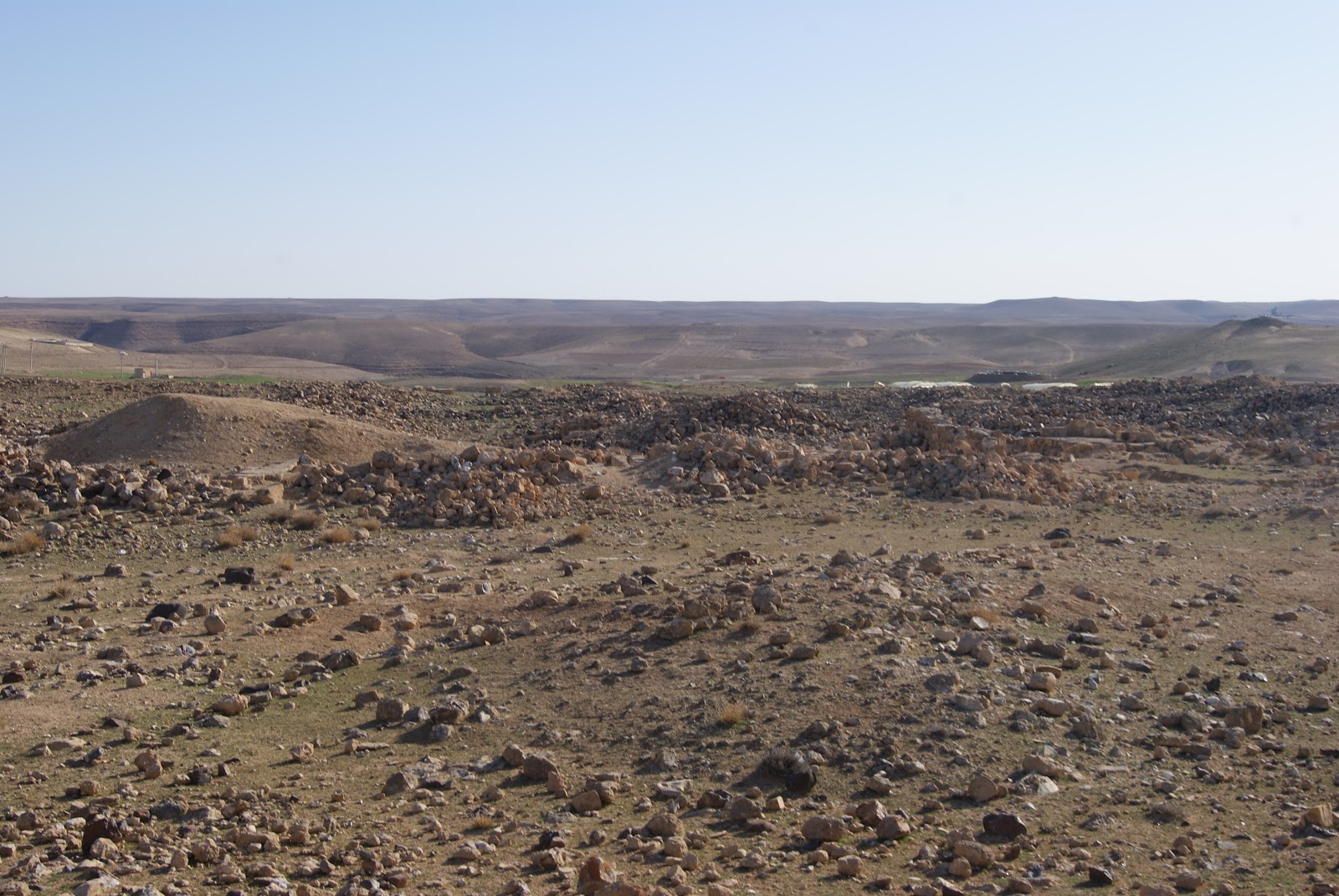
But it's also the case that access to water was important. Funnily enough, about two weeks before this trip I'd been in Vancouver giving a paper. During the talk I mentioned el-Lejjun, and someone asked me about its water supply after I'd finished. I didn't have a good answer, for it wasn't something I'd given much thought to beforehand. Given the desert conditions, I'd assumed the water had to come from somewhere. What I hadn't appreciated, however, was that each of the forts I visited was constructed with access to water well in mind. Some were adjacent to free-flowing water (or what had been free-flowing water). Note, for example, el-Lejjun below.

There was no obvious water source at Qasr Bshir (the wadi we crossed to reach the fort was dry), but the immediate environs of the fort itself was green, as you can see below.

Then those that were a bit removed from water sources had cisterns to store said water. Note, for instance, this re-purposed - and still in use - cistern from Umm el-Jimal, admittedly not solely a military site.

In many ways, then, visiting these sites reinforced some of the beliefs I'd already had about Roman decision making when it came to the construction of forts. But it also opened my eyes to others, especially when it came to water. Suffice to say, the trip has done its trip and more, and I have reams of data to process as a result.
Tuesday, 13 December 2016
Agathias, a Herodotus for the Age of Justinian
I've been slowly working my way through Agathias, reading the text, in translation I admit (though with the accompanying Greek text), much closer than I ever have before. Some of it I'd already gone through before, but this time I'm trying to soak it all in, so to speak, partially keeping my open for certain things, like evidence of combat motivation (for a paper) and military communities (again for a paper), but while also keeping my eyes open to interesting features. I've found more than a few, and as I near the end there are a few things stand out. I'd planned to discuss a few of them here, but the others, the careful crafting of his historian persona, his abundant (in comparison to Procopius) methodological statements, his interest in the personal or intimate anecdotes, and his interest in the sensory and the emotional will have to wait for another day, because I'm tired. So here, a couple of observations on his Herodotean proclivities.
For one, Agathias is, in many respects, far more Herodotean than I had appreciated before. Some time ago Averil Cameron went carefully through a set of supposed correspondences identified by Franke and highlighted some of the glaring problems. Much of what she said all that time ago makes a lot of sense. Some years later, Whitby (nb - former supervisor) highlighted, if briefly, Agathias' love of digressions. While I take Cameron's point, it's worth highlighting those digressions. While they might seem weird and unnecessary - Agathias has been criticized for spending too much time on things that matter too little - I think they do offer him a means of engaging more fully with his audience. He wants to show us what he knows, though more on that personal aspect in a second. It also gives him a chance to display his learning, while also adhering to the grand classical historical tradition. Digressions were important, and this was one of their distinctive features that he chose to pay attention to, in part because he knew what his strengths were.
Now the very fact that his longest of digressions concerns the Persians should be a red flag: he has Herodotus on his mind. Yes, it's also relevant. The most recent Persian war was drawing to a close, and the historian who professed to be succeeding, Procopius, had devoted considerable attention to them. But the most obvious ancient historian, for any late antique or Byzantine historian to my eyes, when Persians are the subject is Herodotus. That doesn't necessarily mean that he needed to flood his Persian-themed discussions with Herodotean-borrowings. In fact, it would be difficult, given Herodotus wrote in Ionian Greek and Agathias favoured the Atticizing Greek of Procopius and their predecessors. While there likely are a host of particular episodes in Herodotus that are paralleled in Agathias, I'm not so sure it has to be so exact.
There's one last Herodotean characteristic, a smaller one, admittedly, that I want to draw attention to. Agathias regularly presents two explanations or theories in his digressions. So, something along the lines of, some think this is the case, others think this is the case. Quite often, and possibly in the latter half in particular - though I'd have to check, it might just be my memory - Agathias will also finish a digression or extended discussion with something along the lines of, let the reader decide for him or herself how she feels. To me, that screams of Herodotus, more so than anything else. It'll do with some fleshing out, however.
So, his Herodotean-leanings deserve additional attention. Plus, it has me rethinking what I said about his Thucydidean-borrowings in a chapter that'll be out next year. Basically, I said he was less successful, by some margin, at the Thucydidean-style history than Procopius. While this hasn't changed my mind, I would, on further thought, have made greater emphasis on the possibility - lo likelihood - that this was ok, because that wasn't what he had in mind: Agathias didn't want to be a modern-day Thucydides, for Procopius had already done that. Indeed, he spends lots of time commending Procopius for what he's already done, and stressing what he'll do differently. Rather, Agathias, I'm starting to think, was much more interested in being a modern-day Herodotus.
For one, Agathias is, in many respects, far more Herodotean than I had appreciated before. Some time ago Averil Cameron went carefully through a set of supposed correspondences identified by Franke and highlighted some of the glaring problems. Much of what she said all that time ago makes a lot of sense. Some years later, Whitby (nb - former supervisor) highlighted, if briefly, Agathias' love of digressions. While I take Cameron's point, it's worth highlighting those digressions. While they might seem weird and unnecessary - Agathias has been criticized for spending too much time on things that matter too little - I think they do offer him a means of engaging more fully with his audience. He wants to show us what he knows, though more on that personal aspect in a second. It also gives him a chance to display his learning, while also adhering to the grand classical historical tradition. Digressions were important, and this was one of their distinctive features that he chose to pay attention to, in part because he knew what his strengths were.
Now the very fact that his longest of digressions concerns the Persians should be a red flag: he has Herodotus on his mind. Yes, it's also relevant. The most recent Persian war was drawing to a close, and the historian who professed to be succeeding, Procopius, had devoted considerable attention to them. But the most obvious ancient historian, for any late antique or Byzantine historian to my eyes, when Persians are the subject is Herodotus. That doesn't necessarily mean that he needed to flood his Persian-themed discussions with Herodotean-borrowings. In fact, it would be difficult, given Herodotus wrote in Ionian Greek and Agathias favoured the Atticizing Greek of Procopius and their predecessors. While there likely are a host of particular episodes in Herodotus that are paralleled in Agathias, I'm not so sure it has to be so exact.
There's one last Herodotean characteristic, a smaller one, admittedly, that I want to draw attention to. Agathias regularly presents two explanations or theories in his digressions. So, something along the lines of, some think this is the case, others think this is the case. Quite often, and possibly in the latter half in particular - though I'd have to check, it might just be my memory - Agathias will also finish a digression or extended discussion with something along the lines of, let the reader decide for him or herself how she feels. To me, that screams of Herodotus, more so than anything else. It'll do with some fleshing out, however.
So, his Herodotean-leanings deserve additional attention. Plus, it has me rethinking what I said about his Thucydidean-borrowings in a chapter that'll be out next year. Basically, I said he was less successful, by some margin, at the Thucydidean-style history than Procopius. While this hasn't changed my mind, I would, on further thought, have made greater emphasis on the possibility - lo likelihood - that this was ok, because that wasn't what he had in mind: Agathias didn't want to be a modern-day Thucydides, for Procopius had already done that. Indeed, he spends lots of time commending Procopius for what he's already done, and stressing what he'll do differently. Rather, Agathias, I'm starting to think, was much more interested in being a modern-day Herodotus.
Friday, 2 December 2016
War and the Plague in the Sixth Century (AD)
I've been going back over some material on the sixth-century plague in the past month or two, partially for another project (digital textbook), partially for this new (ish) research project, and partially out of interest. I've made Meier's new article (Early Medieval Europe 2016) bus reading, and so I've been slowly working my way through it, and definitely enjoying it. My bus trips are short, so I only ever get so far.
So far, just over halfway through, I think he's done a good job of summarizing earlier research - it's an excellent introduction as is to the subject - and is making some good points all the same. Earlier today, I came across his brief sections, lines even, on the effects of the plague on waging war. As he notes, this is an issue that hasn't been resolved.
Some hold that the plague had a significant impact on Rome's ability to wage war, let alone that of other states like Persia. This impacted everything from financing war to the paying of troops. The varied instances of military unrest that cropped up afterwards in places like Africa should be attributed to the lack of money to pay the men. Problems with recruitment too - Belisarius had to rely on finding men himself later during the war in Italy - would also come down to the impact of the plague. There simply weren't enough men.
Others, however, hold the opposite line. Rome was able to wage war on at least two fronts simultaneously during the outbreak of the plague, which would seem to minimize its impact on the empire's ability to wage war. The thinking goes: if plague really did have a significant impact on Justinian's military, how could they put 1000s of men in the field in Africa, Italy, Bulgaria, and Syria at the same time?
As noted, this is an issue that hasn't been resolved, and it's one that's interested me for a little while. Coming back to it again now, however, is it even possible to get any kind of resolution? Most importantly, how could we hope to measure the plague's direct impact on the state's ability to wage war? Our evidence isn't good enough, so far as I can tell, to indicate changes in the number of soldiers fighting for Rome before or after the plague took hold. There are a few big figures for the military as whole, and references to various armies by Procopius and others. But those are very much context specific, and there's often a lot of material that gets left out.
We also know little about the specifics of recruitment. There are a few pieces of legislation that get into recruitment, and some of this we can date with a good deal of precision. But the recruitment material is from the years before the plague broke out. It also tends to be about the process itself: these are the sorts of men who can and should be recruited, and this is what they should and should not do. It doesn't reveal anything, really, about where they might be from and what to do if men couldn't be found. There's no legislation that reveals any sort of crisis in recruitment in the middle years of the sixth century.
The truth is, the evidence, as a whole, is often ambiguous. While it might reveal things like damage, depopulation, financial instability, and mixed success in war, it doesn't connect these potential impacts of war to the wars themselves or the plague. For instance, was the Roman Empire in the 540s and 550s struggling in war so much because of the plague, or because it was engaged on so many different fronts? To take another example, Procopius spends a good deal of time on the impact of the plague on the empire in his famous passage. He also details the impact of the wars in his Wars and Secret History. What he doesn't do, however, is connect the plague to the mixed success at war. It could be because there was no connection. It could also be that he didn't realize that there was a connection. Or it could be that there was one that he recognized, but one he chose to ignore in favour of other explanations, like the evils of Justinian.
In short, there's no resolution yet for this problem, but I'm not sure we could ever get a definitive one. With that said, the best, I think, that we could hope for is an analysis of the indirect or circumstantial kind. There seems to be better evidence for the impact of the plague on other aspects of life, like the broader economy and rural agriculture. If we can establish its impact on all these other matters, it seems likely that it would have had an impact on the military too.
So far, just over halfway through, I think he's done a good job of summarizing earlier research - it's an excellent introduction as is to the subject - and is making some good points all the same. Earlier today, I came across his brief sections, lines even, on the effects of the plague on waging war. As he notes, this is an issue that hasn't been resolved.
Some hold that the plague had a significant impact on Rome's ability to wage war, let alone that of other states like Persia. This impacted everything from financing war to the paying of troops. The varied instances of military unrest that cropped up afterwards in places like Africa should be attributed to the lack of money to pay the men. Problems with recruitment too - Belisarius had to rely on finding men himself later during the war in Italy - would also come down to the impact of the plague. There simply weren't enough men.
Others, however, hold the opposite line. Rome was able to wage war on at least two fronts simultaneously during the outbreak of the plague, which would seem to minimize its impact on the empire's ability to wage war. The thinking goes: if plague really did have a significant impact on Justinian's military, how could they put 1000s of men in the field in Africa, Italy, Bulgaria, and Syria at the same time?
As noted, this is an issue that hasn't been resolved, and it's one that's interested me for a little while. Coming back to it again now, however, is it even possible to get any kind of resolution? Most importantly, how could we hope to measure the plague's direct impact on the state's ability to wage war? Our evidence isn't good enough, so far as I can tell, to indicate changes in the number of soldiers fighting for Rome before or after the plague took hold. There are a few big figures for the military as whole, and references to various armies by Procopius and others. But those are very much context specific, and there's often a lot of material that gets left out.
We also know little about the specifics of recruitment. There are a few pieces of legislation that get into recruitment, and some of this we can date with a good deal of precision. But the recruitment material is from the years before the plague broke out. It also tends to be about the process itself: these are the sorts of men who can and should be recruited, and this is what they should and should not do. It doesn't reveal anything, really, about where they might be from and what to do if men couldn't be found. There's no legislation that reveals any sort of crisis in recruitment in the middle years of the sixth century.
The truth is, the evidence, as a whole, is often ambiguous. While it might reveal things like damage, depopulation, financial instability, and mixed success in war, it doesn't connect these potential impacts of war to the wars themselves or the plague. For instance, was the Roman Empire in the 540s and 550s struggling in war so much because of the plague, or because it was engaged on so many different fronts? To take another example, Procopius spends a good deal of time on the impact of the plague on the empire in his famous passage. He also details the impact of the wars in his Wars and Secret History. What he doesn't do, however, is connect the plague to the mixed success at war. It could be because there was no connection. It could also be that he didn't realize that there was a connection. Or it could be that there was one that he recognized, but one he chose to ignore in favour of other explanations, like the evils of Justinian.
In short, there's no resolution yet for this problem, but I'm not sure we could ever get a definitive one. With that said, the best, I think, that we could hope for is an analysis of the indirect or circumstantial kind. There seems to be better evidence for the impact of the plague on other aspects of life, like the broader economy and rural agriculture. If we can establish its impact on all these other matters, it seems likely that it would have had an impact on the military too.
Subscribe to:
Posts (Atom)