I've been a bit overwhelmed, for lots of reasons. But, as I trudge on, I think I am making progress. In fact, the principal offshoot of my grant (SSHRC Insight Development Grant), one part of what was once conceived as one large book-length project and now three, is starting to take shape. In fact, I think I've found the ties that should bind it all together in a meaningful way. Given that I expect to start typing before too long, this seemed a good time to pause and write my thoughts/intentions down.
The overarching plan for the grant and now this book was to look at all three of Procopius' works in tandem with a focus on military matters, but more than the battles that occupied book one (and the thesis). The plan was to make my approach as holistic as possible, with Procopius serving as the foundation for all matters pertaining to war, from organization and strategy to logistics and tactics. As I plugged away, however, it started to seem that it was going to become something I'd rather it wasn't: a psuedo-commentary in which I went through all the key topics usually associated with military matters found in Procopius and evaluated them systematically. While that's important, it has the danger of forcing modern concepts or ideas on Procopius. And, it might be a bit dry: I'd rather there be some sort of thread underlining such an approach.
A number of years have passed since I started working on this, and a few things have influenced my thinking including my continued interest in the cultural approach to warfare, which I will likely address in some capacity or other in this book, world history, and in particular the sixth-century Roman state's place in the wider Eurasian world and how it was impacted by people to its west, north, east, and south, and its evidently evolving approach to warfare. Some significant publications have helped too, particularly Justinian's Codex, but also aspects of some of Anastasius' imperial edicts (a bit earlier, yes, but part of the same broader context).
What I've found is that the two central themes that tie the three works together, at least from the perspective I'm interested in, are defence and plunder. In the Secret History (SH) Procopius lambastes Justinian for, among other things, his greed and desire for money, his inability to protect the empire from plundering raids carried out by myriad peoples in the Balkans and the Near East, and the damage he wrought on newly conquered lands like North Africa and Italy, as well as those of the very people he's trying to protect the empire from, the assorted barbarians. In the Buildings (B), Procopius is obviously obsessed with Justinian's (alleged in parts) building programme, and much of it is connected with defence. Indeed, as Procopius sees it in the B, Justinian's job is to protect the empire, and this is done by means of both men and materiel. The B is, of course, filled with forts and fortified settlements, which Procopius alleges Justinian either built himself or repaired. While good questions have been raised about how much of this he actually effected, there's good reason to think that he did devote considerable attention to fortification work, as a host of studies have shown. As I suggested, however, he also regularly mentions the garrisons of these forts in the B, and he even implies that it's not enough to build fortifications, for they need men to man them. Then there's the Wars (W), and Procopius focuses on either defence or plunder depending on the context of a particular war. So, there's much more on defence in the PW than there is in the VW and GW. In fact, defensive-issues tend to surface in those latter two wars after Rome has managed to win, at least initially. The VW is rife with plundering Roman (or allied) soldiers. While it is not quite as prevalent in Italy, it remains a problem, as the actions of Bessas, for instance, illustrate.
I've only just given you the briefest of summaries: the final version will flesh out the details. Suffice to say, what we seem to have is a world rife with armies, Roman, Persian, and otherwise, eager for plunder, in which no one entity is greedier than another. Procopius' works, when read collectively, seem to agree, in some way or another, on this. Indeed, his perspective is understandably pro-Roman, but even he touches on the impact of Rome's actions in this regard on other places in both the W and SH. It's also become clear to me that Procopius' emphasis on the importance of a strong defensive outlook is reflected in much of our additional evidence, from inscriptions and papyri to the law and some of our other literary sources. There is, for instance, a strong undercurrent of fear that seems to pervade life (I've found), and Procopius, and Justinian, really, seems keen on countering this by means of defensive measures that provide safety and security. It's possible that that this climate of fear was constructed by Justinian, and I think that many feel that this was the case. What's less clear (and so new to me), I think, is that this extended to foreign affairs too, i.e. not only natural disasters and the social unrest that often plagued Constantinople.
Anyway, so that's it, or what I'm running with. The final version, obviously, will be much longer. Should add that once all this is finished a few years from now (that's all three parts), I'll be delighted to be free from Procopius. Not sure what I'd do next (I had something I now think I need a prolonged break, if not a clean break, from that former resident of Caesarea), but that's a few years away yet.
Friday, 9 June 2017

Thursday, 2 March 2017
Qasr el-Hallabat and the Edict of Anastasius
Last spring, an internal grant allowed me to make a grand tour of the UK, which included stops at Roman military sites, and some libraries (London, Oxford). At the Institute for Classical Studies Library in London, I spent some time pouring through its excellent collection of published volumes on epigraphy in late antiquity. One inscription I came across was the Edict of Anastasius found in Qasr el-Hallabat. I had already spent a bit of time reading about the similar edict (or one of several edicts) Anastasius had published at Perge, so coming across this other one was something of a boon. I made some notes, made a scan, and determined to come back to it at a later date. Needless to say, I would never have expected that I'd be able to visit Qasr el-Hallabat, an unknown entity to me in early May of 2016, only nine months later. I owe that opportunity to a major external grant I never imagined I'd get.
When in Jordan I put a visit of Qasr el-Hallabat near the top of my list. And on the fourth day, it was our first top, sometime after 8:30am. We were just about the only ones there, barring a few people working at the beautiful welcome centre. The site itself is some ways up from the centre, and it sits on a little plateau with spectacular views of the surrounding countryside.

Once I made it to the top I resolved to make a tour of the walls, which included a stop at the "Roman" crane in righthand side of the photo. I then plunged in, eager to find traces of the edict. Much of the structure, which at various times was an imperial-era (Roman) fort, a late antique quadriburgium, a monastery, and eventually an Umayyad (?) palace, had been reconstructed and reinforced. The presence of the crane suggests that more is planned. Among the many interesting things I stumbled across were yet more mosaics, in this case carefully protected behind a gate.
 If the mosaics are, roughly, in the eastern section of the structure, the fragments of the edict are in the southern section. Several pieces are fixed into the walls. Some were placed in the middle of other bricks, as below.

Some are placed with the letters oriented as they should be, like the photo above. In other spots, the letters are upside down.
 In yet others, the letters are sideways, and even partially cut off.
 As it happens, these fragments are, well, only a fraction of the original total, and by all accounts they seem to be in situ, at least with respect to the time when these blocks were fixed into these walls at el-Hallabat. Many more fragments, however, had toppled over, and though these particular fragments were visible to early excavators, those that had fallen over were not. Although I don't have any visual evidence for what the pile of rubble is likely to have looked like, there are other sites in Jordan, military ones too (it seems), that are overrun with blocks, and which are undoubtedly concealing all sorts of wonderful things. For instance, the fortress at the heart of the World Heritage Site of Umm er-Rasas is strewn with blocks.

This is in contrast to many of the surrounding structures, many of them churches, which are filled with incredible mosaics, like those below.
 Anyway, in good time many more fragments of the edict were recovered, and these have been fixed to a wall in the visitor centre. A picture of one of those fragments is below, with a shot of a good portion of the total below that.

 One feature that stands out about these fragments is their colour: it contrasts, sharply, with the limestone found in the modern visitor centre (above), and the majority of the blocks in the reconstructed structure. A little detective work determined that these blocks had likely come from Umm el-Jimal, some 20km down the road (a fair distance by car, as it happens), and just south of the modern border with Syria (and not far from a Syrian refugee camp incidentally). Umm el-Jimal, a remarkable site itself, and with hardly a visitor, me aside, is filled with these black basalt blocks. Note, for instance, the photos below, the first a shot of the town, the second a larger house/villa.

 Archaeologists four blocks from the larger edict at Umm el-Jimal, and largely on that basis (and the coloration), it seems likely the edict was initially posted at this larger, and seemingly more prominent centre. Umm el-Jimal was at the halfway point (roughly) on the road between Bosra and Gerasa, unlike Qasr el-Hallabat. A copy of the edict is posted on a wall on the visitor centre at Umm el-Jimal.
 Now, we don't know where the edict was originally posted, though the suggestion that it was posted at the praetorium (headquarters) at Umm el-Jimal, which happens to be near the main gate to the town, seems sensible enough. At present work continues on the edict. Professor Denis Feissel, along with Drs. Ignacio Arce and Thomas Weber, have been working away, and it seems that a complete edition will be published before long (a precis http://www.klassische-archaeologie.uni-mainz.de/Bilder_allgemein/Hallabat_Report_2013_2014Final-lightVersion.pdf I found of theirs forms the basis for this post). Regrettably, the easily accessible (free, online) version of the text contains only a portion of the total - fragments discovered later have filled out our picture of the original, though 20% of the total remains lost. You can see that earlier version on the link below.
http://epigraphy.packhum.org/text/321948?hs=96-108
A majority of the fragments remain at Qasr el-Hallabat. Some more are scattered at Umm el-Jimal, and assorted museums, universities, and military (contemporary) mess halls in Jordan. It's hard to overstate the importance of this text. While there are other comparable edicts from Anastasius, including an English translation of a comparable edict found at Cyrenaica (Libya) below, this particular edict seems particularly important for some of the administrative and military-organizational changes implemented by the emperor.
https://books.google.ca/books?id=zBurLat60hIC&pg=PA253&lpg=PA253&dq=ancient+roman+statutes+anastasius+libya&source=bl&ots=gfQoq-N-ZX&sig=hLO_M4YB4rAu4hrrgrKHoNLYb98&hl=en&sa=X&ved=0ahUKEwiIlpKE7bjSAhVB9YMKHeH2CCkQ6AEIHzAA#v=onepage&q=ancient%20roman%20statutes%20anastasius%20libya&f=false
We are told, for instance, that this edict, covers a number of issues ranging from the salary of dukes and assorted branches of the military administration in the east, to the regulations regarding soldiers unfit for service and the requirement that public money for churches not be funnelled to military issues. Needless to say, I eagerly the publication of this edict, and for the time being will content myself on working my way through the currently published portion of the text.
When in Jordan I put a visit of Qasr el-Hallabat near the top of my list. And on the fourth day, it was our first top, sometime after 8:30am. We were just about the only ones there, barring a few people working at the beautiful welcome centre. The site itself is some ways up from the centre, and it sits on a little plateau with spectacular views of the surrounding countryside.

Once I made it to the top I resolved to make a tour of the walls, which included a stop at the "Roman" crane in righthand side of the photo. I then plunged in, eager to find traces of the edict. Much of the structure, which at various times was an imperial-era (Roman) fort, a late antique quadriburgium, a monastery, and eventually an Umayyad (?) palace, had been reconstructed and reinforced. The presence of the crane suggests that more is planned. Among the many interesting things I stumbled across were yet more mosaics, in this case carefully protected behind a gate.


This is in contrast to many of the surrounding structures, many of them churches, which are filled with incredible mosaics, like those below.


http://epigraphy.packhum.org/text/321948?hs=96-108
A majority of the fragments remain at Qasr el-Hallabat. Some more are scattered at Umm el-Jimal, and assorted museums, universities, and military (contemporary) mess halls in Jordan. It's hard to overstate the importance of this text. While there are other comparable edicts from Anastasius, including an English translation of a comparable edict found at Cyrenaica (Libya) below, this particular edict seems particularly important for some of the administrative and military-organizational changes implemented by the emperor.
https://books.google.ca/books?id=zBurLat60hIC&pg=PA253&lpg=PA253&dq=ancient+roman+statutes+anastasius+libya&source=bl&ots=gfQoq-N-ZX&sig=hLO_M4YB4rAu4hrrgrKHoNLYb98&hl=en&sa=X&ved=0ahUKEwiIlpKE7bjSAhVB9YMKHeH2CCkQ6AEIHzAA#v=onepage&q=ancient%20roman%20statutes%20anastasius%20libya&f=false
We are told, for instance, that this edict, covers a number of issues ranging from the salary of dukes and assorted branches of the military administration in the east, to the regulations regarding soldiers unfit for service and the requirement that public money for churches not be funnelled to military issues. Needless to say, I eagerly the publication of this edict, and for the time being will content myself on working my way through the currently published portion of the text.
Tuesday, 28 February 2017
Water and Frontiers in Roman Jordan
I just got back from a short visit to Jordan. It took me just under a day to get there. I had five full days visiting the sites. And then just over a day to get back home. I took between 1500 and 2000 photos (the total eludes me because of some copying errors), which I plan to use in a host of publications. Though brief, the trip was incredible. So much so, in fact, that I'm pretty sure I want to shift my focus more squarely to Roman Jordan.
It's fair to say I've loved (or at least really, really liked) the Near East for some decades now. In the early days of my indoctrination in Classics, I even contemplated shifting to Near Eastern studies, and Assyriology in particular. I was spurred, in part, by my first visit to the British Museum in 1999, when I saw the incredible Assyrian frieze. It was only the relatively limited options for Assyriologists that kept me away.
But there's more. For a few years when I was little (1983 and 1986 - I was born in 1978), we lived in Saudi Arabia, first in Tabuk in the northwest, then in Dhahdran/al-Damman in the southeast. While there, we visited Jordan and Egypt. Somewhat surprisingly, many years later my parents returned to the Middle East, only in this case to the UAE, first Abu Dhabi, and for several years now Dubai. There is, then, good reason for this personal affection for the Middle East.
Coming to Jordan now, however, after I've managed to make a career (or at least started one) as an ancient historian/Classicist/Byzantinist, made the visit all that much more special, especially given that I've done some work on the area, and have desired doing more. To see, then, some of the sites I've written about and/or studied as an undergraduate and graduate student was fantastic.
The intention of the visit was to visit as many Roman military sites as possible, and I managed to make it to Petra (honorable mention on the military front - inscriptions, papyri), Udruh, el-Lejjun, Qasr-Bshir, Umm er-Resas, Qasr el-Hallabat, and Umm el-Jimal. I missed quite a few, and hope to see some of those next year, in addition to some of the ones I've already seen.
One of the purposes of the visit was to get a sense of Roman strategic sense in the choosing of these sites. It's a big issue that's attracted a good deal of attention thanks in part to the work of Luttwak, Whittaker, and Isaac on frontiers more generally, and Parker, Mayerson, and Graf on the southeast frontier more specifically. It is, admittedly, hard to know why certain sites were chosen, particularly new ones like el-Lejjun, which weren't occupied beforehand, unlike, say, Udruh, the history of which seems to stretch back to the Nabataean age. We don't, really, have documents that explain their decisions, so scholars have tried to figure this out by means of evaluating the locations of the forts and fortifications themselves, and careful analysis of what documentary and literary evidence of relevance we have.
I've visited Roman military sites in the opposite frontier before, namely Roman Britain, particularly along Hadrian's Wall. Of the few that I've seen, it can sometimes be difficult to tell why particular places were chosen. Roman Britain, however, is another story - and I think I would need to visit them all to really appreciate the British context. The same's true for what little I've seen myself of Roman Bulgaria, though what I did see suggests to me that crossing points played a big part.
Having now visited these few in Jordan, one of the last of Rome's frontiers, it seems careful consideration was given to sight-lines and general visibility, and access to water. First, the site lines. I've attached below some photos of select views from some of the fortresses I visited. Udruh, el-Lejjun, Qasr-Bshir, Umm er-Resas, and Qasr el-Hallabat all offer excellent views of the surrounding countryside in all or most directions. This is especially true of Qasr Bhsir (top) and Qasr el-Hallabat (bottom).


But this is also true, to a large degree, of Udruh (top) and el-Lejjun (bottom), two late Roman legionary sites of roughly the same size.


But it's also the case that access to water was important. Funnily enough, about two weeks before this trip I'd been in Vancouver giving a paper. During the talk I mentioned el-Lejjun, and someone asked me about its water supply after I'd finished. I didn't have a good answer, for it wasn't something I'd given much thought to beforehand. Given the desert conditions, I'd assumed the water had to come from somewhere. What I hadn't appreciated, however, was that each of the forts I visited was constructed with access to water well in mind. Some were adjacent to free-flowing water (or what had been free-flowing water). Note, for example, el-Lejjun below.

There was no obvious water source at Qasr Bshir (the wadi we crossed to reach the fort was dry), but the immediate environs of the fort itself was green, as you can see below.

Then those that were a bit removed from water sources had cisterns to store said water. Note, for instance, this re-purposed - and still in use - cistern from Umm el-Jimal, admittedly not solely a military site.

In many ways, then, visiting these sites reinforced some of the beliefs I'd already had about Roman decision making when it came to the construction of forts. But it also opened my eyes to others, especially when it came to water. Suffice to say, the trip has done its trip and more, and I have reams of data to process as a result.
It's fair to say I've loved (or at least really, really liked) the Near East for some decades now. In the early days of my indoctrination in Classics, I even contemplated shifting to Near Eastern studies, and Assyriology in particular. I was spurred, in part, by my first visit to the British Museum in 1999, when I saw the incredible Assyrian frieze. It was only the relatively limited options for Assyriologists that kept me away.
But there's more. For a few years when I was little (1983 and 1986 - I was born in 1978), we lived in Saudi Arabia, first in Tabuk in the northwest, then in Dhahdran/al-Damman in the southeast. While there, we visited Jordan and Egypt. Somewhat surprisingly, many years later my parents returned to the Middle East, only in this case to the UAE, first Abu Dhabi, and for several years now Dubai. There is, then, good reason for this personal affection for the Middle East.
Coming to Jordan now, however, after I've managed to make a career (or at least started one) as an ancient historian/Classicist/Byzantinist, made the visit all that much more special, especially given that I've done some work on the area, and have desired doing more. To see, then, some of the sites I've written about and/or studied as an undergraduate and graduate student was fantastic.
The intention of the visit was to visit as many Roman military sites as possible, and I managed to make it to Petra (honorable mention on the military front - inscriptions, papyri), Udruh, el-Lejjun, Qasr-Bshir, Umm er-Resas, Qasr el-Hallabat, and Umm el-Jimal. I missed quite a few, and hope to see some of those next year, in addition to some of the ones I've already seen.
One of the purposes of the visit was to get a sense of Roman strategic sense in the choosing of these sites. It's a big issue that's attracted a good deal of attention thanks in part to the work of Luttwak, Whittaker, and Isaac on frontiers more generally, and Parker, Mayerson, and Graf on the southeast frontier more specifically. It is, admittedly, hard to know why certain sites were chosen, particularly new ones like el-Lejjun, which weren't occupied beforehand, unlike, say, Udruh, the history of which seems to stretch back to the Nabataean age. We don't, really, have documents that explain their decisions, so scholars have tried to figure this out by means of evaluating the locations of the forts and fortifications themselves, and careful analysis of what documentary and literary evidence of relevance we have.
I've visited Roman military sites in the opposite frontier before, namely Roman Britain, particularly along Hadrian's Wall. Of the few that I've seen, it can sometimes be difficult to tell why particular places were chosen. Roman Britain, however, is another story - and I think I would need to visit them all to really appreciate the British context. The same's true for what little I've seen myself of Roman Bulgaria, though what I did see suggests to me that crossing points played a big part.
Having now visited these few in Jordan, one of the last of Rome's frontiers, it seems careful consideration was given to sight-lines and general visibility, and access to water. First, the site lines. I've attached below some photos of select views from some of the fortresses I visited. Udruh, el-Lejjun, Qasr-Bshir, Umm er-Resas, and Qasr el-Hallabat all offer excellent views of the surrounding countryside in all or most directions. This is especially true of Qasr Bhsir (top) and Qasr el-Hallabat (bottom).


But this is also true, to a large degree, of Udruh (top) and el-Lejjun (bottom), two late Roman legionary sites of roughly the same size.

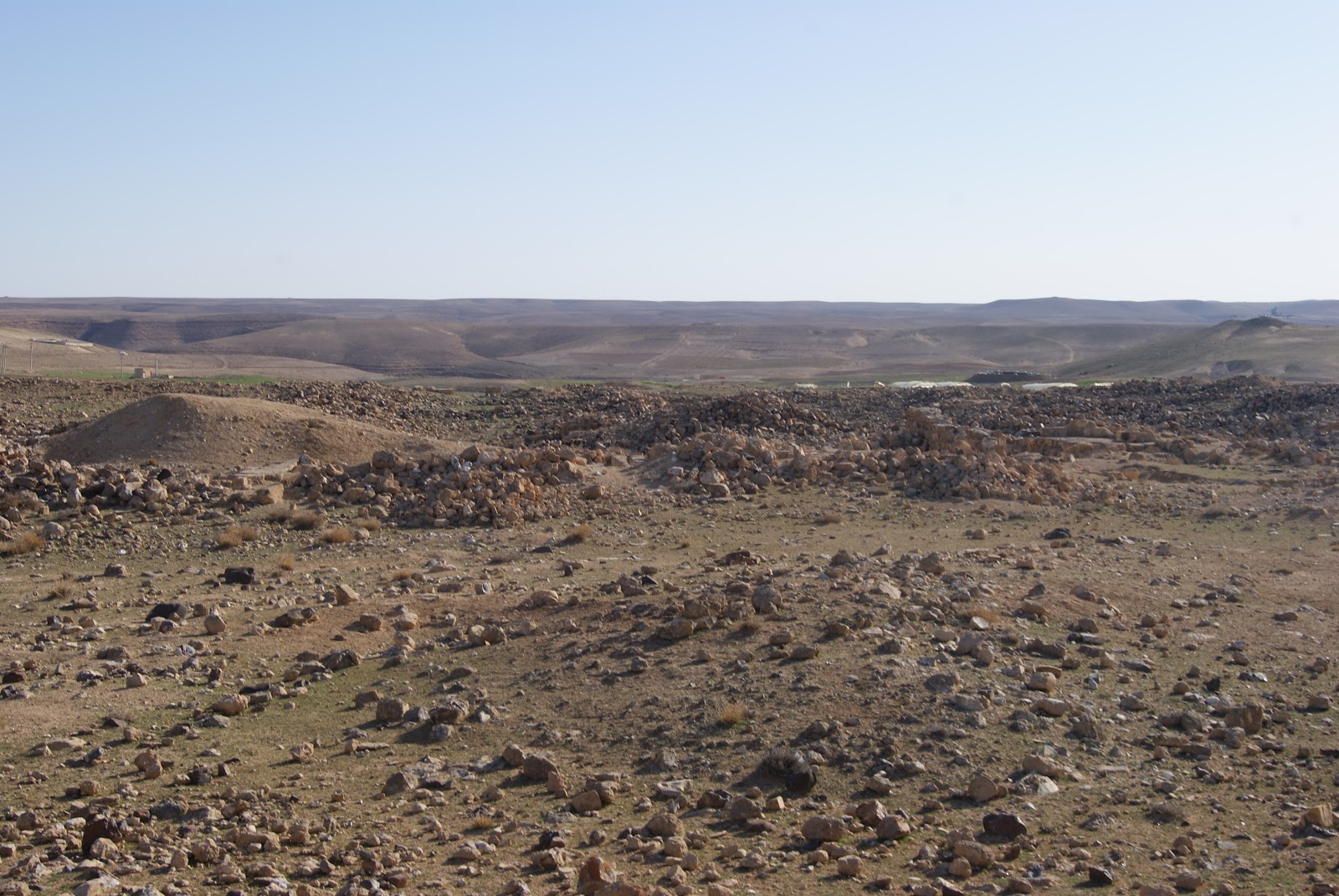
But it's also the case that access to water was important. Funnily enough, about two weeks before this trip I'd been in Vancouver giving a paper. During the talk I mentioned el-Lejjun, and someone asked me about its water supply after I'd finished. I didn't have a good answer, for it wasn't something I'd given much thought to beforehand. Given the desert conditions, I'd assumed the water had to come from somewhere. What I hadn't appreciated, however, was that each of the forts I visited was constructed with access to water well in mind. Some were adjacent to free-flowing water (or what had been free-flowing water). Note, for example, el-Lejjun below.

There was no obvious water source at Qasr Bshir (the wadi we crossed to reach the fort was dry), but the immediate environs of the fort itself was green, as you can see below.

Then those that were a bit removed from water sources had cisterns to store said water. Note, for instance, this re-purposed - and still in use - cistern from Umm el-Jimal, admittedly not solely a military site.

In many ways, then, visiting these sites reinforced some of the beliefs I'd already had about Roman decision making when it came to the construction of forts. But it also opened my eyes to others, especially when it came to water. Suffice to say, the trip has done its trip and more, and I have reams of data to process as a result.
Tuesday, 13 December 2016
Agathias, a Herodotus for the Age of Justinian
I've been slowly working my way through Agathias, reading the text, in translation I admit (though with the accompanying Greek text), much closer than I ever have before. Some of it I'd already gone through before, but this time I'm trying to soak it all in, so to speak, partially keeping my open for certain things, like evidence of combat motivation (for a paper) and military communities (again for a paper), but while also keeping my eyes open to interesting features. I've found more than a few, and as I near the end there are a few things stand out. I'd planned to discuss a few of them here, but the others, the careful crafting of his historian persona, his abundant (in comparison to Procopius) methodological statements, his interest in the personal or intimate anecdotes, and his interest in the sensory and the emotional will have to wait for another day, because I'm tired. So here, a couple of observations on his Herodotean proclivities.
For one, Agathias is, in many respects, far more Herodotean than I had appreciated before. Some time ago Averil Cameron went carefully through a set of supposed correspondences identified by Franke and highlighted some of the glaring problems. Much of what she said all that time ago makes a lot of sense. Some years later, Whitby (nb - former supervisor) highlighted, if briefly, Agathias' love of digressions. While I take Cameron's point, it's worth highlighting those digressions. While they might seem weird and unnecessary - Agathias has been criticized for spending too much time on things that matter too little - I think they do offer him a means of engaging more fully with his audience. He wants to show us what he knows, though more on that personal aspect in a second. It also gives him a chance to display his learning, while also adhering to the grand classical historical tradition. Digressions were important, and this was one of their distinctive features that he chose to pay attention to, in part because he knew what his strengths were.
Now the very fact that his longest of digressions concerns the Persians should be a red flag: he has Herodotus on his mind. Yes, it's also relevant. The most recent Persian war was drawing to a close, and the historian who professed to be succeeding, Procopius, had devoted considerable attention to them. But the most obvious ancient historian, for any late antique or Byzantine historian to my eyes, when Persians are the subject is Herodotus. That doesn't necessarily mean that he needed to flood his Persian-themed discussions with Herodotean-borrowings. In fact, it would be difficult, given Herodotus wrote in Ionian Greek and Agathias favoured the Atticizing Greek of Procopius and their predecessors. While there likely are a host of particular episodes in Herodotus that are paralleled in Agathias, I'm not so sure it has to be so exact.
There's one last Herodotean characteristic, a smaller one, admittedly, that I want to draw attention to. Agathias regularly presents two explanations or theories in his digressions. So, something along the lines of, some think this is the case, others think this is the case. Quite often, and possibly in the latter half in particular - though I'd have to check, it might just be my memory - Agathias will also finish a digression or extended discussion with something along the lines of, let the reader decide for him or herself how she feels. To me, that screams of Herodotus, more so than anything else. It'll do with some fleshing out, however.
So, his Herodotean-leanings deserve additional attention. Plus, it has me rethinking what I said about his Thucydidean-borrowings in a chapter that'll be out next year. Basically, I said he was less successful, by some margin, at the Thucydidean-style history than Procopius. While this hasn't changed my mind, I would, on further thought, have made greater emphasis on the possibility - lo likelihood - that this was ok, because that wasn't what he had in mind: Agathias didn't want to be a modern-day Thucydides, for Procopius had already done that. Indeed, he spends lots of time commending Procopius for what he's already done, and stressing what he'll do differently. Rather, Agathias, I'm starting to think, was much more interested in being a modern-day Herodotus.
For one, Agathias is, in many respects, far more Herodotean than I had appreciated before. Some time ago Averil Cameron went carefully through a set of supposed correspondences identified by Franke and highlighted some of the glaring problems. Much of what she said all that time ago makes a lot of sense. Some years later, Whitby (nb - former supervisor) highlighted, if briefly, Agathias' love of digressions. While I take Cameron's point, it's worth highlighting those digressions. While they might seem weird and unnecessary - Agathias has been criticized for spending too much time on things that matter too little - I think they do offer him a means of engaging more fully with his audience. He wants to show us what he knows, though more on that personal aspect in a second. It also gives him a chance to display his learning, while also adhering to the grand classical historical tradition. Digressions were important, and this was one of their distinctive features that he chose to pay attention to, in part because he knew what his strengths were.
Now the very fact that his longest of digressions concerns the Persians should be a red flag: he has Herodotus on his mind. Yes, it's also relevant. The most recent Persian war was drawing to a close, and the historian who professed to be succeeding, Procopius, had devoted considerable attention to them. But the most obvious ancient historian, for any late antique or Byzantine historian to my eyes, when Persians are the subject is Herodotus. That doesn't necessarily mean that he needed to flood his Persian-themed discussions with Herodotean-borrowings. In fact, it would be difficult, given Herodotus wrote in Ionian Greek and Agathias favoured the Atticizing Greek of Procopius and their predecessors. While there likely are a host of particular episodes in Herodotus that are paralleled in Agathias, I'm not so sure it has to be so exact.
There's one last Herodotean characteristic, a smaller one, admittedly, that I want to draw attention to. Agathias regularly presents two explanations or theories in his digressions. So, something along the lines of, some think this is the case, others think this is the case. Quite often, and possibly in the latter half in particular - though I'd have to check, it might just be my memory - Agathias will also finish a digression or extended discussion with something along the lines of, let the reader decide for him or herself how she feels. To me, that screams of Herodotus, more so than anything else. It'll do with some fleshing out, however.
So, his Herodotean-leanings deserve additional attention. Plus, it has me rethinking what I said about his Thucydidean-borrowings in a chapter that'll be out next year. Basically, I said he was less successful, by some margin, at the Thucydidean-style history than Procopius. While this hasn't changed my mind, I would, on further thought, have made greater emphasis on the possibility - lo likelihood - that this was ok, because that wasn't what he had in mind: Agathias didn't want to be a modern-day Thucydides, for Procopius had already done that. Indeed, he spends lots of time commending Procopius for what he's already done, and stressing what he'll do differently. Rather, Agathias, I'm starting to think, was much more interested in being a modern-day Herodotus.
Friday, 2 December 2016
War and the Plague in the Sixth Century (AD)
I've been going back over some material on the sixth-century plague in the past month or two, partially for another project (digital textbook), partially for this new (ish) research project, and partially out of interest. I've made Meier's new article (Early Medieval Europe 2016) bus reading, and so I've been slowly working my way through it, and definitely enjoying it. My bus trips are short, so I only ever get so far.
So far, just over halfway through, I think he's done a good job of summarizing earlier research - it's an excellent introduction as is to the subject - and is making some good points all the same. Earlier today, I came across his brief sections, lines even, on the effects of the plague on waging war. As he notes, this is an issue that hasn't been resolved.
Some hold that the plague had a significant impact on Rome's ability to wage war, let alone that of other states like Persia. This impacted everything from financing war to the paying of troops. The varied instances of military unrest that cropped up afterwards in places like Africa should be attributed to the lack of money to pay the men. Problems with recruitment too - Belisarius had to rely on finding men himself later during the war in Italy - would also come down to the impact of the plague. There simply weren't enough men.
Others, however, hold the opposite line. Rome was able to wage war on at least two fronts simultaneously during the outbreak of the plague, which would seem to minimize its impact on the empire's ability to wage war. The thinking goes: if plague really did have a significant impact on Justinian's military, how could they put 1000s of men in the field in Africa, Italy, Bulgaria, and Syria at the same time?
As noted, this is an issue that hasn't been resolved, and it's one that's interested me for a little while. Coming back to it again now, however, is it even possible to get any kind of resolution? Most importantly, how could we hope to measure the plague's direct impact on the state's ability to wage war? Our evidence isn't good enough, so far as I can tell, to indicate changes in the number of soldiers fighting for Rome before or after the plague took hold. There are a few big figures for the military as whole, and references to various armies by Procopius and others. But those are very much context specific, and there's often a lot of material that gets left out.
We also know little about the specifics of recruitment. There are a few pieces of legislation that get into recruitment, and some of this we can date with a good deal of precision. But the recruitment material is from the years before the plague broke out. It also tends to be about the process itself: these are the sorts of men who can and should be recruited, and this is what they should and should not do. It doesn't reveal anything, really, about where they might be from and what to do if men couldn't be found. There's no legislation that reveals any sort of crisis in recruitment in the middle years of the sixth century.
The truth is, the evidence, as a whole, is often ambiguous. While it might reveal things like damage, depopulation, financial instability, and mixed success in war, it doesn't connect these potential impacts of war to the wars themselves or the plague. For instance, was the Roman Empire in the 540s and 550s struggling in war so much because of the plague, or because it was engaged on so many different fronts? To take another example, Procopius spends a good deal of time on the impact of the plague on the empire in his famous passage. He also details the impact of the wars in his Wars and Secret History. What he doesn't do, however, is connect the plague to the mixed success at war. It could be because there was no connection. It could also be that he didn't realize that there was a connection. Or it could be that there was one that he recognized, but one he chose to ignore in favour of other explanations, like the evils of Justinian.
In short, there's no resolution yet for this problem, but I'm not sure we could ever get a definitive one. With that said, the best, I think, that we could hope for is an analysis of the indirect or circumstantial kind. There seems to be better evidence for the impact of the plague on other aspects of life, like the broader economy and rural agriculture. If we can establish its impact on all these other matters, it seems likely that it would have had an impact on the military too.
So far, just over halfway through, I think he's done a good job of summarizing earlier research - it's an excellent introduction as is to the subject - and is making some good points all the same. Earlier today, I came across his brief sections, lines even, on the effects of the plague on waging war. As he notes, this is an issue that hasn't been resolved.
Some hold that the plague had a significant impact on Rome's ability to wage war, let alone that of other states like Persia. This impacted everything from financing war to the paying of troops. The varied instances of military unrest that cropped up afterwards in places like Africa should be attributed to the lack of money to pay the men. Problems with recruitment too - Belisarius had to rely on finding men himself later during the war in Italy - would also come down to the impact of the plague. There simply weren't enough men.
Others, however, hold the opposite line. Rome was able to wage war on at least two fronts simultaneously during the outbreak of the plague, which would seem to minimize its impact on the empire's ability to wage war. The thinking goes: if plague really did have a significant impact on Justinian's military, how could they put 1000s of men in the field in Africa, Italy, Bulgaria, and Syria at the same time?
As noted, this is an issue that hasn't been resolved, and it's one that's interested me for a little while. Coming back to it again now, however, is it even possible to get any kind of resolution? Most importantly, how could we hope to measure the plague's direct impact on the state's ability to wage war? Our evidence isn't good enough, so far as I can tell, to indicate changes in the number of soldiers fighting for Rome before or after the plague took hold. There are a few big figures for the military as whole, and references to various armies by Procopius and others. But those are very much context specific, and there's often a lot of material that gets left out.
We also know little about the specifics of recruitment. There are a few pieces of legislation that get into recruitment, and some of this we can date with a good deal of precision. But the recruitment material is from the years before the plague broke out. It also tends to be about the process itself: these are the sorts of men who can and should be recruited, and this is what they should and should not do. It doesn't reveal anything, really, about where they might be from and what to do if men couldn't be found. There's no legislation that reveals any sort of crisis in recruitment in the middle years of the sixth century.
The truth is, the evidence, as a whole, is often ambiguous. While it might reveal things like damage, depopulation, financial instability, and mixed success in war, it doesn't connect these potential impacts of war to the wars themselves or the plague. For instance, was the Roman Empire in the 540s and 550s struggling in war so much because of the plague, or because it was engaged on so many different fronts? To take another example, Procopius spends a good deal of time on the impact of the plague on the empire in his famous passage. He also details the impact of the wars in his Wars and Secret History. What he doesn't do, however, is connect the plague to the mixed success at war. It could be because there was no connection. It could also be that he didn't realize that there was a connection. Or it could be that there was one that he recognized, but one he chose to ignore in favour of other explanations, like the evils of Justinian.
In short, there's no resolution yet for this problem, but I'm not sure we could ever get a definitive one. With that said, the best, I think, that we could hope for is an analysis of the indirect or circumstantial kind. There seems to be better evidence for the impact of the plague on other aspects of life, like the broader economy and rural agriculture. If we can establish its impact on all these other matters, it seems likely that it would have had an impact on the military too.
Thursday, 1 December 2016
Procopius, War, and the Law
One of the
biggest surprises of the summer was receiving a grant for a research project on
more sixth-century things. I’ve applied
for all sorts of grants over the years, and generally been unsuccessful. I’d all but dismissed my chances of getting this
one until I received the shocking notice.
The grant is,
effectively, for a book that will be the follow-up to Procopius book one, and
it will look more at the history side than the historiographical one. That means Procopius is still important, but
he’s one part of a whole, with the other part/s occupied by the archaeological,
epigraphic, legal, and papyrological evidence.
It also entails considering, at least to some degree, the other literary
evidence. Ultimately the book will
provide something of a commentary on how Procopius deals with war in the sixth
century, with the discussion ranging from military organization to planning and
logistics, and even how war was fought.
The book
will offer a holistic approach, and we’re fortunate in that the age of
Justinian is so well documented, perhaps more so than just about every other
period of the ancient or late antique worlds, at least in my opinion. The catch is that the voluminous evidence
doesn’t always cover the same affairs, and this is particularly true for military
matters. There are, for instance, some
detailed reports on fortifications in Jordan and Bulgaria, but scarce reports
on those same structures in our surviving literary evidence. We have detailed descriptions of battles from
Procopius and some other authors, but little in the way of surviving
weaponry. This means we can’t always
compare this disparate material, and trying to make sense of all of it can be a
bit of a challenge. The danger, lo
temptation, too is trying to make all the pieces fit together, when, in reality,
the pieces come from different puzzles. Still,
one of the great thrills of this project is that it’s given me the opportunity
to dabble into all sorts of other kinds of evidence that I’ve paid less
attention to in the past.
To this point,
when I haven’t been embroiled in all sorts of other work matters, I’ve been concentrating
a great deal on the other evidence. I’ve
discovered, for instance, that there is far more epigraphic evidence for military
matters in the sixth century than I’d previously believed. While we’re nowhere near the epigraphic
heights of the first two centuries AD, there are a few inscriptions in Latin
that either mention Justinian, a general, and assorted other commanders as well
some military units. There are even more
Greek ones. Many of these have only a tangential
bearing on my project, for most of the war-related ones have more to say about
war’s impact than about how it is waged, and I’m starting to think I won’t be
able to get into those matters. There’s
also the Anastasius edict, which I’d only been vaguely familiar with
before. I certainly hadn’t realized what
a fabulous document it is.
In fact, I
feel fortunate that there are so many wonderful research tools at our disposal
now, from the two excellent epigraphic databases (for Greek and Latin), to the
papyrological one, and the TLG, which does require access to a research library
of some capacity or other.
We also now
have the wonderful text and translation of the Justinianic Codex, and the grant allowed me to buy a copy. I’ve been looking at this legal material in
more depth than I ever have before, and it’s forced me to come to grips with
what is quite a substantial body evidence, and one that’s been scarcely applied
to the military sphere, especially in the sixth century, apart from Jones. So far it’s posing all sorts of interesting questions
for me. For one thing, there’s a
staggering amount of legislation, and it seems aspiring lawyers would have had
to understand, even know, just about all of it.
If Procopius himself had been a lawyer, and I think he had, this means
that he too would have had to have been intimately familiar with the material. It turns out too that assessors were tasked
with knowing the law, and even providing guidance to judges who might require
assistance.
If
Procopius was both a lawyer and an assessor, this in itself raises interesting
questions about Procopius’ practices as an historian, but also what or who was considered
an essential part of an army. Surely
Procopius wasn’t the only assessor acting in a military environment, just the
only one who wrote quite so much and so well.
It also raises questions about the long reach of Justinian, and how
exactly Procopius might have got the job.
Were generals assigned assessors by Justinian so that he could, in some
ways, keep a check on the generals?
Maybe not directly, but indirectly.
In other words, were the generals expected to follow the letter of the
law as dictated by Justinian, and were they assigned assessors to ensure that
this happened? It seems unlikely, perhaps, but then quite a lot of the legislation
found in the Corpus Iuris Civilis that
specifically concerns military matters actually deals with what could be
considered property duties and expectations of generals and the like.
The legal
material also has me wondering if it, in some way, should be considered an
ideal: this is how things should be, in
Justinian’s eyes. How often would they
work that way in practice? And for my
purposes (military stuff), can Procopius provide evidence for this? Is the law in some sense the rhetoric, and
what Procopius describes the reality?
Anyway,
there’s a lot to chew on, and quite a bit more to digest, so I hope to provide
more posts in the coming months.
Thursday, 26 May 2016
Roman Military Kaibos (i.e. loos)
One of the biggest surprises
of my tour of select Roman military sites on the British frontier/s has been
coming across the "prominently" placed, and often signposted, Roman
military loos (in Britain, so loos). Of course, there had to be a place
where people did numbers ones and number twos, but in normal conversation or
discussion - at least in my experiences in class and in the course of my
research - it's not something that's entered my stream (pun intended) of
consciousness. Toilets have come occasionally, or rarely even, in my
preparation in years past for the UofW's Roman Society course. It's
always fun too to bring up the famed bleaching of Roman togas, for which we
have such great evidence from Pompeii. Indeed, I remember learning all
about it in my 4th year honours seminar class on Pompeii at Mac.
Anyway, point is it's come up on occasion, I know it had to be there (in the back of my mind), but I hadn't given much thought beyond that. I've come across five Roman military loos on this comparably short and condensed tour: one at Caerleon in Wales, one at Chesters in England, one at Housesteads in England, and one at Arbeia in England. Evidently too, though I haven't seen it myself, they've found a wooden "posh" toilet seat at Vindolanda. What's familiar about seeing what few "seats" we've found is that the shape is basically the same that you find in most toilets, at least in the west, today. What's less familiar, again in the west, save for those troughs you find in so many UK mens' toilets, is the public aspect of the urination and defecation. Some of us don't have any trouble doing the duty in the presence of others; others of us, myself included, like to keep our number ones and numbers twos on the down-loo. In the Roman forts, however, at least those that I've seen, the common soldiers are more often than not going to be doing the business - how many euphemisms can I use? - in the presence of their comrades. Sure, we can't prove that those long-dead Roman soldiers who shared my views didn't go off into the middle of the woods to do their thing, but I'm guessing given various rules and regulations surrounding movement into and out of a fort on duty, this might have been more difficult to do.
Ultimately, this public pooing raises all sorts of interesting questions. For one thing, from the perspective of the sensory experience of Roman life, it's not hard to imagine what it might have been like. If you've ever had some experience of port-o-johns, as they called them in my youth, put up for construction workers or at outdoor concerts and the like, or even the kaibos and outhouses of the Canadian cottage-country world, then you know how bad those things can smell when you're inside. Many of those, at least the former, would be emptied on some sort of rotation; of the latter, I've never really known. In the case of Roman military bases, however, would anyone every empty those things? Presumably something would have to give, though beyond my experience with dog poo in the cities and wilds of Canada, I know little-to-nothing about how long it takes for it decompose. Still, if it was allowed to pile up, and if the all the men (to say nothing of the women and children) in a base were regular (no fibre needed), it wouldn't be long before you might have something approaching "Aegean Stable" proportions with no Herakles in sight. Even so, even if the emptying of the loos wasn't regular, the smell, possibly even the taste, of those environments would have been remarkable unless they made some attempt to mask the smell or keep things in check. And, these loos were also found within the confines of what where enclosed settlements – Roman military forts were without fail surrounded by walls, often stone ones that would, I’m guessing, trap the smell inside. For, as bad as it might be for those who went in to do a number one or number two, there’s also the issue of the smell wafting over to those who lived beside the loos. If I recall, at Caerleon the loos were positioned right beside one part of the barracks. Perhaps if you’d been a bad soldier you’d have to live at that end for a time?
As many forts as possible, it seems, from what I can gather, tried their utmost to be self-sustaining. Should the loos be seen as part of this practice? When it comes to urine I would think so, if we assume that there was some sort of piping that led the urine to some sort of fulling centre. On the other hand, I don’t recall ever coming across some sort of place in a fort. Maybe they’re there and I missed them, but maybe not. Of course, Roman soldiers, the odd officer aside, would likely have little concern with getting their togas gleaming white. If we get back to the poo, might it have been used as part of wider fertilization practices in and around the fort? I have no idea how useful human poo is when it comes to fertilization, though I imagine it would have some benefit. At the same time, their diets wouldn’t have been comprised of the same sorts chemicals and processed foods that ours are today, so their poo might have been more valuable from a re-use perspective, though I’m speculating.
Another issue is the standing or sitting for number ones – and one can’t hope to resolve (I think?). We thinking of men standing to pee and, well, obviously sitting to poo. From a practical point of view – and bear in mind you would get a whole row of these toilets – would those who had to pee be standing, hypothetically, between those who had to poo? What happened if the spray got out of control? On the other hand, did you just sit in these environments? Standing while peeing, at least among males, seems like a biological characteristic, at least when toilets aren’t involved. But if you were in this environment would you change your habits?
One last thing to note: unit cohesion. What better way to bond with your fellow soldiers than in the loos? Those who shit together, fight better together. Might these public military loos have had some sort of advantage from that perspective? I guess the only catch with this angle is that I believe that public loos were a common thing in the Roman Empire in general. In that instance it might have been less the case that it provided soldiers an opportunity to bond and more the case that it was just part of regular Roman urban life. Indeed, many see Roman forts as mini-outposts of Roman urban life, which I think is a reasonable enough assumption.
All in all, much food for thought – or in this case digest. And I leave you with a photo of the Roman military kaibos at Arbeia.

Anyway, point is it's come up on occasion, I know it had to be there (in the back of my mind), but I hadn't given much thought beyond that. I've come across five Roman military loos on this comparably short and condensed tour: one at Caerleon in Wales, one at Chesters in England, one at Housesteads in England, and one at Arbeia in England. Evidently too, though I haven't seen it myself, they've found a wooden "posh" toilet seat at Vindolanda. What's familiar about seeing what few "seats" we've found is that the shape is basically the same that you find in most toilets, at least in the west, today. What's less familiar, again in the west, save for those troughs you find in so many UK mens' toilets, is the public aspect of the urination and defecation. Some of us don't have any trouble doing the duty in the presence of others; others of us, myself included, like to keep our number ones and numbers twos on the down-loo. In the Roman forts, however, at least those that I've seen, the common soldiers are more often than not going to be doing the business - how many euphemisms can I use? - in the presence of their comrades. Sure, we can't prove that those long-dead Roman soldiers who shared my views didn't go off into the middle of the woods to do their thing, but I'm guessing given various rules and regulations surrounding movement into and out of a fort on duty, this might have been more difficult to do.
Ultimately, this public pooing raises all sorts of interesting questions. For one thing, from the perspective of the sensory experience of Roman life, it's not hard to imagine what it might have been like. If you've ever had some experience of port-o-johns, as they called them in my youth, put up for construction workers or at outdoor concerts and the like, or even the kaibos and outhouses of the Canadian cottage-country world, then you know how bad those things can smell when you're inside. Many of those, at least the former, would be emptied on some sort of rotation; of the latter, I've never really known. In the case of Roman military bases, however, would anyone every empty those things? Presumably something would have to give, though beyond my experience with dog poo in the cities and wilds of Canada, I know little-to-nothing about how long it takes for it decompose. Still, if it was allowed to pile up, and if the all the men (to say nothing of the women and children) in a base were regular (no fibre needed), it wouldn't be long before you might have something approaching "Aegean Stable" proportions with no Herakles in sight. Even so, even if the emptying of the loos wasn't regular, the smell, possibly even the taste, of those environments would have been remarkable unless they made some attempt to mask the smell or keep things in check. And, these loos were also found within the confines of what where enclosed settlements – Roman military forts were without fail surrounded by walls, often stone ones that would, I’m guessing, trap the smell inside. For, as bad as it might be for those who went in to do a number one or number two, there’s also the issue of the smell wafting over to those who lived beside the loos. If I recall, at Caerleon the loos were positioned right beside one part of the barracks. Perhaps if you’d been a bad soldier you’d have to live at that end for a time?
As many forts as possible, it seems, from what I can gather, tried their utmost to be self-sustaining. Should the loos be seen as part of this practice? When it comes to urine I would think so, if we assume that there was some sort of piping that led the urine to some sort of fulling centre. On the other hand, I don’t recall ever coming across some sort of place in a fort. Maybe they’re there and I missed them, but maybe not. Of course, Roman soldiers, the odd officer aside, would likely have little concern with getting their togas gleaming white. If we get back to the poo, might it have been used as part of wider fertilization practices in and around the fort? I have no idea how useful human poo is when it comes to fertilization, though I imagine it would have some benefit. At the same time, their diets wouldn’t have been comprised of the same sorts chemicals and processed foods that ours are today, so their poo might have been more valuable from a re-use perspective, though I’m speculating.
Another issue is the standing or sitting for number ones – and one can’t hope to resolve (I think?). We thinking of men standing to pee and, well, obviously sitting to poo. From a practical point of view – and bear in mind you would get a whole row of these toilets – would those who had to pee be standing, hypothetically, between those who had to poo? What happened if the spray got out of control? On the other hand, did you just sit in these environments? Standing while peeing, at least among males, seems like a biological characteristic, at least when toilets aren’t involved. But if you were in this environment would you change your habits?
One last thing to note: unit cohesion. What better way to bond with your fellow soldiers than in the loos? Those who shit together, fight better together. Might these public military loos have had some sort of advantage from that perspective? I guess the only catch with this angle is that I believe that public loos were a common thing in the Roman Empire in general. In that instance it might have been less the case that it provided soldiers an opportunity to bond and more the case that it was just part of regular Roman urban life. Indeed, many see Roman forts as mini-outposts of Roman urban life, which I think is a reasonable enough assumption.
All in all, much food for thought – or in this case digest. And I leave you with a photo of the Roman military kaibos at Arbeia.

Subscribe to:
Posts (Atom)